This article was automatically translated from the original Turkish version.
Scientific Name(s) | Numenius arquata | ||||||||
|---|---|---|---|---|---|---|---|---|---|
Team(s) | Charadriiformes | ||||||||
Family | Scolopacidae | ||||||||
Genus | Numenius | ||||||||
Specie(s) | N. arquata | ||||||||
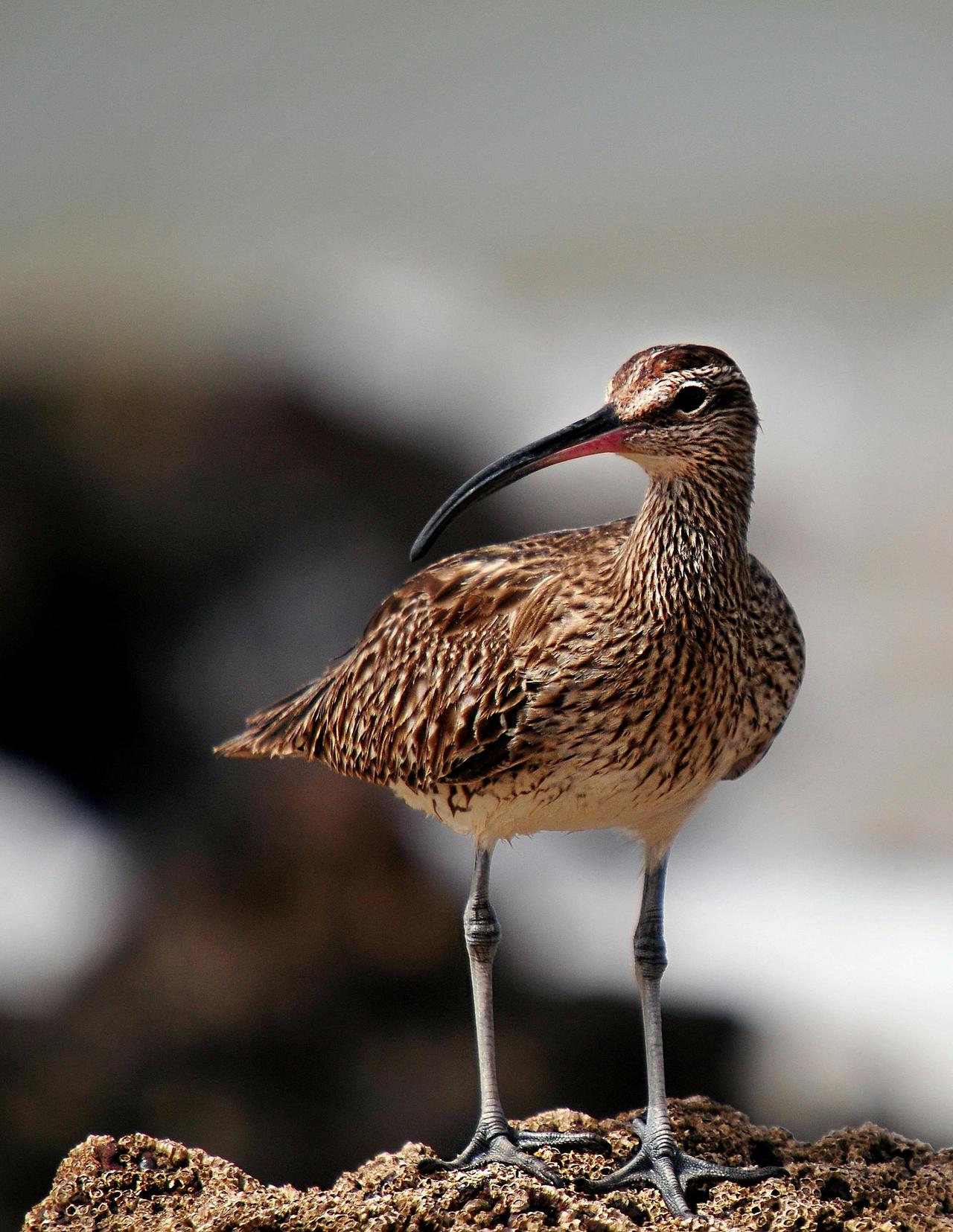
Whimbrel (Numenius arquata) is the largest shorebird observed in Türkiye. Its body is brown and streaked; it is easily recognized by its long, downward-curved bill. Bill length varies according to sex, age, and subspecies; females have longer bills than males. During flight, the white rump and the white wedge-shaped patch on the back are conspicuous. The tail is transversely barred, and the legs extend slightly beyond the tail tip. In flight, it resembles a martin with slow, deliberate wingbeats. It is often detected by its calls, typically a "vi-vi-vü" pattern.

Whimbrel (pexels)
During the breeding season, the Whimbrel is found in peat bogs, marshes, wet meadows, and wetlands surrounded by shrubs. In winter, it inhabits coastal areas of seas and lakes, mudflats, estuaries, floodplains, and lagoons. During migration, it also frequents cultivated fields, shores of inland lakes, and wet grasslands.
The Whimbrel is distributed across Europe, Asia, and partially northern Africa. It can be observed throughout all regions of Türkiye during migration periods and winter months, provided suitable habitats are present. In Europe, it occurs as a winter visitor or passage migrant along coasts and inland areas. Some individuals spend the summer outside their breeding grounds.
Thanks to its long, curved bill, it captures worms, crustaceans, and insects buried in mud and soil. It can rotate its prey with its bill and break apart hard-shelled animals such as crabs before swallowing them whole. Its primary food sources include worms, spiders, marine crustaceans, mollusks, and insects.
The breeding season occurs in spring, between April and early July. Nests are typically built in depressions on the ground and lined with grasses and feathers. The female lays four olive-brown eggs with dark spots. Incubation lasts 27 to 29 days, and both parents participate in incubation. Chicks are yellowish-brown and spotted at hatching, with lighter underparts; they fledge in 32 to 38 days. Nest predation, predators, and agricultural activities frequently lead to breeding failure.
The Whimbrel is a partially migratory species. Individuals breeding in Europe migrate south and west during winter, particularly to Spain and the western coasts of Europe. During migration, it stops over in many regions including Türkiye.
The summer population in Europe is estimated at 170,000 to 240,000 pairs. For example, between 1995 and 1999, 3,200 to 4,000 pairs were recorded in Germany; between 1998 and 2002, 1,500 to 1,800 pairs in France; and 48,000 to 120,000 pairs in Russia.
According to assessments by the International Union for Conservation of Nature (IUCN), the Whimbrel is classified as "Least Concern" (LC). However, habitat loss, agricultural activities, and nest predation pose threats to regional populations.
During the breeding season, it performs courtship flights. While foraging, it particularly shakes prey such as crabs to break them apart before swallowing them whole. After migration, when disturbed in feeding areas, it flies short distances and then returns to the ground to resume feeding.
Ornito.org. "Kervançulluğu." Ornito.org. Accessed August 16, 2025. https://ornito.org/Bird/Detail/262
Pexels. "Kahverengi uzun gagalı kuşun macroshot JPG." Accessed August 16, 2025. https://www.pexels.com/tr-tr/fotograf/kahverengi-uzun-gagali-kusun-macroshot-39383/
Pexels. "Panama City, Panamá Province, Panama JPG." Accessed August 16, 2025. https://www.pexels.com/tr-tr/fotograf/kus-hayvan-gaga-surmeli-kervancullugu-13865745/
İzmir Kuş Cenneti Koruma ve Geliştirme Birliği. "Kervançulluğu." T.C. İzmir Kuş Cennetini Koruma ve Geliştirme Birliği. Accessed August 16, 2025.

Scientific Name(s) | Numenius arquata | ||||||||
|---|---|---|---|---|---|---|---|---|---|
Team(s) | Charadriiformes | ||||||||
Family | Scolopacidae | ||||||||
Genus | Numenius | ||||||||
Specie(s) | N. arquata | ||||||||
No Discussion Added Yet
Start discussion for "Caravan Snipe (Numenius arquata)" article
Habitat
Distribution
Diet
Biology and Breeding
Migration
Population and Conservation Status
Behavior