


This article was automatically translated from the original Turkish version.
+1 More
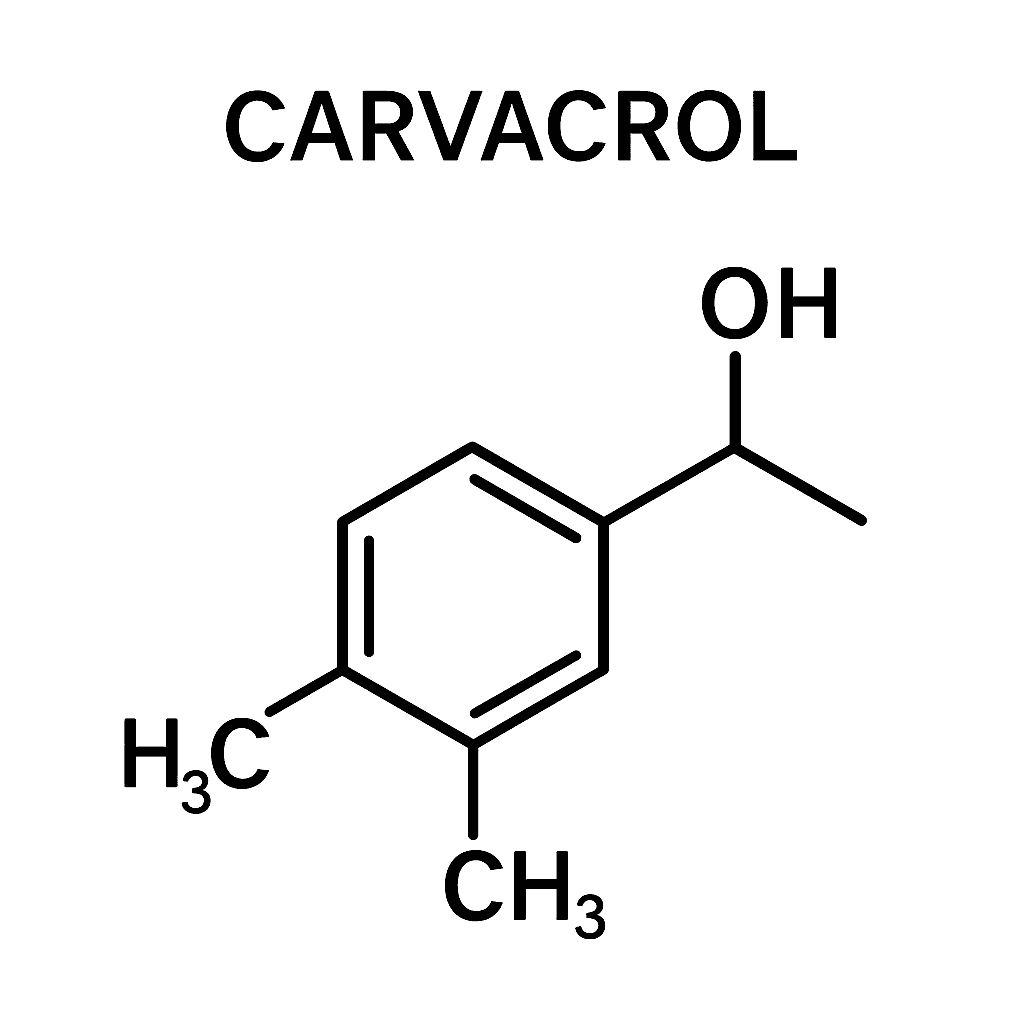
Carvacrol (Generated by Artificial Intelligence.)
Chemical Name | 5-Isopropyl-2-methylphenol | ||||||||
|---|---|---|---|---|---|---|---|---|---|
Molecular Formula | C₁₀H₁₄O | ||||||||
Molecular Weight | 150.22 g/mol | ||||||||
CAS Number | 499-75-2 | ||||||||
Structural Class | Monoterpenic phenol | ||||||||
Physical Appearance | Colorless or pale yellow liquid with a sharp aromatic odor | ||||||||
Melting Point | 0–2 °C | ||||||||
Odor Profile | Spicy, sharp, thyme-like aroma | ||||||||
KarvaKrol (Carvacrol) is a monoterpenic phenol naturally found in certain plants, particularly aromatic species such as Origanum vulgare (oregano), Thymus vulgaris (thyme), and Satureja hortensis (summer savory). Chemically, it has the formula 5-isopropyl-2-methylphenol and a molecular formula of C₁₀H₁₄O. Carvacrol is present in high concentrations in oregano oil and thyme oil and is responsible for their characteristic sharp aroma. At room temperature, it exists as a colorless or pale yellow liquid with a pungent aromatic odor. Due to its natural structure and biological activities, it is widely used in the food, pharmaceutical, and cosmetic industries.
The melting point of carvacrol is approximately 0–2 °C, and its boiling point ranges from 236–238 °C. It is only slightly soluble in water but readily dissolves in organic solvents such as ethanol, ether, and chloroform. Due to its phenolic structure, it exhibits high reactivity, which confers antimicrobial and antioxidant properties. Its density is approximately 0.976 g/cm³, and it can be affected by prolonged storage in light or heat. Although chemically stable, prolonged exposure to oxygen may cause gradual discoloration.
Carvacrol is most abundantly found in the essential oils of Origanum onites, Origanum vulgare, and Thymus capitatus. The concentration of carvacrol in these essential oils typically ranges between 30% and 80%. The compound is usually isolated from plant material through steam distillation. It can also be synthesized chemically from p-cymene and isopropylphenol. Carvacrol derived from natural sources is considered more biologically active and is preferred in food and medicinal products.
Carvacrol exhibits a broad spectrum of biological activities. Scientific studies have demonstrated its antimicrobial, antioxidant, anti-inflammatory, antifungal, antiviral, and anticancer effects. It disrupts bacterial cell membranes, increasing permeability and thereby inhibiting pathogen proliferation. It also neutralizes free radicals, reducing oxidative stress. Animal studies have further shown anti-inflammatory and analgesic effects. Due to these properties, carvacrol is evaluated as a food preservative, a natural antibacterial agent, and an auxiliary ingredient in pharmaceutical formulations.
Carvacrol is widely used in the food industry as a natural preservative and flavoring agent. It is added to meat, dairy, vegetables, and beverages to delay microbial spoilage. It is also present in cosmetic products, toothpastes, soaps, and antiseptic formulations. In agriculture, it is considered a natural pesticide, and in veterinary medicine, it is used as an antimicrobial additive. In the pharmaceutical field, it is regarded as a potential compound for combating multidrug-resistant microorganisms.
Carvacrol is generally recognized as a compound with low toxicity. However, high doses have been reported to cause alterations in liver and kidney function. Its use as a food additive has been deemed safe by the European Food Safety Authority (EFSA), with consumption approved within specified limits. Due to its potential to cause skin irritation, direct contact with the pure substance is not recommended. When used at appropriate doses, it is a safe, biologically compatible, and environmentally friendly compound.
Baser, K. H. "Biological and Pharmacological Activities of Carvacrol and Carvacrol Bearing Essential Oils." *Current Pharmaceutical Design* 14, no. 29 (2008): 3106–3119. Accessed October 19, 2025. https://doi.org/10.2174/138161208786404227
Sharifi‐Rad, M., E. M. Varoni, M. Iriti, M. Martorell, W. N. Setzer, M. del Mar Contreras et al. “Carvacrol and Human Health: A Comprehensive Review.” *Phytotherapy Research* 32, no. 9 (2018): 1675–1687. Accessed October 19, 2025. https://doi.org/10.1002/ptr.6103

Carvacrol (Generated by Artificial Intelligence.)
Chemical Name | 5-Isopropyl-2-methylphenol | ||||||||
|---|---|---|---|---|---|---|---|---|---|
Molecular Formula | C₁₀H₁₄O | ||||||||
Molecular Weight | 150.22 g/mol | ||||||||
CAS Number | 499-75-2 | ||||||||
Structural Class | Monoterpenic phenol | ||||||||
Physical Appearance | Colorless or pale yellow liquid with a sharp aromatic odor | ||||||||
Melting Point | 0–2 °C | ||||||||
Odor Profile | Spicy, sharp, thyme-like aroma | ||||||||
Physical and Chemical Properties
Natural Sources and Extraction
Biological and Pharmacological Activities
Applications and Uses
Toxicity and Safety