


This article was automatically translated from the original Turkish version.
+1 More

Discussion Process Using the Case Study Method
(Generated with Artificial Intelligence)
Case Study Method
Area(s) | Social sciences Education Engineering Business Medicine Law | ||||||||
|---|---|---|---|---|---|---|---|---|---|
Historical Origin | 1870 - Harvard Law School | ||||||||
Type(s) | Analysis case Decision case Half-open case Guided case Teaching method | ||||||||
Purpose(s) | decision making Analysis | ||||||||
Focus | Problem solving | ||||||||
Theoretical Foundation | Constructivism | ||||||||
Field | Educational sciences | ||||||||
English Name | Case Study Method | ||||||||
Case Study Method is an active teaching approach that systematically brings complex real-life situations, outcomes, or dilemmas into the classroom for analysis.
The case study method draws its theoretical foundation from Constructivist Learning Theory. According to this theory, knowledge is not transmitted to the student as a fixed and unchanging truth; rather, the learner actively constructs knowledge by processing interpreting and connecting it with personal experiences. Case studies provide authentic learning environments that support this process, as students analyze data within the case, draw inferences, and generate meaning. Thus, learning transforms from passive reception to an active construction process.
Theory–Practice Dialectic: The method enables abstract concepts to be tested within real-life contexts. Theoretical knowledge such as ethical principles scientific laws or management strategies is applied to concrete scenarios through case narratives. This process ensures that students do not merely know theory but can apply it appropriately under specific conditions. Thus a dynamic interaction is established between theoretical knowledge and practical experience.
Cognitive Flexibility: Case studies often involve situations with no single correct answer multiple variables and high levels of uncertainty. This characteristic helps students develop skills in evaluating alternative possibilities generating diverse solutions and revising their thinking in response to changing conditions. Students who gain cognitive flexibility learn to approach complex problems from multiple perspectives rather than a single dimension.
Meaningful and Lasting Learning: Placing knowledge within a narrative or scenario enhances its encoding in the mind. Story-based contexts increase student attention support emotional engagement and facilitate recall by linking information to associative networks. This strengthens learning retention and enhances the student’s ability to transfer knowledge to new situations.
The case study method is a powerful pedagogical approach that views learning not merely as an information acquisition process but as a holistic cognitive activity encompassing interpretation analysis application and evaluation.
The academic origins of the case study method trace back to the late nineteenth century when traditional lecture-based instruction was recognized as inadequate for developing professional competencies. The method found its first systematic application in the 1870s at Harvard Law School where the goal was to move beyond rote memorization of legal texts and instead have students analyze actual court rulings to develop legal reasoning. This approach enabled students to interpret abstract legal principles through concrete cases and sparked a significant transformation in pedagogical thinking of the time.
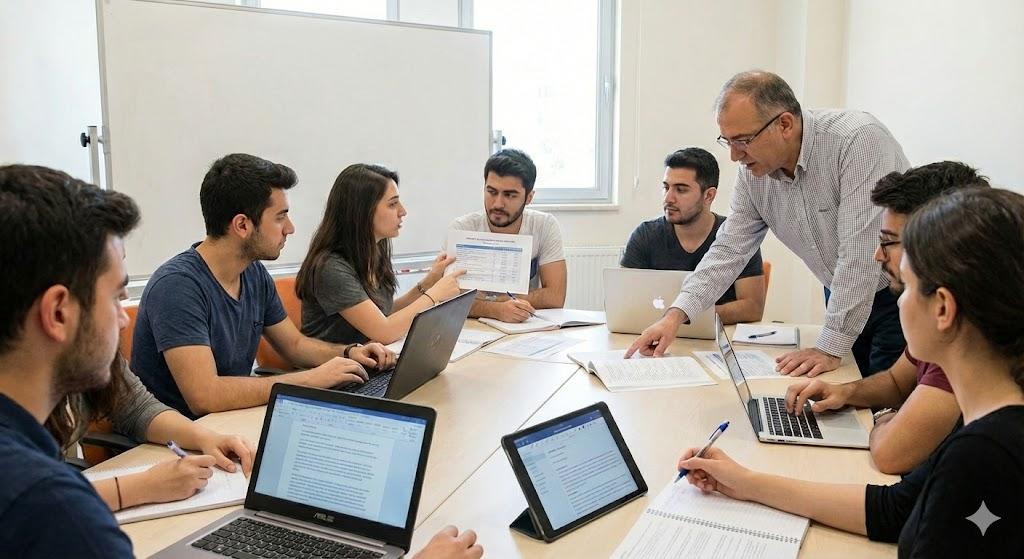
Case Study Method Application (Generated by Artificial Intelligence)
In the early twentieth century the method began to spread to fields where decision-making skills were critical. In the 1920s Harvard Business School placed the case study method at the center of its teaching model to enhance managers’ ability to make strategic decisions under uncertainty with limited data. From this period onward the method was recognized not merely as a teaching technique but as an educational approach that simulates professional thinking.
Today the case study method is widely used across numerous disciplines including medicine engineering law social sciences psychology education and public administration. Its interdisciplinary nature is one of its greatest strengths as it fosters the development of common competencies such as complex problem solving analysis and decision making. In medical education case-based learning is recognized as a fundamental teaching strategy for developing clinical reasoning diagnostic skills and treatment planning. Similarly in engineering education real-world problem-based cases facilitate the application of theoretical knowledge while in teacher education classroom scenarios strengthen prospective teachers’ pedagogical decision-making abilities.
Throughout its historical development the case study method has evolved to provide learning experiences closely aligned with professional reality. Today it has become one of the modern teaching approaches that aim not only to transfer knowledge but also to cultivate professional thinking skills through its interdisciplinary applicability.
Effective implementation of the case study method requires not random application but a systematic sequence of pedagogically structured and mutually reinforcing stages. The process begins with selecting or designing a case that is realistic problem-oriented and aligned with instructional goals. The case content must be appropriate to students’ level open to discussion multidimensional and capable of supporting multiple solutions. This preparatory stage is a fundamental design element that directly influences the method’s success.
The implementation process typically follows five main stages:
1. Individual Preparation and Preliminary Analysis: Students examine the case individually extract relevant data identify the core problem and formulate initial hypotheses. This stage develops independent thinking and prepares students for group discussion. Structured tasks such as note-taking concept mapping or question generation may be assigned.
2. Small Group Discussion: Students meet in small groups to compare individual analyses discuss diverse perspectives and attempt to construct shared problem definitions. This stage supports collaborative learning while strengthening students’ abilities to justify their reasoning and present evidence.
3. Whole-Class Analysis and Discussion: Led by the instructor this stage involves groups sharing findings discussing cause-effect relationships and conducting in-depth analysis through critical questions. The instructor enriches the discussion with guiding questions corrects conceptual errors and facilitates comparison of alternative solutions. This is the stage where collective reasoning is most intensely experienced.
4. Decision Making and Solution Development: Students generate solution proposals evaluate alternatives and formulate reasoned decisions. There is no requirement for a single correct answer; what matters is that students ground their decisions in logical reasoning and defend their solution processes. Thus decision-making analytical and strategic thinking skills are developed.
5. Reflection and Evaluation: In the final stage students assess both the outcomes they reached and the reasoning pathways they followed. The transferability of learned knowledge to other contexts is discussed and students develop metacognitive awareness by reflecting on their own learning processes. The instructor provides feedback in this stage to reinforce learning durability and ensure conceptual coherence when necessary.
This sequential structure transforms the case study method from a mere discussion technique into a planned measurable and learning-outcome-oriented holistic teaching strategy. Through this systematic process students actively produce test and interpret knowledge rather than passively receiving it.
Effective implementation of the case study method consists of a systematic sequence of steps. The process begins with preparing a case aligned with learning objectives.
Implementation typically follows these five main stages:
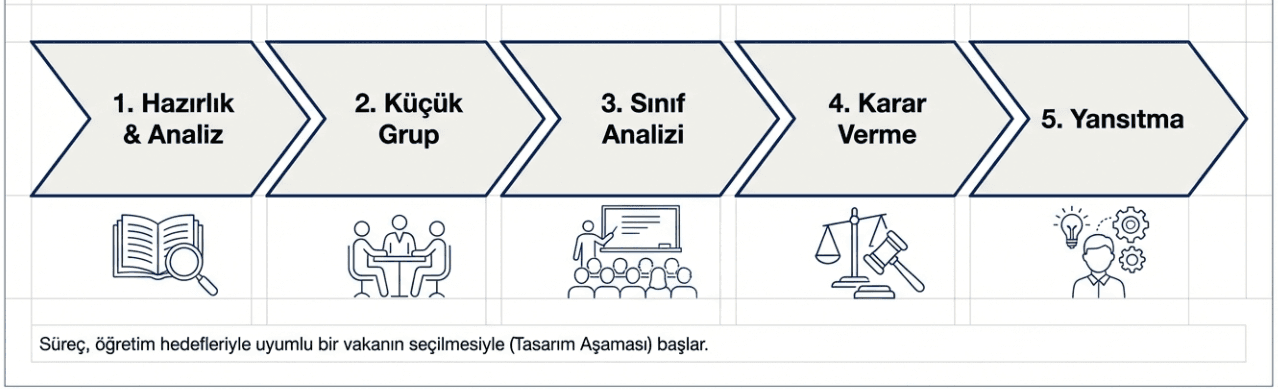
Methodological Process Schema (Generated by Artificial Intelligence)
In the case study method the learner rather than the instructor is at the center of the learning process; therefore a significant transformation occurs in the roles of both instructor and student. The instructor moves from being a knowledge-transmitting authority to assuming the role of a guide who structures guides and facilitates the learning process. In this context the instructor’s primary responsibilities include clearly defining the purpose and boundaries of discussion ensuring the process aligns with pedagogical goals encouraging peer interaction and making strategic interventions to prevent deviation from the topic. Additionally the instructor fosters an inclusive discussion environment by supporting balanced expression of diverse viewpoints and deepens thinking through guiding questions when necessary.
The student transitions from being a passive recipient of information to assuming the roles of researcher problem solver and critical analyst. In the case analysis process students collect data compare information generate alternative solutions and ground their arguments in evidence. During group discussions students assume functional roles such as initiator facilitator recorder questioner or summarizer and experience collaborative learning. This role-sharing not only increases participation but also supports the development of responsibility self-regulation communication skills and academic self-confidence. Ultimately the case study method transforms the traditional hierarchical relationship between teacher and student into a dynamic process of co-constructed learning.
The case study method provides a multidimensional learning experience that develops not only knowledge acquisition but also the ability to process and apply knowledge. This method effectively activates the higher-order cognitive domains of Bloom’s Taxonomy—analysis synthesis and evaluation—strengthening students’ abilities to solve complex problems establish cause-effect relationships and compare alternative solutions. As students interpret case content they learn evidence-based reasoning test assumptions and develop the habit of justifying inferences. Thus learning moves from superficial knowledge to deep conceptual understanding.
The social dimension of the method is as powerful as its cognitive dimension. Discussion and collaborative solution-generation processes systematically develop critical thinking effective listening clear and persuasive communication evaluation of diverse perspectives and consensus-building skills. While defending their own views students also strive to understand opposing perspectives; this fosters the development of essential academic qualities such as cognitive flexibility perspective-taking and intellectual tolerance.
In the affective domain the case study method cultivates empathy respect for diverse viewpoints adoption of democratic discussion culture and habits of collaborative work. Students encounter ethical dilemmas through real-life scenarios and gain experience in value-based decision making. This process supports not only academic achievement but also character development and social responsibility awareness.
Moreover this method safely introduces students to the complex and uncertain nature of the real world strengthening their abilities in decision-making assuming responsibility and anticipating consequences. As a result students grow into individuals who can connect theoretical knowledge with lived experience think critically and make multidimensional evaluations significantly enhancing learning durability and transferability.
Effective implementation of the case study method requires systematic planning and a robust pedagogical preparatory process. Selecting appropriate cases designing aligned questions structuring discussion flow and establishing evaluation criteria are time- and expertise-intensive steps. Consequently the method can pose time-management challenges especially in courses with heavy curricular demands. The meticulous nature of planning necessitates that instructors possess advanced subject-matter knowledge and instructional design skills.
Large class sizes represent a significant operational challenge. In large groups it becomes difficult to manage balanced participation ensure equitable speaking opportunities and guarantee active involvement from all students. This situation risks domination of discussion by a few vocal students and passive participation by more reserved ones. Therefore the instructor’s classroom management skills moderation strategies and ability to guide group dynamics play a decisive role in the method’s success.
Another limitation of the method is its dependence on students’ prior knowledge. If students lack sufficient familiarity with foundational concepts the case analysis may remain superficial and intended learning outcomes may not be achieved. Therefore the case study method is often supported by instructional designs that ensure prerequisite knowledge is established or preparatory activities are conducted. Moreover finding or creating high-quality realistic and pedagogically appropriate cases for every topic is not always easy; developing original context-specific cases requires additional effort and time from instructors.
Other challenges in implementation include potential conflicts during discussion inefficient use of time deviation from the topic and superficial interpretations. To mitigate these risks clear guidelines structured discussion rules role assignments and phased guidance strategies should be employed. In conclusion the case study method although possessing high pedagogical potential is an instructional approach that requires careful planning strong classroom management and well-designed teaching materials to achieve effective outcomes.
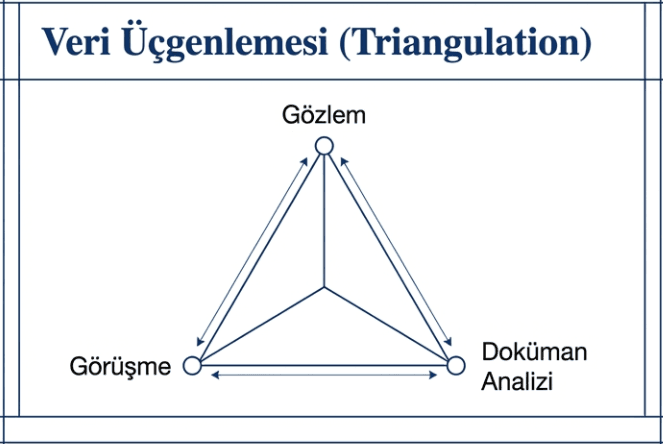
Research Methods Schema (Generated by Artificial Intelligence)
Case study research is treated within various methodological frameworks as a multilayered approach that enables in-depth examination of complex learning processes in educational research. These studies are conducted using designs such as ethnographic research evaluative research action research and case analysis to understand learning environments within their real-world contexts. Particularly in research aiming to reveal the impact of contextual variables on learning the case study method serves as a vital tool for making visible process dynamics that quantitative measurements alone cannot explain.
Researchers employing this method utilize multiple data collection techniques. Direct classroom observations semi-structured or in-depth interviews focus group discussions analysis of student products teaching materials and official documents provide data variety. This diversity enables data triangulation enhancing the validity and reliability of the research. Furthermore data are systematically analyzed using techniques such as descriptive statistics content analysis thematic analysis and discourse analysis.
In case study research with the nature of “field study” the fundamental principle is examining cases within their natural contexts rather than artificial settings. This approach allows researchers to focus not only on outcomes but also on processes and interaction patterns. Thus the entire picture of how learning occurs what factors influence it and under what conditions it becomes more effective is revealed holistically.
Reporting research findings may follow descriptive interpretive or comparative analytical approaches. Detailed contextual descriptions direct participant quotations and process diagrams help readers mentally reconstruct the research environment. Such reporting not only contributes to academic literature but also strengthens the link between educational practice and research by providing evidence-based pedagogical recommendations for practitioners.
Thanks to its flexible structure that enables analysis of complex realities the case study method has a broad application range across disciplines. Its interdisciplinary nature stems not only from teaching subject-specific content but from its capacity to develop higher-order thinking interpretation and decision-making skills that are transferable across fields. This feature has made it a universal pedagogical tool in both academic education and professional training programs.
In legal education case studies help students develop skills in legal interpretation comparison of precedents and normative evaluation through concrete case examples. In medicine and health sciences case-based learning enables safe experiential learning of clinical reasoning diagnosis and treatment planning. In engineering real-world problem-based cases integrate technical knowledge with design thinking while in business and management education complex organizational scenarios support strategic decision-making and risk analysis.
In the social sciences the method is used to examine the multidimensional nature of social phenomena; students can analyze the interaction of economic cultural psychological and political variables within a single case. In teacher education classroom scenarios serve as simulations that enhance prospective teachers’ abilities in pedagogical decision-making classroom management and ethical evaluation. In public administration and policy studies case studies provide opportunities to assess the societal consequences of administrative decisions and compare alternative policy options.
Interdisciplinary application demonstrates that the case study method is not merely a teaching technique but a learning approach that connects different fields of knowledge. The method creates a common pedagogical ground that fosters holistic thinking contextual analysis and multidimensional evaluation by bringing together diverse disciplinary perspectives on the same problem.
Columbia Center for Teaching and Learning. "Case Method Teaching and Learning." Columbia University. Accessed February 6, 2026. https://ctl.columbia.edu/resources-and-technology/resources/case-method/
Köklü, N. *Örnek Olay Çalışma Metodları.* PDF article, 9 pages. Accessed February 6, 2026. https://dergipark.org.tr/tr/download/article-file/777170
Uluyol, Çetin, and Tuncay Güyer. “Web Destekli Örnek Olay Yönteminde Yüz Yüze Etkileşimin Öğrencilerin Eleştirel Düşünme Becerilerine Etkisi.” *Eğitimde Kuram ve Uygulama* 10, no. 4 (2014): 942–969. Accessed February 6, 2026. https://dergipark.org.tr/en/download/article-file/43701
Çolak, Emine Devlet. *Örnek Olay İnceleme Yönteminin 8. Sınıf Türkçe Dersi Okuma ve Yazma Başarısı ile Problem Çözme Becerisine Etkisi (Toplum Hayatı Teması Örneği).* Master's thesis,Giresun Üniversitesi Institute of Social Sciences, 2017. Accessed February 6, 2026. https://tez.yok.gov.tr/UlusalTezMerkezi/tezDetay.jsp?id=_C0s143DO-howD-GGyoNIw&no=K5aFbm1I3FqY5u_Hlcxqhw
Şahin, S., Bülent Atasoy, and Serkan Somyürek. “Öğretmen Eğitiminde Örnek Olay Yöntemi.” *University of Gaziantep Journal of Social Sciences* 9, no. 2 (2010): 253–277. Accessed February 6, 2026. http://2019.fmgtegitimikongresi.com/?s=999&dil=en

Discussion Process Using the Case Study Method
(Generated with Artificial Intelligence)
Case Study Method
Area(s) | Social sciences Education Engineering Business Medicine Law | ||||||||
|---|---|---|---|---|---|---|---|---|---|
Historical Origin | 1870 - Harvard Law School | ||||||||
Type(s) | Analysis case Decision case Half-open case Guided case Teaching method | ||||||||
Purpose(s) | decision making Analysis | ||||||||
Focus | Problem solving | ||||||||
Theoretical Foundation | Constructivism | ||||||||
Field | Educational sciences | ||||||||
English Name | Case Study Method | ||||||||
Pedagogical Foundations
Historical Development and Interdisciplinary Application
Types of Case Studies and Classification Models
Methodological Implementation Process and Stages
Transformation of Instructor and Student Roles
Educational Outcomes and Social Dynamics
Application Limitations and Operational Challenges
Research Methods and Academic Approaches
Interdisciplinary Application