

This article was automatically translated from the original Turkish version.
Producer(s) | Casio (Japan) | ||||||||
|---|---|---|---|---|---|---|---|---|---|
Market Entry | 1989 | ||||||||
Designer | Ryūsuke Moriai | ||||||||
Feature(s) | 30m Water Resistance LED Light Annual Calendar Daily Alarm 1/100 Second Stopwatch Digital Display | ||||||||
Size(s) | 37.5 × 34.5 × 8.5 mm | ||||||||
Weight(s) | 21 grams | ||||||||
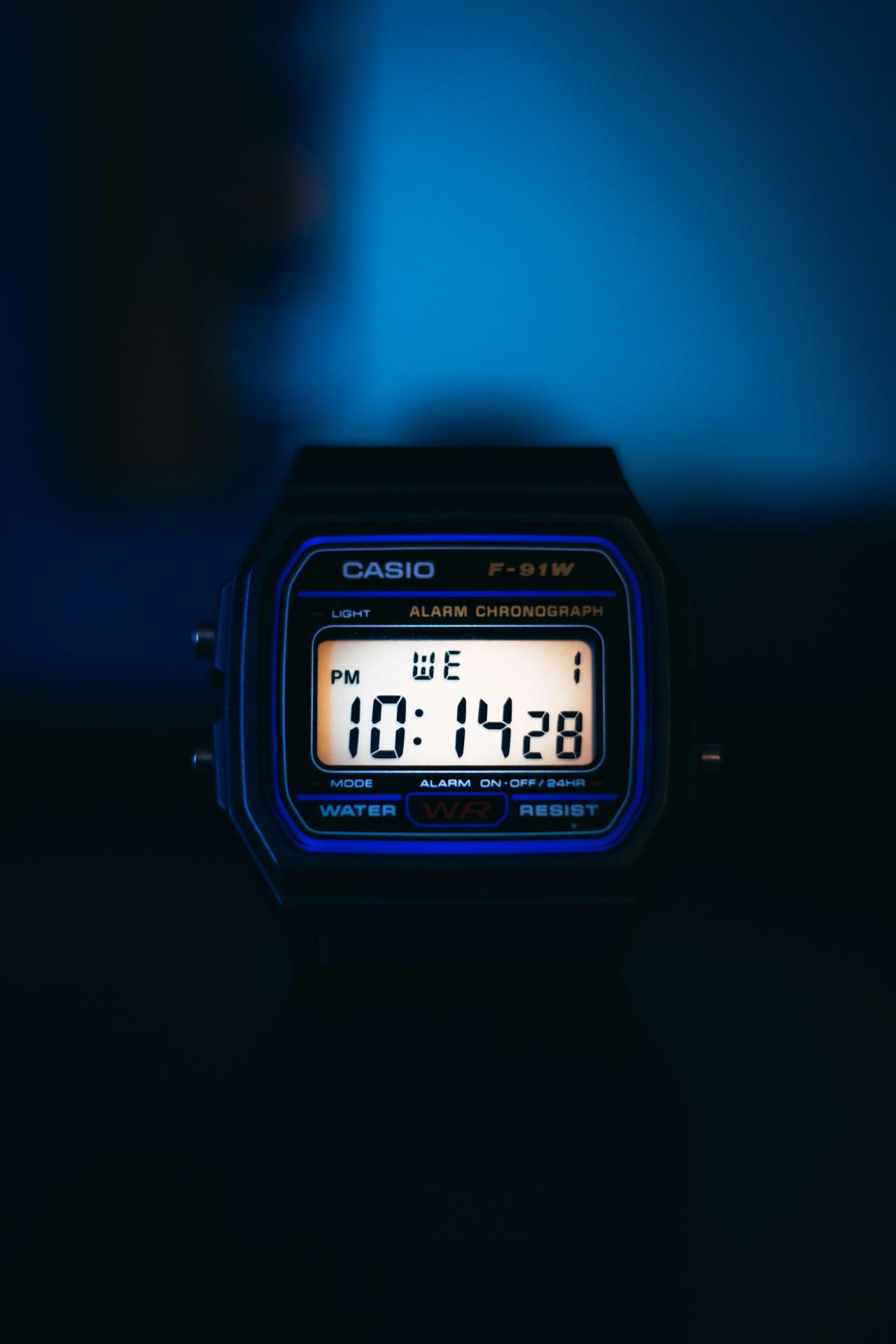
Casio F-91W is a digital wristwatch first produced in 1989 by the Japanese company Casio. Its low cost, durable construction, long battery life, and simple operation have made it widely popular on a global scale. It is estimated that approximately three million units are produced annually, and over time the watch has attracted attention not only as a consumer product but also as an object mentioned in security reports.
The Casio F-91W was introduced in June 1989 as the successor to the F-87W model. Designer Ryūsuke Moriai developed the watch based on the principles of being small thin and simple. Since its production began, its design has undergone no significant changes, and it has maintained its popularity due to its functionality and price-to-performance balance.

Casio F-91W (Generated by Artificial Intelligence.)
The F-91W features a resin case a stainless steel back cover and weighs 21 grams. It is designed with a simple yet functional layout controlled by three side buttons. The upper left button activates the light turns off the alarm or resets the stopwatch. The lower left button allows switching between modes which include time display alarm setting stopwatch and time setting. The right button serves to start stop or adjust settings. Features of the watch include a stopwatch capable of measuring up to 59 minutes and 59.99 seconds a daily alarm hourly signal and an automatic calendar. The LED light appears as a small green dot on the left side of the display. The watch operates with an accuracy of ±30 seconds per month and can be powered by a CR2016 button cell battery for at least seven years often longer. The case dimensions are approximately 37.5 × 33.5 × 8.5 mm and the weight is only 21 grams. The black F-91W-1 model is water resistant up to 30 meters providing protection against daily splashes and brief water exposure.
In addition to its global recognition the watch has also appeared in security reports in negative contexts. Intelligence reports published in the early 2000s indicated that the F-91W was used by organizations such as Al-Qaeda as a timer in explosive devices.
In 2011 U.S. classified intelligence documents recorded that over fifty individuals detained at Guantánamo Bay were found to be wearing either an F-91W or an A-159W model (the metal-cased version) and these watches were linked to training in bomb timing used by specific terrorist groups. The watch’s ability to set alarms longer than 24 hours its low cost and easy availability formed the technical basis for these claims.
In 1994 Ramzi Yousef a terrorist linked to Al-Qaeda used a Casio F-91W timer set to detonate hours later on Philippine Airlines Flight 434. In 1999 Ahmed Ressam employed similar watch-based timers to trigger explosives in his planned attack on Los Angeles International Airport. Additionally photographs of Al-Qaeda leader Osama bin Laden wearing this watch were published in the media. These instances are regarded as examples of potential misuse stemming from the watch’s technical capabilities.

Casio F-91W(Flickr)
Experts emphasize that due to its millions of users worldwide the F-91W cannot by itself serve as evidence of criminal activity. Many other electronic devices with similar functions can also be used for the same purposes.
The F-91W is preferred by users across different age groups and professions. It is commonly observed among students workers in various fields and individuals engaged in outdoor activities. It has also been documented that political figures and public personalities such as Barack Obama have used it. The watch’s low weight and durable case make it suitable for daily use. Its design has appeared in various pop culture products and gained visibility in fashion due to its retro aesthetic. Its appearance in numerous television series films and documentaries has contributed to its recognition as a cultural reference. To prevent counterfeiting the presence of the word “CASIO” displayed on the screen when the right button is held down is used as a verification method. A common issue with long-term use is wear of the strap ends which can be easily replaced at low cost.
Since its introduction in 1989 the Casio F-91W has maintained a place in the digital watch market through its low cost durability and basic functionality. Although there are records of its use as a timer by certain terrorist organizations this has not diminished its widespread civilian adoption. The lack of significant changes to its design and technical features over many years demonstrates the continuity of its production strategy. The model remains among the most recognizable watches both for everyday use and within popular culture contexts.
BBC News. “Casio F-91W: The Strangely Ubiquitous Watch.” BBC. Accessed August 5, 2025. https://www.bbc.com/news/magazine-13194733
Casio. "1980'ler." Casio. Accessed August 5, 2025. https://www.casio.com/tr/watches/50th/Heritage/1980s/
Casio. "F-91W – Standard Digital." Casio. Accessed August 5, 2025. https://www.casio.com/intl/watches/casio/standard/standard/products/f-91w/
Der Spiegel. "Wearing a Casio Enough to Become Terror Suspect." Accessed August 5, 2025. https://www.spiegel.de/international/world/al-qaida-s-watch-of-choice-wearing-a-casio-enough-to-become-terror-suspect-a-758913.html
Flickr. "Casio F-91W." Flickr. Accessed August 5, 2025. https://www.flickr.com/photos/markgregory/42669640332
MEPA News. “Casio F-91W Nasıl Silahlı Grupların İkonu Haline Geldi?” Mepa News. Accessed August 5, 2025. https://www.mepanews.com/casio-f-91w-nasil-silahli-gruplarin-ikonu-haline-geldi-55447h.htm
McEachern, Ian Coll. “The History and Legacy of the Casio F-91W Quartz Watch.” IanCollMcEachern.com. Accessed August 5, 2025. https://www.iancollmceachern.com/single-post/the-history-and-legacy-of-the-casio-f-91w-quartz-watch
NBC News. “Timepiece of Terrorism?” Accessed August 5, 2025. https://www.nbcnews.com/id/wbna11750939
The Guardian. “Guantánamo Bay Files: Casio Wristwatch 'The Sign Of Al-Qaida'.” Accessed August 5, 2025. https://www.theguardian.com/world/2011/apr/25/guantanamo-files-casio-wristwatch-alqaida
Unsplash. “A Close Up Of A Digital Watch On A Table.” Unsplash. Accessed August 5, 2025. https://unsplash.com/photos/a-close-up-of-a-digital-watch-on-a-table-HiHQwzv9N2o

Producer(s) | Casio (Japan) | ||||||||
|---|---|---|---|---|---|---|---|---|---|
Market Entry | 1989 | ||||||||
Designer | Ryūsuke Moriai | ||||||||
Feature(s) | 30m Water Resistance LED Light Annual Calendar Daily Alarm 1/100 Second Stopwatch Digital Display | ||||||||
Size(s) | 37.5 × 34.5 × 8.5 mm | ||||||||
Weight(s) | 21 grams | ||||||||
History
Technical Specifications
Association with Terrorism
Criticism and Debate
Applications and Cultural Impact