

This article was automatically translated from the original Turkish version.
World | Animalia | ||||||||
|---|---|---|---|---|---|---|---|---|---|
Branch | Chordata | ||||||||
Class | Aves | ||||||||
Family | Laridae | ||||||||
Dimensions | 47–54 cm | ||||||||
Wingspan | 127–140 cm | ||||||||
Weight | 530–782 g | ||||||||
Dimensions | 47–54 cm | ||||||||
Incubation Period | 25–28 days | ||||||||
Egg Count | 2–3 individuals | ||||||||
Conservation Status | (IUCN): Least Concern (LC) | ||||||||
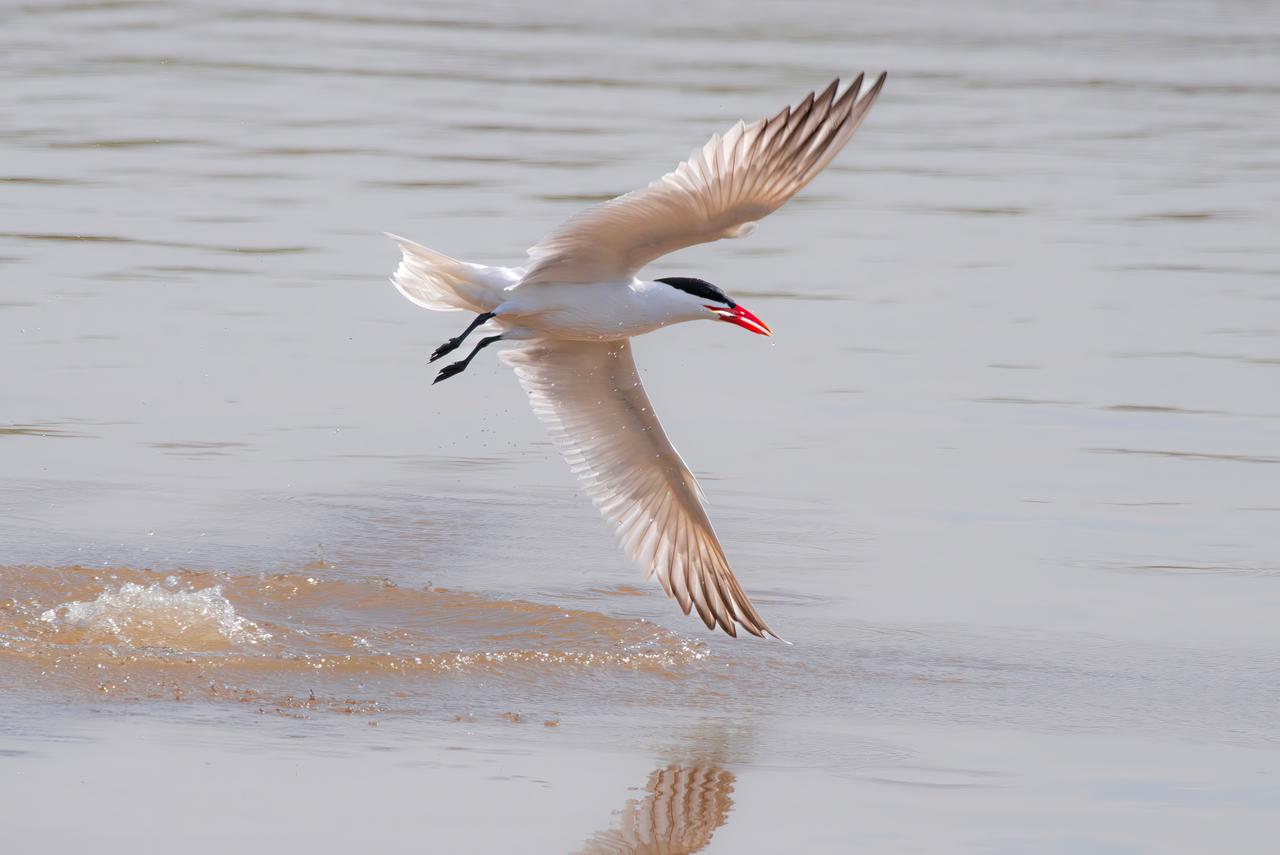
Caspian Tern (Hydroprogne caspia) is a bird species belonging to the family Laridae, recognized by its bright red bill and black head. It is the largest member of the Laridae family.【1】 Its large size and broad wings clearly distinguish it from other tern species. The species is also distinguished by its distinctive low, harsh calls and its appearance in flight, which resembles large gulls.
The Caspian Tern (Hydroprogne caspia) has undergone various taxonomic revisions over time. Early studies, based on behavioral and morphological similarities, considered it closely related to the crested terns (Thalasseus), particularly the Royal Tern (Thalasseus maximus), and for a long time it was classified within the broadly defined genus Sterna. However, modern phylogenetic studies have revealed that the traditional genus Sterna is paraphyletic, leading to the conclusion that the Caspian Tern belongs in its own distinct, monotypic genus Hydroprogne. Since the distinguishing features of populations match those of individuals in other regions, the species is now definitively recognized as monotypic (without subspecies).【2】
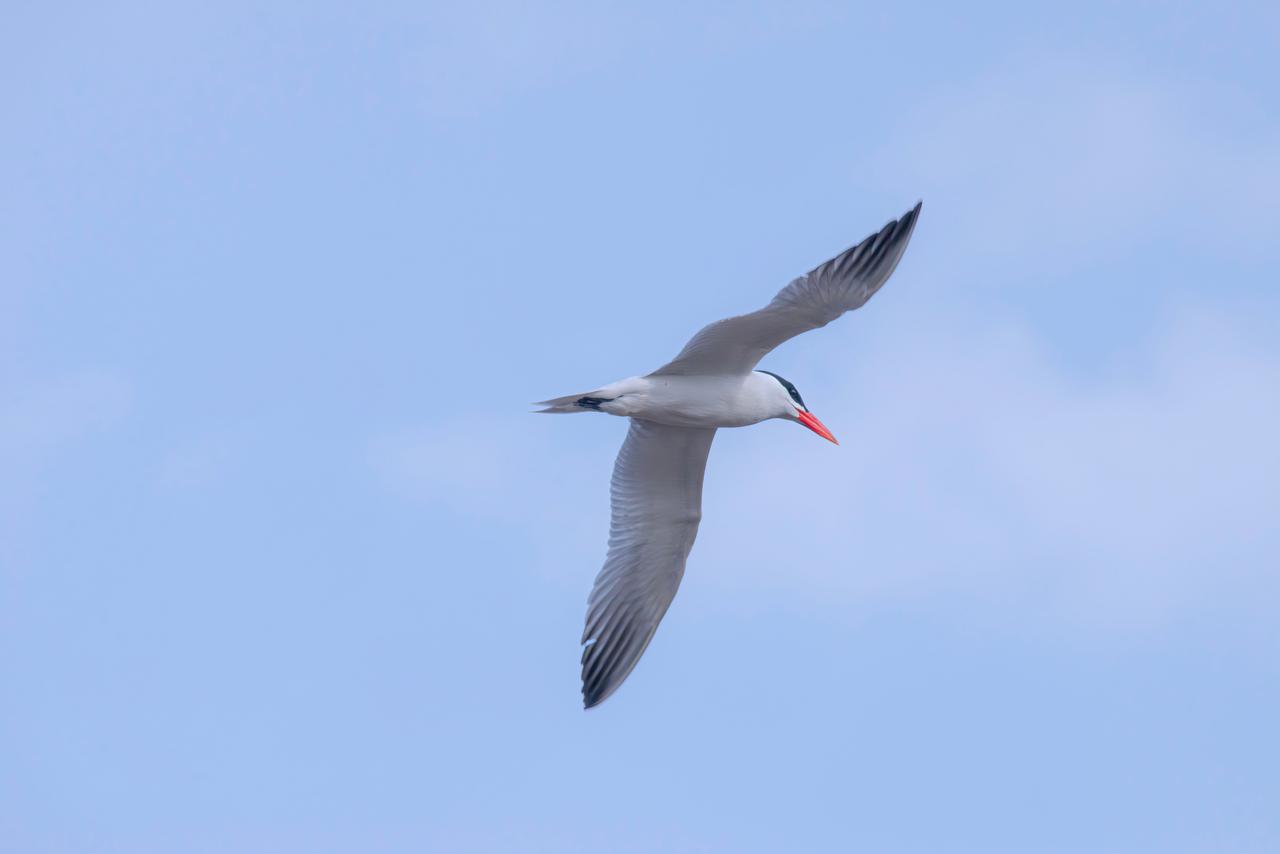
Hazar Sumrusu (pexels)
The Caspian Tern is a bird measuring 47–54 cm in body length, weighing 530–782 grams, and with a wingspan of 127–140 cm. During the breeding season, adults have pale gray upperparts and wings, while the underparts, belly, rump, and short slightly forked tail are entirely white. One of its most distinctive features is that the undersides of the primary flight feathers, except the innermost ones, are dark gray or blackish, creating a prominent dark patch beneath the wing during flight. The head is entirely black, with a hood extending clearly below the eye and forming a slight crest at the nape. The bill is red, with a variable black band or spot at the tip; the legs and feet are black. In winter, the black hood is replaced by white and grayish-brown streaks, but the forehead never becomes as completely white as in other tern species. The sexes are morphologically similar and indistinguishable externally. Juvenile birds have a paler orange-red bill tip and brownish shoulder markings on their gray upperparts.
The Caspian Tern is a cosmopolitan species that breeds and winters across a wide geographic range on all continents except Antarctica. In Europe, it is found along the coasts of the Baltic Sea, the North Sea, and the Black Sea; in Asia, along the coasts of the Caucasus, Central Asia, Siberia, China, Korea, and Japan; in the Middle East, it occurs in Iran, Iraq, Syria, Türkiye, Israel, and Saudi Arabia. In Africa, it ranges from Senegal to Tanzania, along the Mediterranean coast to South Africa and Madagascar. In North America, it breeds along the Pacific, Atlantic, and Gulf of Mexico coasts as well as in large freshwater systems such as the Great Lakes; during winter it migrates south as far as Colombia and Venezuela. Its preferred habitats include seacoasts, beaches, islands, deltas, lagoons, estuaries, river channels, and large inland lakes. During the breeding season, it selects sandy, muddy, or stony islands with open, flat terrain, sparse vegetation, and accumulations of driftwood and debris carried by waves, to protect eggs and chicks from terrestrial predators. During the non-breeding season, it avoids open seas where sea surface temperatures fall below 13°C, preferring temperate coastal zones, mudflats, and shallow marshes.
Outside the breeding season, the Caspian Tern is a social bird that rests alongside other gull and tern species on land, shores, and sandbars. Its terrestrial locomotion is less agile than that of smaller terns and tends to involve a slight wobble or forward lurch as it walks or runs. When hunting for fish, it flies close to the water surface, hovers briefly, then plunges into the water, often becoming fully submerged. Ecologically, it practices at least seasonal monogamy. During pair formation, the male presents a fish to the female in the colony, performing a rhythmic head and tail movement known as "fish-bending" as part of a courtship feeding display. The Caspian Tern exhibits highly aggressive behavior within colonies and can seriously injure intruding birds or researchers by striking them directly on the head with its bill. It shows strong site fidelity, and successful breeding adults typically return to the same colony the following year.
The Caspian Tern has a diet almost entirely based on fish. It may also feed on crustaceans, mussels, snails, insects, and the eggs or chicks of other bird species, as well as carrion washed ashore. Foraging typically occurs in shallow surface waters 0.5 to 5 meters deep in freshwater lakes, rivers, coastal lagoons, and estuaries. The bird flies slowly at heights of 3 to 30 meters above the water, holding its bill completely vertical downward while scanning for prey. Upon detecting a fish, it hovers momentarily, extends its wings, and performs a rapid, steep plunge-dive, often submerging its entire body. It surfaces 1–2 seconds later and usually swallows the captured prey mid-flight or carries it to the nest. The size of the fish caught typically ranges from 5 to 15 cm, but individuals have been recorded successfully capturing fish up to 25–29 cm in length. The species is also known to steal food from other terns and gulls in flight.
The breeding season of the Caspian Tern occurs between April and June in the Northern Hemisphere and between September and December in the Southern Hemisphere; in northern Australia, breeding has been recorded almost year-round. The species typically nests in dense colonies. The nest is a shallow depression, averaging 19.5 cm in outer diameter, 16.1 cm in inner diameter, and 4.5 cm in depth, usually excavated on bare ground, among debris, or in crevices on rocky outcrops. The interior may be lined with fragments of local vegetation, pebbles, mussel, or oyster shells, or left bare. The female lays two to three oval eggs with pale cream or pale beige coloration, marked with dark brown and black spots. Incubation, shared by both sexes, lasts 25 to 28 days. Hatchlings are covered in pale cream down and are mobile within 3–6 hours, but usually remain in the nest cup for the first 1–2 days. Chicks are fed by both parents with fish and remain dependent on them for 8–9 months after fledging, during which time they refine their fishing skills within the family group.
The Caspian Tern (Hydroprogne caspia) is classified as "Least Concern" (LC) on the current IUCN Red List of Threatened Species. This classification reflects its very wide distribution and the fact that its global population remains well below critical threat thresholds.
BirdLife International. “*Hydroprogne caspia*.” *The IUCN Red List of Threatened Species 2019*. Accessed July 2, 2026.https://www.iucnredlist.org/species/22694524/155509311
Coldbeer. "Close-Up of a Flying Tern in Clear Blue Sky." Pexels. Accessed July 2, 2026.https://www.pexels.com/photo/close-up-of-a-flying-tern-in-clear-blue-sky-31898184/
Coldbeer. "Elegant Caspian Tern Flying Over Calm Water." Pexels. Accessed July 2, 2026.https://www.pexels.com/photo/elegant-caspian-tern-flying-over-calm-water-32071582/
Cuthbert, Francesca J., and Linda R. Wires. “Caspian Tern (Hydroprogne caspia),” version 1.0. Birds of the World. Edited by S. M. Billerman. Ithaca, NY: Cornell Lab of Ornithology, 2020. Accessed July 2, 2026.https://birdsoftheworld.org/bow/species/caster1/cur/introduction
Ornito. “Hazar Sumrusu (Hydroprogne caspia).” Ornito (Kuş Gözlem Topluluğu). Accessed July 2, 2026.https://ornito.org/Bird/Detail/200.
[1]
Cuthbert, Francesca J. ve Linda R. Wires. “Caspian Tern (Hydroprogne caspia)”, Birds of the World, Derleyen S. M. Billerman. Ithaca, NY: Cornell Lab of Ornithology, Erişim tarihi 2 Temmuz 2026, https://birdsoftheworld.org/bow/species/caster1/cur/introduction?login
[2]
Cuthbert, Francesca J. ve Linda R. Wires. “Caspian Tern (Hydroprogne caspia)."


World | Animalia | ||||||||
|---|---|---|---|---|---|---|---|---|---|
Branch | Chordata | ||||||||
Class | Aves | ||||||||
Family | Laridae | ||||||||
Dimensions | 47–54 cm | ||||||||
Wingspan | 127–140 cm | ||||||||
Weight | 530–782 g | ||||||||
Dimensions | 47–54 cm | ||||||||
Incubation Period | 25–28 days | ||||||||
Egg Count | 2–3 individuals | ||||||||
Conservation Status | (IUCN): Least Concern (LC) | ||||||||
No Discussion Added Yet
Start discussion for "Caspian Tern (Hydroprogne caspia)" article
Taxonomy
Morphological Characteristics
Distribution and Habitat
Behavior and Ecology
Feeding
Breeding
Conservation Status