


This article was automatically translated from the original Turkish version.
+2 More
(pexels)
CCTV Central Building
Location | China Beijing | ||||||||
|---|---|---|---|---|---|---|---|---|---|
Total Area | Approximately 465,000 m² | ||||||||
Completion Date | 2012 | ||||||||
Lead Designer | Rem Koolhaas | ||||||||
Architecture Office | OMA (Office for Metropolitan Architecture) | ||||||||
Client | China Central Television (CCTV) | ||||||||
Building Type | office and broadcasting complex media center | ||||||||
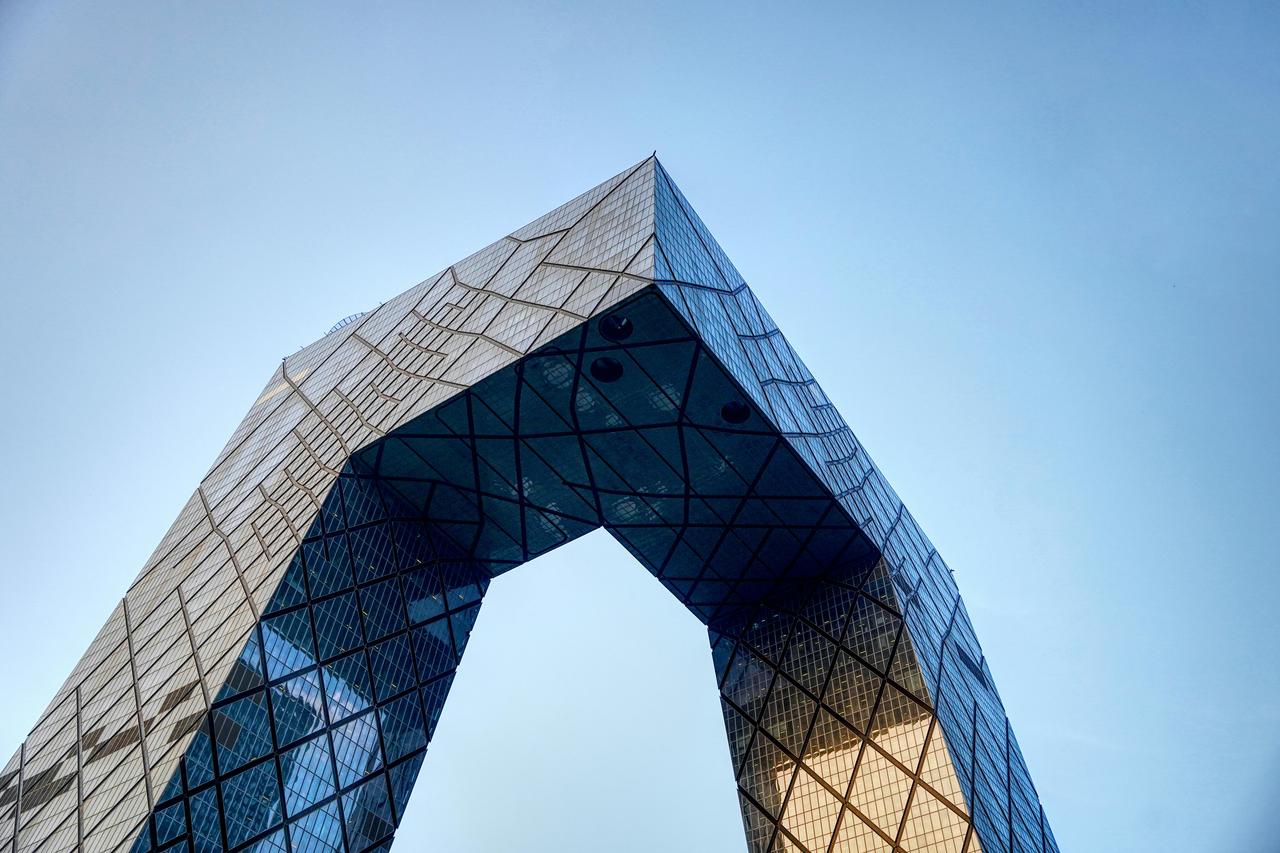
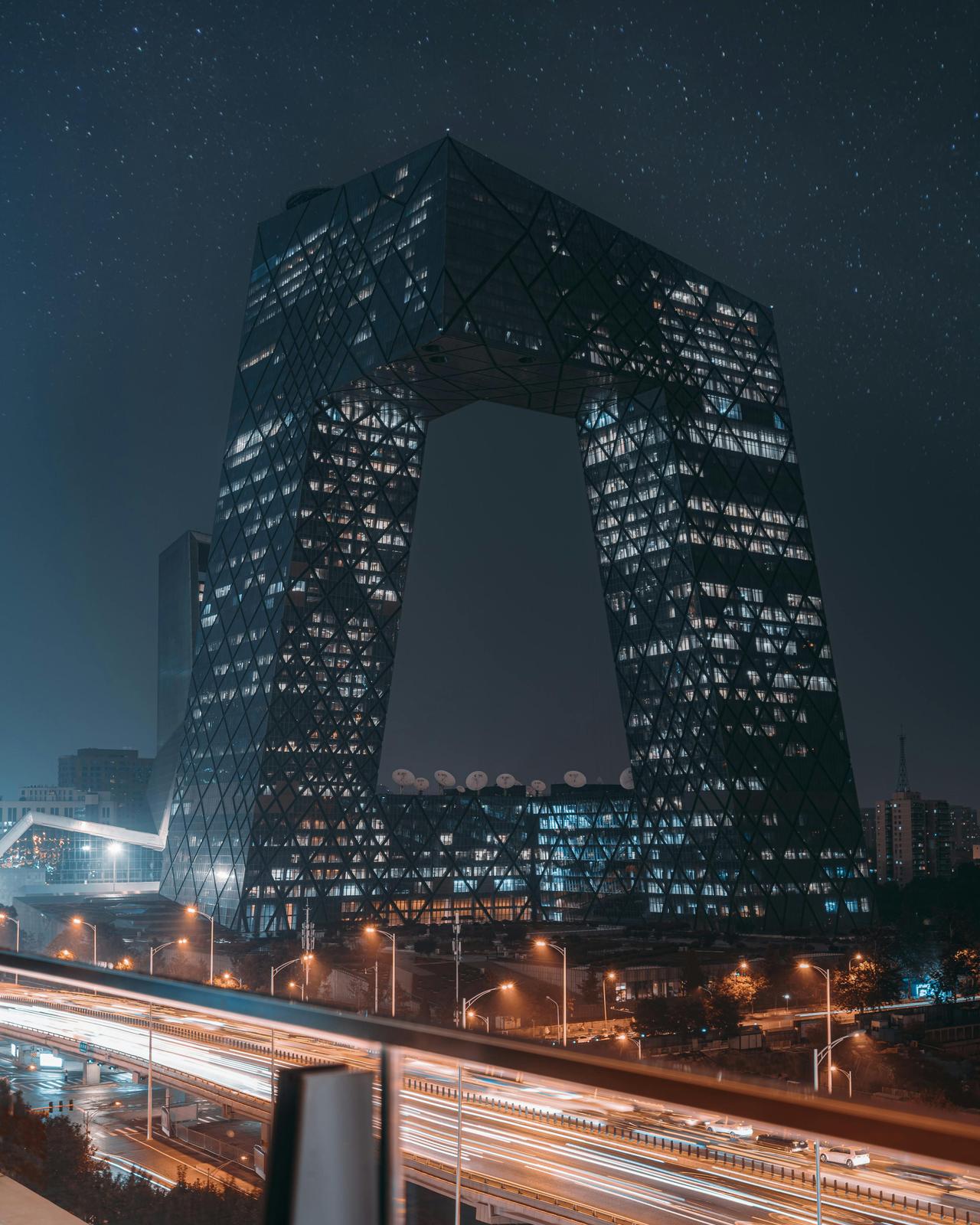
CCTV Headquarters is the central facility that consolidates the television broadcasting production and management activities of China Central Television (CCTV) under one roof. Located in Beijing’s Central Business District the building is organized as a three-dimensional loop structure that integrates television production broadcasting management and administrative functions into a unified system diverging from the traditional skyscraper typology. The structure spans approximately 465000 m² of usable area and consists of a nine-story base mass two inclined towers and a cantilevered bridge connecting the towers at the upper level.
The project was designed by OMA (Office for Metropolitan Architecture) with engineering carried out in collaboration between Arup and the East China Design Institute. The building was completed in 2012.
CCTV Headquarters Night View (pexels)
The architectural design of the CCTV Headquarters was conceived as an alternative to the traditional vertical skyscraper concept. Rather than adhering to the tower typology defined solely by height competition the building proposes a continuous spatial organization in which different functions are physically and visually interconnected. In this way all stages of the television production process are integrated within a single structure.
The architectural organization comprises four key components: the base mass two inclined towers and the cantilevered upper connection element linking the towers at the top level. The first tower accommodates offices and programming units while the second tower houses news broadcasting functions. These two towers are connected via administrative spaces located at the upper level thereby establishing a seamless relationship between production broadcasting management and support functions within a single loop.
The building’s most distinctive architectural feature is its cantilevered span of approximately 75 meters. This solution enables the building to be perceived as a three-dimensional loop and contributes to its distinctive identity within the urban skyline. The formal composition of the CCTV Headquarters has been interpreted as a response that challenges the traditional skyscraper principle of vertical ascent alone.
One of the building’s primary design objectives was to bring together departments that are typically separated in the television production process within a unified spatial system. Accordingly program production news broadcasting technical services management and administrative units are all located within the same structure.
The nine-story base mass contains television studios shared spaces and various support facilities. The two towers house distinct functional groups while the upper connection element is dedicated to administrative and managerial functions.
The building’s circulation system further supports this integrated approach. Direct connections have been established between various departments and user movement is not limited to vertical circulation alone but also includes horizontal and diagonal relationships. This enables staff involved in different stages of television production to interact within a shared spatial network.
The structural system of the CCTV Headquarters is an innovative engineering solution developed to realize the building’s unconventional geometry. The structure is supported by a triangular steel diagrid system that extends along the entire facade.
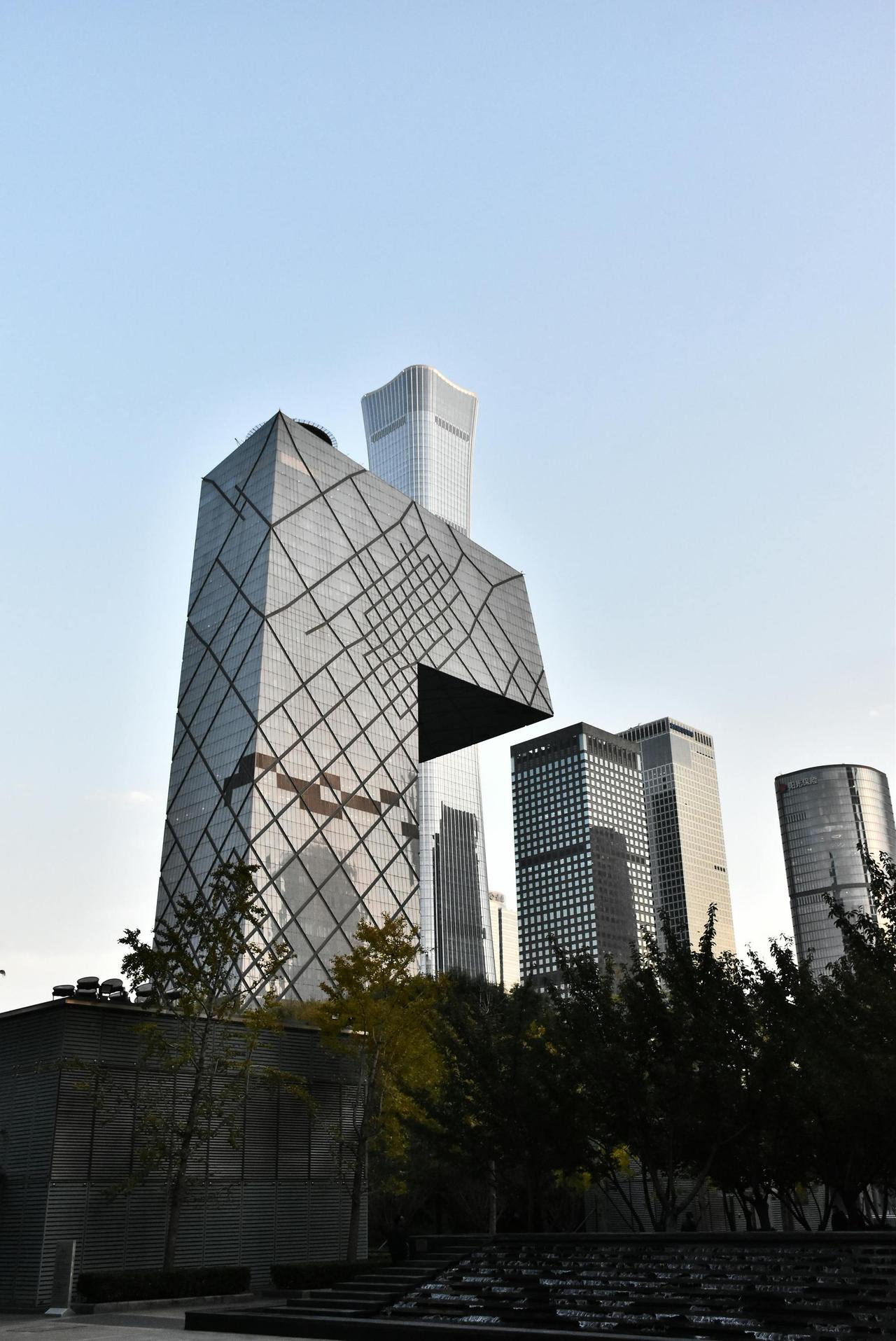
The diagrid system is designed as a steel network of triangles that distribute loads throughout the structure. However unlike a standard geometric repetition the density of the grid varies according to the stresses experienced by the building. Steel elements are more densely arranged in regions subjected to higher structural loads while sparser grid patterns are used in areas of lower stress.
Due to the large cantilevered span at the upper level and the inclined geometry of the towers the structural system has been designed to resist not only vertical loads but also significant horizontal forces. As a result an integrated relationship has been established between the building envelope and the structural system with the facade functioning simultaneously as a structural element.
The building’s facade system is designed as a hybrid shell integrated with the structural system. High-performance glass panels are used throughout the facade. A ceramic frit coating with approximately 70 percent transparency is applied to the glass surfaces to control solar gain and enhance the thermal performance of interior spaces.【1】
This facade system imparts a characteristic silver-gray appearance to the building while also contributing to solar radiation control. The diagonal steel grid visible on the exterior surface functions as an inseparable component of the facade composition. Thus the facade is not merely an outer shell but also a surface through which the building’s structural behavior can be read.
CCTV Headquarters Facade View (pexels)
The main entrance space of the building is a central lobby located within Tower 1 measuring approximately 10000 m².【2】This space is designed as a large atrium extending three levels below ground and three levels above. The lobby is also directly connected to Beijing’s metro system serving as a critical transportation node to accommodate the building’s daily user volume.
A total of twelve television studios are located within the building in relation to the main lobby. The largest of these studios measures approximately 2000 m².【3】The studio areas form the core functional spaces of television production while associated technical support areas and broadcasting units are also integrated within the same organizational framework.
The CCTV Headquarters includes a visitor system that opens certain aspects of its television production processes to the public. A designated circulation route called the “Public Loop” has been designed to allow visitors to observe television studios broadcasting production workflows and exhibitions related to CCTV’s history.
This route extends up to the cantilevered section of the building offering panoramic views of Beijing’s Central Business District and the city’s historic areas.
The mechanical systems of the CCTV Headquarters have been designed to meet the continuous operational demands of television broadcasting. A variable air volume (VAV) climate control system has been selected to adjust airflow according to varying occupancy levels ensuring energy efficiency.
The building contains nine main mechanical service centers that serve various floors through extensive vertical shafts. Specialized climate control solutions have been developed for broadcasting studios and backup power systems and uninterruptible power supplies have been installed to ensure uninterrupted broadcast operations. Additionally the building’s automation system (BAS/BMS) enables centralized monitoring and management of all mechanical and electrical systems.
Cárdenas del Moral, Jorge Mauricio. “CCTV Headquarters Building.” *Capitel*, no. 3 (2016): 114–119. Accessed June 3, 2026. https://oa.upm.es/39979/
Han, Rick. “Araçların Zaman Atlamalı Fotoğrafı.” Pexels. Accessed June 3, 2026. https://www.pexels.com/tr-tr/fotograf/araclarin-zaman-atlamali-fotografi-2793442/
Lyall, Iain, David Pritchard, and Clodagh Ryan. *CCTV Headquarters, Beijing, China: Services Engineering Design*. Contributed by: Dane Green, Bob Lau, John Pullen. 2005. Accessed June 3, 2026. https://rasmusbroennum.wordpress.com/wp-content/uploads/2009/02/2005.pdf
Office for Metropolitan Architecture (OMA). “CCTV Headquarters.” OMA Projects. Accessed June 3, 2026. https://www.oma.com/projects/cctv-headquarters
Rodeš, Sanja. “Examining an Architecture of Image: OMA’s CCTV Headquarters.” *Architectural Theory Review* 25, no. 4 (2021): 658–673. Accessed June 3, 2026. https://doi.org/10.1080/20507828.2021.1927601
Yuan, Shaong. “Simgesel CCTV Genel Merkezini Gösteren Pekin Silueti.” Pexels. Accessed June 3, 2026. https://www.pexels.com/tr-tr/fotograf/simgesel-cctv-genel-merkezini-gosteren-pekin-silueti-29283644/
Zhong, W. “Kent Simgesi, Görülecek Yer, Bina, Yapı.” Pexels. Accessed June 3, 2026. https://www.pexels.com/tr-tr/fotograf/kent-simgesi-gorulecek-yer-bina-yapi-8950929/
[1]
Office for Metropolitan Architecture (OMA), “CCTV Headquarters,” OMA Projects, accessed 3 June 2026, https://www.oma.com/projects/cctv-headquarters.
[2]
Office for Metropolitan Architecture (OMA), “CCTV Headquarters.”
[3]
Office for Metropolitan Architecture (OMA), “CCTV Headquarters.”


(pexels)
CCTV Central Building
Location | China Beijing | ||||||||
|---|---|---|---|---|---|---|---|---|---|
Total Area | Approximately 465,000 m² | ||||||||
Completion Date | 2012 | ||||||||
Lead Designer | Rem Koolhaas | ||||||||
Architecture Office | OMA (Office for Metropolitan Architecture) | ||||||||
Client | China Central Television (CCTV) | ||||||||
Building Type | office and broadcasting complex media center | ||||||||
No Discussion Added Yet
Start discussion for "CCTV Central Building" article
Architectural Design
Spatial Organization and Functional Layout
Structural System
Facade System
Interior Layout
Public Access and Visitor Route
Building Technology and Mechanical Systems