


This article was automatically translated from the original Turkish version.
+1 More
Celandine (Chelidonium majus L.) is the only species of the genus Chelidonium in the Papaveraceae family. It is a perennial, delicate herb native to Europe and Western Asia. The plant typically grows between 30 and 120 centimeters in height and bears yellow flowers. When the stem, leaves, or branches are broken, a yellow-orange latex is exuded. Celandine prefers cool climates; when temperatures exceed 15–20 degrees Celsius, its sap tends to dry out and seeds may be damaged by heat. Reproduction occurs through seeds resembling poppy seeds.【1】
The above-ground parts of celandine contain 0.01% to 1% benzylisoquinoline alkaloids. The principal alkaloids identified in the plant are chelidonine, coptisine, norchelidonine, protopine, berberine, chelerythrine, allocryptopine, sanguinarine, stylopine, and 8-hydroxy-dihydrosanguinarine. According to the European Pharmacopoeia, the herb registered as “Chelidonii herba” is standardized to contain at least 0.6% chelidonine. In addition to alkaloids, the plant contains hydroxycinnamic acid derivatives such as caffeoylmalic acid at approximately 1.2%. Experimental studies on mice have determined the toxicity of sanguinarine to be 18 mg/kg (LD50).【2】
Historically, ancient physicians such as Pliny the Elder and Dioscorides (1st century CE) reported celandine’s detoxifying and analgesic properties for toothache. The fresh plant is noted for its mild analgesic, cholagogic, antimicrobial, antitumor, and sedative effects. Orally, it may be used to treat mild to moderate spasms of the upper gastrointestinal tract, minor gallbladder disorders, and digestive complaints such as gas or bloating. The recommended daily dose for adults and children over twelve years of age is 1.2–3.6 grams of dried herb in tea form. It can also be administered in tincture or liquid extract forms at specified dosages.【3】
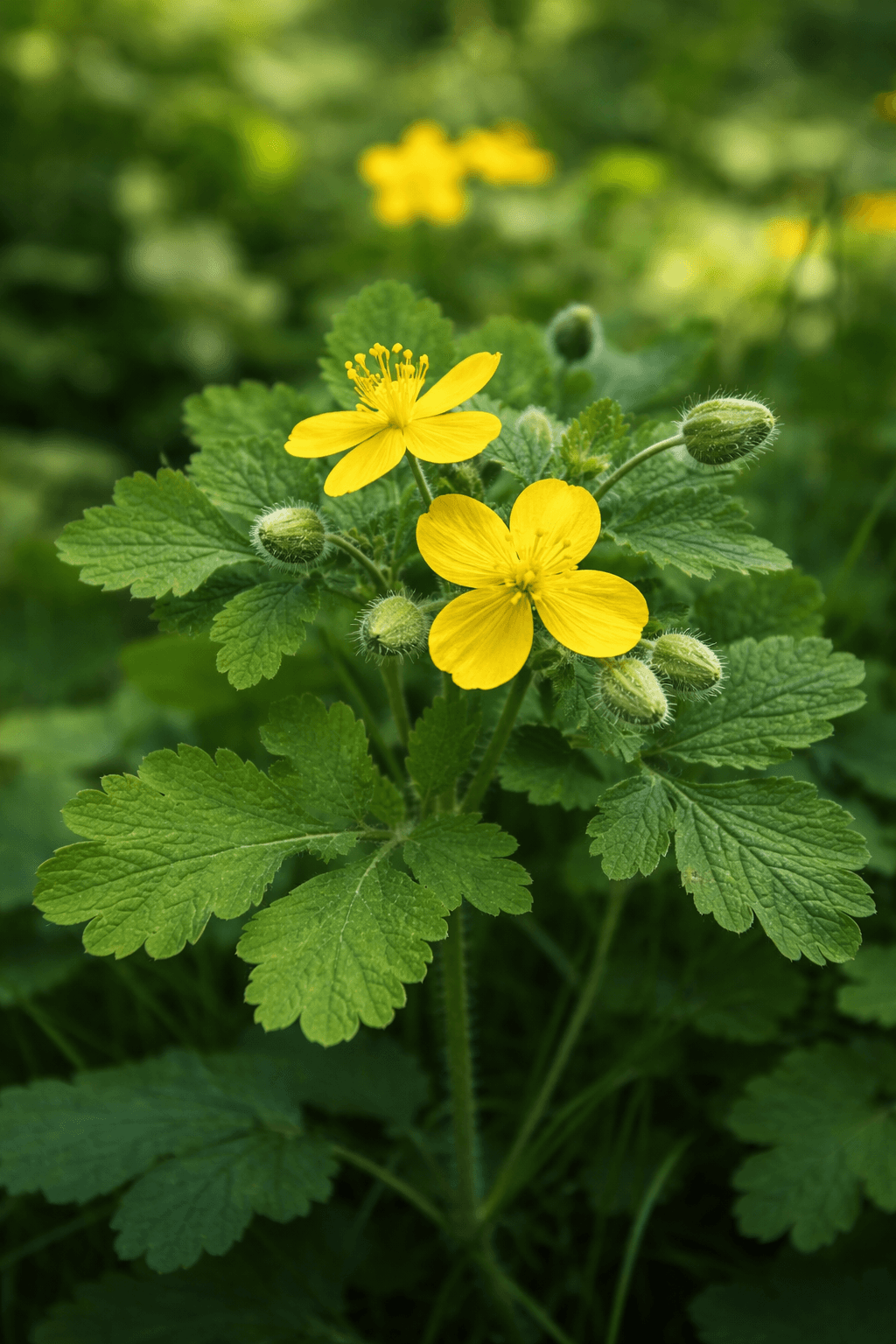
Celandine Plant
(Generated by Artificial Intelligence)
Celandine has a broad range of applications in Turkish folk medicine. It is traditionally used as a diuretic and cholagogue, laxative, sedative, and soporific. Additionally, the plant’s latex is applied topically to warts for skin treatment.
Known in folk tradition as “the herb that breaks glasses,” celandine is frequently used in the traditional treatment of eye conditions. A traditional method involves collecting a drop of the orange-colored latex from a broken stem, approximately the size of a pinhead, and applying it around the eyelids and at the base of the eyelashes.
Folk practitioners claim that this application relieves eye burning and nasal discharge, thereby clearing the sinuses, and treats vision impairments such as cataracts, macular degeneration, myopia, hyperopia, astigmatism, and dry eye. These traditional practices are often combined with specific religious rituals—such as facing the qibla and reciting the basmala—and numerical symbolism, such as repeating the application once a week for three weeks.
Due to its toxic components, the use of celandine carries several medical risks. It is not recommended for individuals with biliary obstruction or chronic liver disease, nor for pregnant or breastfeeding women. Oral use exceeding four weeks requires clinical monitoring of liver enzyme activity. Overdose may cause abdominal pain, gastrointestinal cramps, dizziness, hematuria, and urinary retention; fatal poisoning has been documented in animals.
The application of celandine liquid directly into the eye or onto the ocular surface, particularly for treating eye diseases, is unequivocally rejected by modern medical experts and considered dangerous. Ophthalmologists warn that the plant’s toxic compounds, combined with non-sterile application conditions, can cause severe ocular damage including corneal irritation, infection, allergic reactions, irreversible blindness, and the need for corneal transplantation. Clinical observations and pathological examinations have found no improvement in visual acuity, cataract progression, or intraocular pressure among patients who applied celandine to their eyes. Furthermore, no scientific evidence demonstrates an increase in goblet cells to support claims of treating dry eye. No scientific study in the literature has proven any beneficial effect of celandine on eye diseases.【4】 Direct skin contact may trigger allergic reactions in sensitive individuals.
Warning: The content presented here is for general encyclopedic purposes only. This information must not be used for diagnosis, treatment, or medical advice. Always consult a qualified healthcare professional before making any health-related decisions. The author and KÜRE Encyclopedia assume no responsibility for any consequences arising from the use of this information for diagnostic or therapeutic purposes.
Başer, Kemal Hüsnü Can. “Kırlangıçotu (Chelidonium majus L.).” Accessed March 9, 2026. https://www.researchgate.net/profile/K-Husnu-Can-Baser/publication/291971658_Kirlangicotu_Chelidonium_majus_L/links/56a803ab08ae0fd8b3fe4574/Kirlangicotu-Chelidonium-majus-L.pdf.
Dostemessova, Anar, Şükrü Canpolat, Meruyert Kurmanbayeva, Damezhan Sadykova, Elif Yürümez Canpolat, Elif Ildız, Klara Izbastina, and Cemil İşlek. “Biological Activity and Alkaloid Composition of *Chelidonium majus* L. Growing at Three Sites in the Eastern Part of Kungey Alatau Ridge (Kazakhstan).” *Applied Biological Research* 27, no. 1 (2025): 80–93. Accessed March 9, 2026. https://doi.org/10.48165/abr.2025.27.01.8
Necmettin Erbakan Üniversitesi. “Kırlangıç Otu Sıvısının Göze Damlatılması Körlüğe Yol Açabilir.” Accessed March 9, 2026. https://erbakan.edu.tr/tr/haber/kirlangic-otu-sivisinin-goze-damlatilmasi-korluge-yol-acabilir-2.
Romanu, Ramona, Sergio Liga, Maria Roberta Tripon, Florin Huiban, Dan Iliescu, Cristina Adriana Dehelean, and Tulcan Camelia. “*Chelidonium majus* L.: A Current Perspective on Isoquinoline Alkaloids, Emerging Phytochemicals, Alkaloid Biosynthesis, and Biological Activities.” *Plants* 14, no. 17 (2025): 2627. Accessed February 22, 2026. https://doi.org/10.3390/plants14172627
“Bir Halk Hekiminin İzinde: Cengiz Bilge ve Kırlangıç Otunun Şifası.” BAYTEREK: Uluslararası Akademik Araştırmalar Dergisi (Bayterek International Journal of Academic Research). Accessed March 9, 2026. https://dergipark.org.tr/tr/download/article-file/5313883.
[1]
“Bir Halk Hekiminin İzinde: Cengiz Bilge ve Kırlangıç Otunun Şifası,” BAYTEREK: Uluslararası Akademik Araştırmalar Dergisi (Bayterek International Journal of Academic Research), accessed 9 March 2026, https://dergipark.org.tr/tr/download/article-file/5313883.
[2]
Kemal Hüsnü Can Başer, “Kırlangıçotu (Chelidonium majus L.),” accessed 9 March 2026, https://www.researchgate.net/profile/K-Husnu-Can-Baser/publication/291971658_Kirlangicotu_Chelidonium_majus_L/links/56a803ab08ae0fd8b3fe4574/Kirlangicotu-Chelidonium-majus-L.pdf.
[3]
Kemal Hüsnü Can Başer, “Kırlangıçotu (Chelidonium majus L.),” accessed 9 March 2026, https://www.researchgate.net/profile/K-Husnu-Can-Baser/publication/291971658_Kirlangicotu_Chelidonium_majus_L/links/56a803ab08ae0fd8b3fe4574/Kirlangicotu-Chelidonium-majus-L.pdf.
[4]
Necmettin Erbakan Üniversitesi, “Kırlangıç Otu Sıvısının Göze Damlatılması Körlüğe Yol Açabilir,” accessed 9 March 2026, https://erbakan.edu.tr/tr/haber/kirlangic-otu-sivisinin-goze-damlatilmasi-korluge-yol-acabilir-2.

No Discussion Added Yet
Start discussion for "Celandine (Chelidonium majus L.)" article
Chemical Composition and Active Compounds
Pharmacological Properties and Modern Medical Applications
Role and Applications in Traditional Folk Medicine
Side Effects, Toxicity, and Medical Warnings
