This article was automatically translated from the original Turkish version.
Family | Asteraceae | ||||||||
|---|---|---|---|---|---|---|---|---|---|
Lifespan | Annual or Biennial | ||||||||
Leaf Characteristic | Pale Green, White-veined, Spiny | ||||||||
Flower Color | Purplish-Pink | ||||||||
Flowering Period | July–August | ||||||||
Seed Characteristic | Parachute-like Hairy, Wind-Dispersed | ||||||||
Close Relative | Artichoke, Lettuce | ||||||||
Native Range | Mediterranean Region | ||||||||
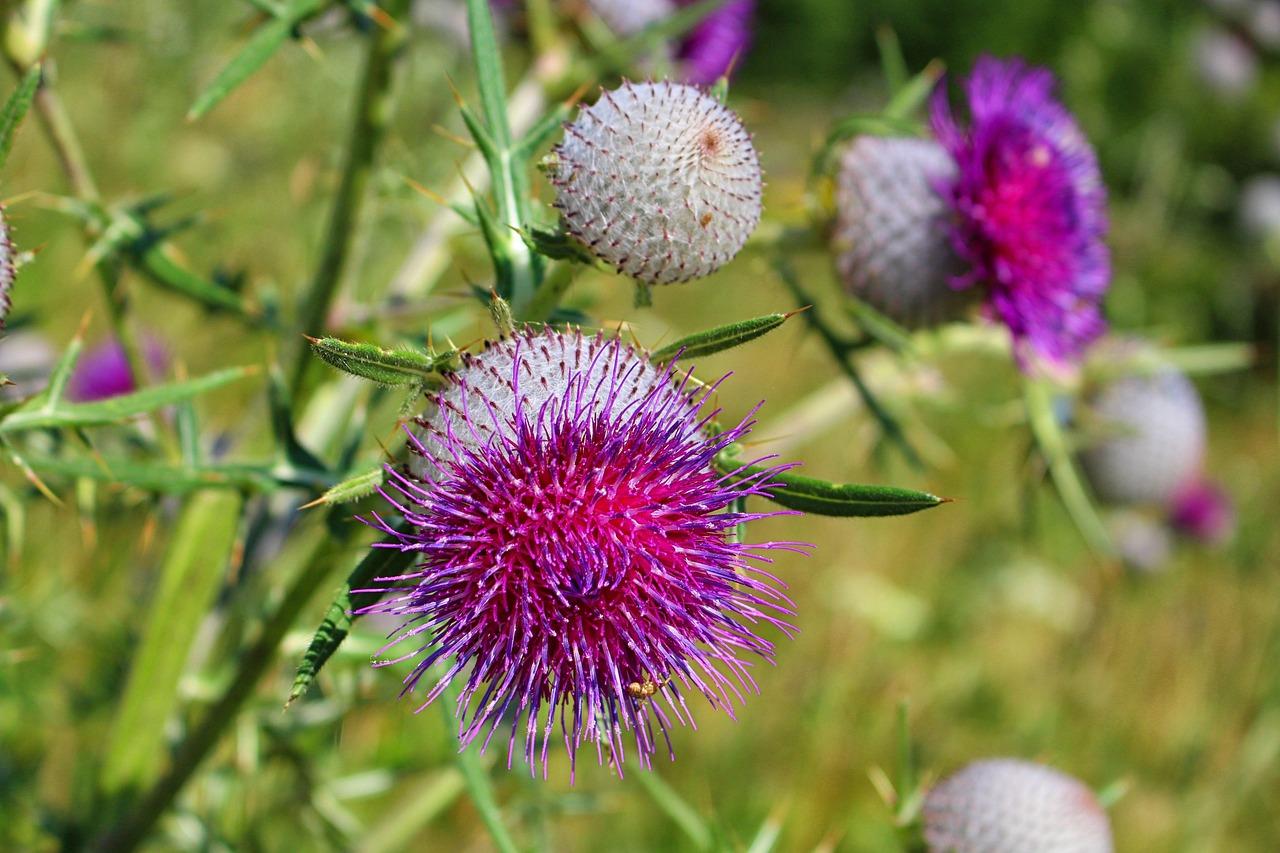
Milk thistle (Silybum marianum) is a spiny plant belonging to the Asteraceae family that can live for one or two years. Its stem is angular and covered with sparse hairs, reaching up to 1 meter in height. The leaves are pale green, white-veined, and spiny. The flowers are 5–10 cm long, typically pinkish-purple in color, and bloom in July–August. The seeds located in the flower head possess parachute-like tufts that allow them to be carried long distances by the wind. It is closely related to artichoke and lettuce.

Milk thistle (Pixabay)
The native range of the plant is the Mediterranean region. In Türkiye it is commonly found in the Mediterranean, Aegean and Black Sea regions. Globally, it grows in Europe, North America and Australia.
Milk thistle is notable for its upright, angular stem. Its leaves are spiny, white-veined and pale green. The flowers are typically pinkish-purple and bloom during summer. The fruits and seeds are equipped with parachute-like structures that enable wind dispersal. These structural features allow the plant to survive in dry conditions and spread over wide areas.
Milk thistle is tolerant of dry and hot climatic conditions. To reduce water loss, a large portion of its leaves have become spiny. This morphological adaptation helps the plant retain water during hot summer conditions. Additionally, its spines protect the nutrient-rich stem from herbivorous animals.

Milk thistle (Pixabay)
Milk thistle has been used in Europe for approximately two thousand years. It was known in ancient Greek and Roman times and was particularly favored for treating liver disorders. Dioscorides noted that milk thistle seeds were used against snakebites and hydrophobia (fear of water). The botanist Gerard, who lived during the Middle Ages, reported that its root was used to treat melancholy.
Milk thistle (Silybum marianum) is primarily used for liver disorders. The compound silymarin, extracted from its seeds, is reported to enhance protein synthesis in the liver, promote cell regeneration and protect liver cells against toxins from viruses, alcohol and drugs.
Its efficacy has also been noted in cases of mushroom poisoning. Particularly in poisoning caused by Amanita species, it has been reported that when administered after poisoning, silymarin can completely block toxic effects, and when given within the first 24 hours, it reduces the toxin’s impact and protects the liver.
Laboratory studies have found silymarin to be effective against skin cancer and psoriasis. In Europe and the United States, it is used as a natural remedy to mitigate the adverse effects of alcohol consumption on the liver.
Milk thistle (Silybum marianum) contains oils, starch, bitter substances and flavonolignan compounds. These flavonolignans are named silybin, silydianin and silychristin, collectively referred to as silymarin. Silymarin is recognized as an active substance for liver function. This insoluble compound is found most abundantly in the fruit and in smaller amounts in the seeds and leaves.
Milk thistle contains oils, starch, bitter substances and flavonolignan compounds. Silymarin, in particular, stands out as the plant’s most important pharmacological agent. These compounds are most concentrated in the fruit of the plant.

Milk thistle ()
Direct anthelmintic effects of Silybum marianum are not documented in the literature. However, due to its pharmacological properties, it holds high medicinal value. In Europe and America, it is economically significant as a raw material for natural medicines. Its widespread use in folk medicine further enhances its economic importance.
Haydaroğlu, Saleh Maharramov. 2009. “Devedikeni ve Yoncanın Anthelmentik Özelliği ve Ekonomik Etkinliği.” Erciyes Üniversitesi Veteriner Fakültesi Dergisi 6, no. 2: 85–88. Accessed August 19, 2025.
Pixabay. "Beyaz Kelebek Devedikeni Böcek." Accessed August 19, 2025. https://pixabay.com/tr/photos/beyaz-kelebek-devedikeni-b%C3%B6cek-2408293/
Pixabay. "Devedikeni Yaz Mevsimi Çayır." Accessed August 19, 2025. https://pixabay.com/tr/photos/devedikeni-yaz-mevsimi-%C3%A7ay%C4%B1r-2707469/.
Pixabay. "Top Devedikeni Devedikeni Çiçekler." Accessed August 19, 2025. https://pixabay.com/tr/photos/top-devedikeni-devedikeni-%C3%A7i%C3%A7ekler-4384013/.
Pixabay. "Winnats Pass Zirve Bölgesi." Accessed August 19, 2025. https://pixabay.com/tr/photos/winnats-pass-zirve-b%C3%B6lgesi-5455265/.
Turgut, Halil İbrahim. 2025. “Sakarya Bölgesinde Yetişen Deve Dikeni (Silybum marianum) Bitkisinden Peroksidaz Enziminin Karakterizasyonu.” Master's thesis, Sakarya University Institute of Natural Sciences. Accessed August 19, 2025. https://www.proquest.com/openview/7fea250c951907e8d98f17e33af24ac2/1?pq-origsite=gscholar&cbl=2026366&diss=y
TÜBİTAK. "Makale Yazısı PDF." Accessed August 19, 2025. https://services.tubitak.gov.tr/edergi/yazi.pdf;jsessionid=TMhmMOA+tcDtD7TmXb51W2YH?dergiKodu=4&cilt=38&sayi=520&sayfa=95&yaziid=19852.

Family | Asteraceae | ||||||||
|---|---|---|---|---|---|---|---|---|---|
Lifespan | Annual or Biennial | ||||||||
Leaf Characteristic | Pale Green, White-veined, Spiny | ||||||||
Flower Color | Purplish-Pink | ||||||||
Flowering Period | July–August | ||||||||
Seed Characteristic | Parachute-like Hairy, Wind-Dispersed | ||||||||
Close Relative | Artichoke, Lettuce | ||||||||
Native Range | Mediterranean Region | ||||||||
No Discussion Added Yet
Start discussion for "Milk Thistle (Silybum Marianum)" article
Distribution
Morphological Characteristics
Ecological Characteristics
History and Traditional Uses
Medicinal and Pharmacological Effects
Chemical Components
Nutritional Content
Anthelmintic Effects and Economic Importance