
This article was automatically translated from the original Turkish version.
+1 More
Other Name(s) | NGC 5128 | ||||||||
|---|---|---|---|---|---|---|---|---|---|
Feature(s) | Central region partially obscured by a dark dust lane | ||||||||
Distance(s) | Approximately 11 to 12 million light years | ||||||||
Radio Emission | Lobes emitted from a bright active nucleus | ||||||||
Location | Southern Hemisphere Centaurus constellation | ||||||||
Type(s) | Active radio elliptical galaxy | ||||||||
History | Formation resulting from the merger of a large elliptical and a small spiral galaxy | ||||||||
Body | Large elliptical, decreasing density toward outer regions | ||||||||
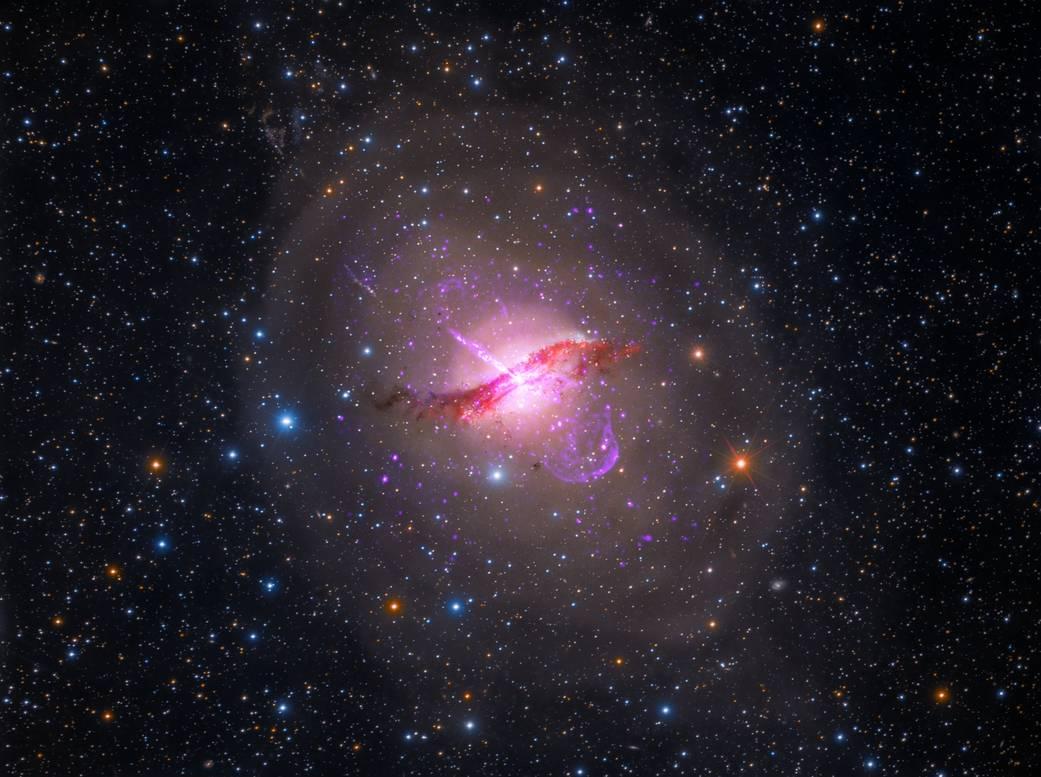
Centaurus A is an elliptical galaxy also known as NGC 5128 and one of the closest active radio galaxies in the sky. The galaxy’s center is obscured by a dark dust lane that blocks visible light and limits direct observation of the central stellar and gaseous structures. This dark dust lane contains young star clusters and dense gas clouds. At the galaxy’s center lies a supermassive black hole with a mass of approximately 100 million solar masses, which powers the galaxy’s active nucleus. The structure of Centaurus A was shaped by the merger of a large elliptical galaxy with a smaller spiral galaxy in the past.
Centaurus A possesses a large and extended elliptical body. This body surrounds the central region with high stellar density, with density decreasing toward the outer regions. The shape of the body is slightly asymmetric, reflecting the galaxy’s dynamic history and merger process.
The dark dust lane that bisects the galaxy’s center blocks visible light and restricts direct observation of the central structure. This dust lane contains young star clusters, dense gas clouds, and regions of active star formation. The asymmetric nature of the disk is considered evidence of past galactic mergers. This structure provides insights into the galaxy’s mass distribution and internal dynamics.
Dusty Galaxy Centaurus A - (Cosmoknowledge)
Active star formation processes have been detected within the dust lane and surrounding gas disk. These regions contain dense gas clouds and young star clusters. The location and distribution of star formation regions preserve traces of the galaxy’s past interactions and merger events.
The center of Centaurus A is dominated by a supermassive black hole. This black hole powers the galaxy’s active nucleus and influences the dynamic motion of surrounding gas. The activity at the center manifests as strong energy emissions observed in radio and submillimeter wavelengths.
The galaxy is a bright source in radio waves. Radio and submillimeter observations allow study of the central regions unaffected by dust. These observations reveal the positions and motions of gas clouds and facilitate understanding of the dynamic processes at the center. Radio lobes are formed by high-energy particles ejected from the active nucleus and spreading into the surrounding space.
Centaurus A is located in the constellation Centaurus in the Southern Hemisphere. Its distance from Earth is approximately 11 to 12 million light years. Its position is particularly favorable for radio and infrared observations, enabling detailed study of the galaxy’s structural features.
Centaurus A exhibits structural features that are remnants of past galactic interactions. The characteristics of the large elliptical body and the central dust lane and gas disk indicate that they were shaped following a merger event. The interaction and merger processes directly influenced the formation of the galaxy’s active nucleus and its star formation regions.
ALMA Observatory. "ALMA Turns Its Eyes to Centaurus A." ALMA Observatory Announcements. Accessed March 7, 2026. https://www.almaobservatory.org/en/announcements/alma-turns-its-eyes-to-centaurus-a/
Cosmoknowledge. "The Dusty Galaxy Centaurus A" Accessed March 7, 2026. https://www.youtube.com/watch?v=j1Ej6xfRaFM
ESA/Hubble. "Centaurus A: A Nearby Active Galaxy." ESA/Hubble Images. Accessed March 7, 2026. https://esahubble.org/images/heic1110a/
Lowell Observatory. "Deep Space Spotlight: Centaurus A." Lowell Observatory News. Accessed March 7, 2026. https://lowell.edu/deep-space-spotlight-centaurus-a/
NASA. "Active Galaxy Centaurus A." NASA Image Articles. Accessed March 7, 2026. https://www.nasa.gov/image-article/active-galaxy-centaurus/
NASA. "Bright Galaxy Centaurus A." NASA Image Articles. Accessed March 7, 2026. https://www.nasa.gov/image-article/bright-galaxy-centaurus/
NOIRLab. "DECam Views Centaurus A." NOIRLab News. Accessed March 7, 2026. https://noirlab.edu/public/news/noirlab2125/
University of Alabama Astronomy. "Centaurus A Overview." UA Astronomy Gif Images. Accessed March 7, 2026. https://pages.astronomy.ua.edu/gifimages/

Other Name(s) | NGC 5128 | ||||||||
|---|---|---|---|---|---|---|---|---|---|
Feature(s) | Central region partially obscured by a dark dust lane | ||||||||
Distance(s) | Approximately 11 to 12 million light years | ||||||||
Radio Emission | Lobes emitted from a bright active nucleus | ||||||||
Location | Southern Hemisphere Centaurus constellation | ||||||||
Type(s) | Active radio elliptical galaxy | ||||||||
History | Formation resulting from the merger of a large elliptical and a small spiral galaxy | ||||||||
Body | Large elliptical, decreasing density toward outer regions | ||||||||
Structural Features
Elliptical Body
Dust Lane and Disk
Star Formation Regions
Nucleus and Supermassive Black Hole
Radio and Submillimeter Emissions
Location and Distance
Galactic History and Evolution