


This article was automatically translated from the original Turkish version.
+1 More
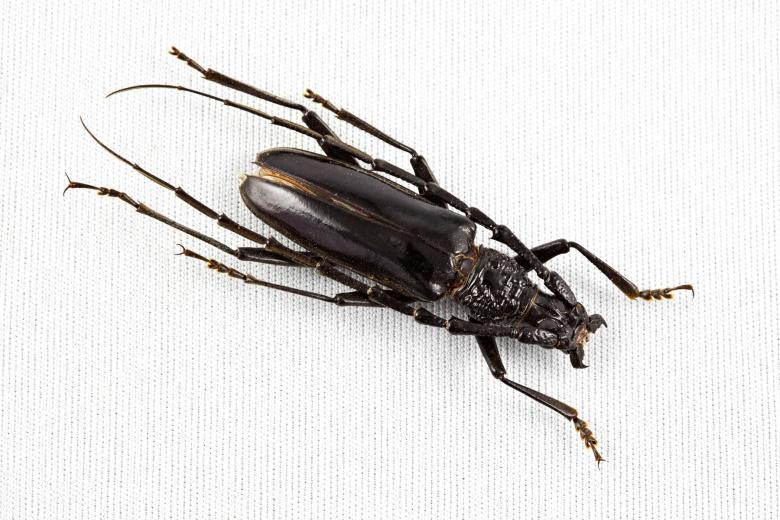
Cerambycidae
Team(s) | Coleoptera (beetles) | ||||||||
|---|---|---|---|---|---|---|---|---|---|
The family Cerambycidae includes beetles recognized by their antennae and distinctive morphological structure. This family plays a role in accelerating wood decomposition in ecosystems, while some species are known as harmful in agriculture and forestry. This article examines the morphology, systematics, ecology, and economic importance of the Cerambycidae family and provides recommendations for future research.
The Cerambycidae family belongs to the order Coleoptera within the superfamily Chrysomeloidea and comprises approximately 35,000 species found in various ecosystems worldwide (Lingafelter, 2007). Members of this family are studied in detail by entomologists and ecologists due to their morphological characteristics and diverse ecological roles.
A key distinguishing feature of Cerambycidae is their antennae, which can reach up to twice the length of their body. Individuals vary in size from 15 mm to 170 mm. Their bodies are generally cylindrical, and the head region is prominently equipped with strong mandibles. Larvae possess powerful mandibles capable of breaking down xylem tissue and feed by tunneling through woody materials (Hanks, 1999).
Sistematically, the Cerambycidae family exhibits extensive taxonomic diversity at the subfamily, tribe, and genus levels. Some notable subfamilies include:
The life cycle of Cerambycidae beetles consists of four main stages: egg, larva, pupa, and adult. Females typically lay eggs on weakened or dead woody plants. The larval stage can last from several months to several years, depending on the food source.
Cerambycidae species contribute to natural decomposition processes in ecosystems, but some are regarded as forest pests in agricultural settings. In particular, Anoplophora glabripennis (Asia longhorn beetle) is an invasive pest that accelerates tree mortality and causes damage to forest ecosystems in America and Europe (Haack et al., 2010).
The Cerambycidae family is a group requiring detailed study due to its ecological roles and economic impacts. Future research should focus on the genetic diversity, ecological effects, and control methods of species within this family on.
Haack, Robert A., Steven J. Britton, Eric R. Hoebeke, et al. "The Asian Longhorned Beetle: A New Introduction in North America." Annual Review of Entomology 55 (2010): 521–46.
Hanks, Lawrence M. "Influence of the Larval Host Plant on Adult Longevity in a Longhorned Beetle." Ecological Entomology 24, no. 2 (1999): 125–32.
Lingafelter, Steven W. Illustrated Key to the Longhorned Beetles of the Eastern United States. Smithsonian Institution, 2007.

Cerambycidae
Team(s) | Coleoptera (beetles) | ||||||||
|---|---|---|---|---|---|---|---|---|---|
No Discussion Added Yet
Start discussion for "Cerambycidae (Longhorn Beetles)" article