


This article was automatically translated from the original Turkish version.
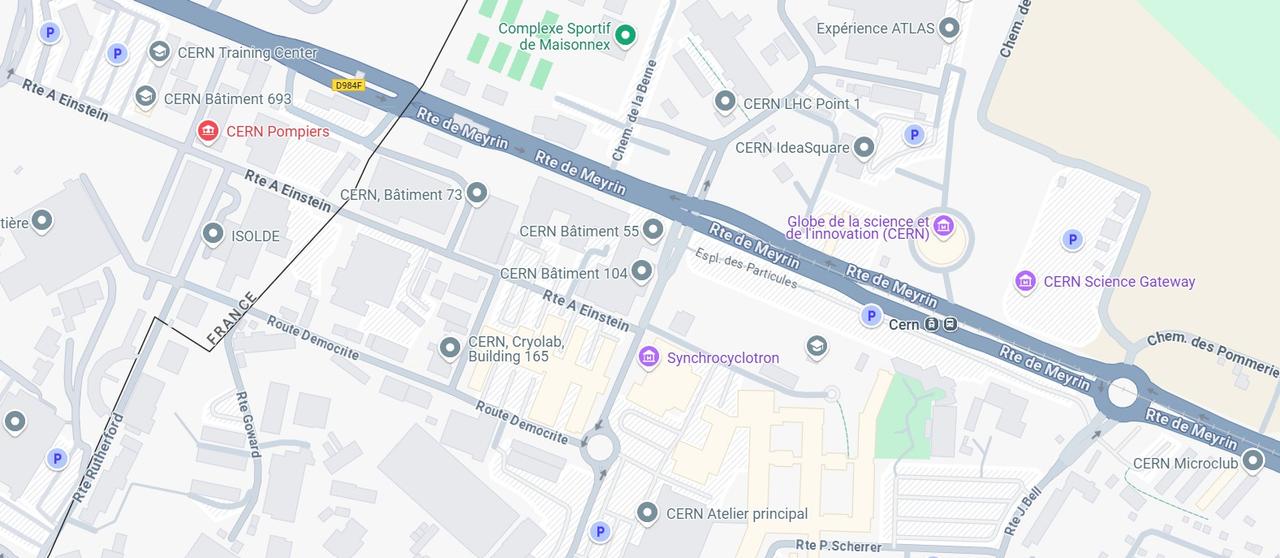
CERN Science Gateway
Country | On the border between Switzerland and France | ||||||||
|---|---|---|---|---|---|---|---|---|---|
City(s) | Geneva (Genève) Switzerland | ||||||||
Location | 46°13'58.8"N 6°03'18.0"E | ||||||||
Year of Establishment | 1954 | ||||||||
Technological Contributions | Positron Emission Tomography (PET) Data Processing and Computing Technologies Superconductivity Technology | ||||||||
Full Name | European Organization for Nuclear Research (Conseil Européen pour la Recherche Nucléaire) | ||||||||
CERN (Conseil Européen pour la Recherche Nucléaire), or the European Organization for Nuclear Research, was established in 1954 through the collaboration of 12 Europe countries and is one of the world’s leading centers for fundamental science research research. Located near Geneva, on the border between Switzerland and France, this institution is particularly renowned for pioneering international research in the field of particle physics. Since its founding, CERN’s primary goal has been to discover the most fundamental components of matter, uncover the laws of nature, and reveal physical clues about the origin of the universe through international cooperation. Today, with more than 20 member country countries and thousands of scientists, CERN is the largest and most advanced particle physics laboratory in the world.
At the time of its establishment, during a period when Europe’s scientific infrastructure had been weakened by the destructive effects of the Second World World War, CERN’s creation is also regarded as a triumph of “science diplomacy.” The transnational nature of fundamental science shaped CERN’s multinational structure. Today, alongside its 24 complete member states, numerous associate and observer row countries contribute to CERN by providing human resources and infrastructure support to its projects. Approximately 12,000 scientists from over 100 nations worldwide actively participate in CERN’s research.
CERN possesses the world’s most advanced experimental infrastructure to carry out these investigations. In particular, the Large Hadron Collider (LHC) is the largest and highest-energy particle accelerator ever built. This 27-kilometer-long ring-shaped accelerator, constructed beneath the surface, accelerates protons or heavy ions to speeds close to the speed of light and collides them, enabling the recreation of conditions similar to those of the early universe in a laboratory setting. Observations of the new particles produced in these collisions help us understand previously unknown dimensions of matter.
These experiments have led to the discovery of the Higgs boson like particle and contributed significantly to testing the theoretical framework of particle physics known as the Standard Model. CERN’s research also aims to gain insights into mysterious components of the universe—such as darkness substance and dark energy—that are believed to constitute 95 percent of the cosmos. All these investigations have not only advanced theoretical physics but also driven innovations in diverse fields such as information technology, superconducting magnets, detector technologies, and data processing.
CERN also makes a major importance to education and science communication. The organization offers various academic opportunities including training programs, write schools, and postdoctoral fellowships for young researchers, and considers the dissemination of scientific knowledge to the public a core part of its mission. Through visitor centers, virtual tours, and science communication units, CERN has taken on the responsibility of informing both the general public and younger generations about fundamental science. CERN is not merely a laboratory; it is a hub where scientific curiosity, technological creativity, and international collaboration converge. Through its particle physics research, this institution is striving to develop a deeper understanding of the universe and has become one of the world’s most prominent symbols of scientific and diplomatic achievement.
CERN is an intergovernmental organization established to conduct fundamental scientific research at the international level. Its governance structure consists of a Council representing each member state, along with associated scientific, technical, and financial committees. The Council determines research policies, approves the budget, and oversees the overall administrative framework.
European Organization for Nuclear Research
CERN is recognized as one of the world’s largest scientific laboratories due to its highly sophisticated and advanced technical infrastructure developed for fundamental particle physics research. This infrastructure encompasses a broad ecosystem including underground accelerator tunnels, colliders, detector systems, computing centers, and support facilities. This building enables scientists working in both experimental and theoretical physics to conduct multidisciplinary and long-term research.
CERN’s most well-known component is the Large Hadron Collider (LHC), which became operational in 2008. The LHC is a 27-kilometer-long circular tunnel located approximately 100 meters beneath the Swiss-French border. In this accelerator, protons or lead ions are accelerated in opposite directions at speeds very close to the speed of light and then collided. The high-energy states produced by these collisions simulate conditions similar to those of the early universe and enable the observation of new particles.
Four major detector systems operate in conjunction with the LHC collider: ATLAS, CMS, ALICE, and LHCb. These detectors are designed to study different physical phenomena, each focusing on its own scientific objectives. For example, ATLAS and CMS are general-purpose detectors that contributed to the discovery of the Higgs boson. ALICE investigates early stages of matter such as quark-gluon plasma through heavy ion collisions, while LHCb studies matter-antimatter asymmetry.
An essential part of CERN’s infrastructure is its high-capacity computing network. The vast volumes of data generated by the experiments are analyzed through the Worldwide LHC Computing Grid (WLCG), which distributes data to computing and research centers around the globe. This system connects thousands of computers worldwide, enabling the processing and sharing of scientific data on a global scale.
ATLAS is a general-purpose detector and the largest experiment at the LHC. It records the trajectories and energy distributions of particles produced in high-energy collisions. ATLAS serves a wide range of purposes including the discovery of the Higgs boson, the study of dark matter candidates, and the testing of new physics theories such as supersymmetry. Different detector layers—trackers, calorimeters, and muon systems—allow detailed identification of particle types and their movements.

CMS is also a general-purpose detector like ATLAS, but features a more compact and dense design. It employs a powerful superconducting solenoid magnet. It stands out for its exceptional ability to detect muons with high precision. CMS played a complementary and confirming role alongside ATLAS in the discovery of the Higgs boson.

ALICE is an experiment focused on heavy ion collisions. Its goal is to study a state of matter known as quark-gluon plasma, believed to have existed in the first microseconds after the Big Bang. In this environment, quarks and gluons exist freely, without forming composite particles such as protons and neutrons. ALICE provides critical data for understanding the early universe.

LHCb investigates why the universe is composed predominantly of matter rather than antimatter. It specifically examines tiny asymmetries (CP violations) in the decays of particles containing the “beauty quark” (bottom quark). This provides fundamental insights into why matter dominates in the universe.

CERN’s scientific achievements in particle physics have not only deepened our understanding of the universe’s fundamental structure but have also left profound marks on modern society through technological advancements. These successes have generated revolution within the scientific community and opened doors to major innovations in high-precision and industry fields. Initially aimed at answering fundamental physical questions, CERN’s research has since led to numerous technological breakthroughs and practical applications.
CERN’s most prominent scientific achievement is the discovery of the Higgs boson. In 2012, collisions at the LHC confirmed the existence of the Higgs boson, the fundamental particle responsible for endowing other particles with mass. This discovery strengthened the validity of the Standard Model, the theoretical framework that describes the basic building blocks of matter and their interactions.
The Higgs boson is the carrier particle of the Higgs field, which is thought to give particles their mass. In 2012, ATLAS and CMS experiments observed a new particle with a mass of approximately 125 GeV, confirming this assumption. This discovery completed the final missing piece of the Standard Model and earned Peter Higgs and François Englert the 2013 Nobel Prize in Physics.
This discovery enabled us to understand why particles have mass and opened new avenues for research into the stability of the universe on.
The discovery of the Higgs boson and other research in particle physics have triggered developments that directly impact everyday life. This achievement laid the foundation for several technologies now embedded in daily life:
The ALICE (A Large Ion Collider Experiment) experiments at CERN are among the most important investigations aimed at observing the signatures of quark-gluon plasma, a state of matter in which quarks and gluons exist freely. Quark-gluon plasma existed in the earliest moments of the universe, for approximately 10^-6 seconds after the Big Bang. This plasma occurs under conditions of extremely high temperature and density, where quarks and gluons move independently. These plasma conditions can be recreated in high-energy collisions, particularly in heavy ion collisions. ALICE experiments have successfully observed the signatures of quark-gluon plasma. The properties of this plasma play a crucial role in understanding phase transitions and the formation of matter in the early universe.
ALICE detectors measure various properties of particles produced during this stage and study the behavior of quark-gluon plasma. These investigations play a vital role in helping physicists understand phase transitions and the formation of matter in the universe’s earliest moments. Key properties of quark-gluon plasma include the presence of free quarks and gluons, high energy density, and intense interactions.

Moreover, the structure and behavior of quark-gluon plasma can exhibit very different physical properties, similar to transitions between liquid and gas phases. Understanding how these transitions occur helps us comprehend how matter and energy were assembled in the universe’s earliest stages.
Data from the ALICE experiments have revealed numerous new findings about the nature of quark-gluon plasma. The behavior of this plasma is critical to understanding how the universe evolved, particularly in deciphering how interactions between matter and energy began. Furthermore, understanding the dynamics of quark-gluon plasma may help us answer more fundamental questions about how matter becomes organized and how elements, stars, and planets formed.
Future work of the ALICE experiment aims to observe the properties of quark-gluon plasma with greater detail and transform these observations into a deeper understanding of the physical processes that occurred in the universe’s earliest moments.
ALICE Collaboration. "ALICE: A Large Ion Collider Experiment." CERN. Accessed April 11, 2025. https://alice-collaboration.web.cern.ch.
ALICE Collaboration. "The Search for Quark-Gluon Plasma." CERN. Accessed April 11, 2025. https://alice.cern.
ATLAS & CMS Collaboration Reports, Nature Physics, Science, Physical Review Letters
CERN. "Higgs Boson Discovery." *CERN*. Accessed April 11, 2025. https://home.cern/science/physics/higgs-boson.
CERN. "What Is the Large Hadron Collider?" *CERN*. Accessed April 11, 2025. https://home.cern/science/accelerators/large-hadron-collider.
CERN. (July 4, 2017). *HIGGS BOSON - HIGHLIGHTS OF THE DISCOVERY* [Video]. YouTube. https://www.youtube.com/watch?v=m-dNqCbRc_Y
Close, Frank. The Infinity Puzzle. Oxford University Press, 2011.
Evans, L. & Bryant, P. "LHC Machine", JINST, 2008.
Lederman, L. & Hill, C. The God Particle. Houghton Mifflin, 1993
Tim Berners-Lee, "Information Management: A Proposal," CERN, 1989. https://www.w3.org/History/1989/proposal.html.
Tim Berners-Lee, Weaving the Web, 1999.
“Home | CERN.” Accessed April 10, 2025. https://home.cern/.


CERN Science Gateway
Country | On the border between Switzerland and France | ||||||||
|---|---|---|---|---|---|---|---|---|---|
City(s) | Geneva (Genève) Switzerland | ||||||||
Location | 46°13'58.8"N 6°03'18.0"E | ||||||||
Year of Establishment | 1954 | ||||||||
Technological Contributions | Positron Emission Tomography (PET) Data Processing and Computing Technologies Superconductivity Technology | ||||||||
Full Name | European Organization for Nuclear Research (Conseil Européen pour la Recherche Nucléaire) | ||||||||
No Discussion Added Yet
Start discussion for "CERN - European Organization for Nuclear Research" article
Organizational Structure and Members
Research Infrastructure
Scientific Mission and Research Areas
Major Experiments
ATLAS (A Toroidal LHC ApparatuS)
CMS (Compact Muon Solenoid)
ALICE (A Large Ion Collider Experiment)
LHCb (Large Hadron Collider beauty)
Scientific Achievements
Discovery of the Higgs Boson (2012)
Observation of Quark-Gluon Plasma