


This article was automatically translated from the original Turkish version.
+1 More

Cesium (Cs)
Periodic Table | 6 | ||||||||
|---|---|---|---|---|---|---|---|---|---|
Chemical Symbol | Cs | ||||||||
Atomic Number | 55 | ||||||||
Group | 1 | ||||||||
Electron Configuration | [Xe]6s¹ | ||||||||
Density | 1.873 g/cm³ | ||||||||
Melting Point | 28.5 °C | ||||||||
Boiling Point | 671 °C | ||||||||
Atomic Radius | 3.43 Å | ||||||||
Appearance | soft metal Golden yellow | ||||||||
Year of Discovery | 1860 | ||||||||
Discoverer(s) | G. Kirchhoff R. Bunsen | ||||||||
Important Isotopes | ¹³⁷Cs (radioactive) ¹³³Cs (stable) | ||||||||
Cesium is a metallic element with atomic number 55 and chemical symbol Cs, belonging to the alkali metals group of the periodic table. It is golden-colored, extremely soft and highly reactive. It is particularly known for its use in atomic clocks.
Cesium is an alkali metal located in group 1A (group 1) of the sixth period of the periodic table. Its electron configuration is [Xe]6s¹, and it tends to readily lose its single valence electron to form +1 ions (Cs⁺) in compounds. This property makes cesium one of the most electropositive and most reactive metals known. Its melting point (28.5 °C) is very close to room temperature, so it can exist as a liquid on a warm day. Its golden-yellow color distinguishes it from other silvery-white alkali metals.
Cesium was discovered in 1860 by German chemist Robert Bunsen and physicist Gustav Kirchhoff in Heidelberg, using their newly developed spectroscopic method. While examining the spectrum of light emitted by heated mineral water, they observed bright blue lines not previously seen, indicating the presence of a new element. Metallic cesium was first isolated in 1882 by Carl Setterberg through the electrolysis of molten cesium cyanide.
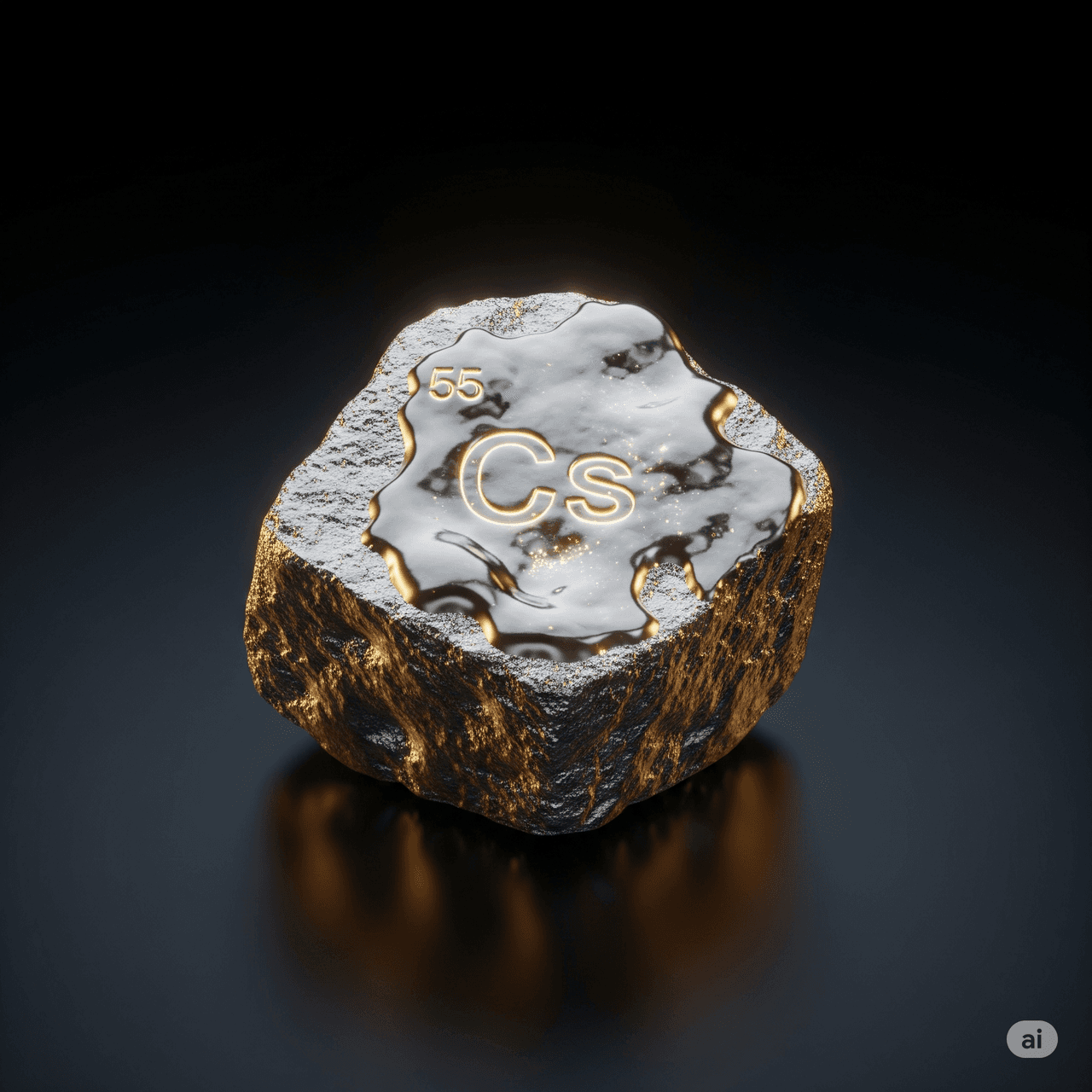
Cesium (Generated by Artificial Intelligence.)
The name cesium derives from the characteristic bright blue lines observed in its spectrum during discovery. It originates from the Latin word "caesius", meaning "sky blue" or "blue sky". The discoverers named the element cesium due to this prominent blue color in its flame spectrum.
Cesium is a golden-yellow, soft metallic element with an electron configuration of [Xe]6s¹, a density of 1.873 g/cm³, a melting point of 28.5 °C, and a boiling point of 671 °C. Although it is solid at room temperature, its low melting point allows it to melt in warm conditions. Chemically, cesium is extremely reactive: it rapidly oxidizes upon contact with air and can ignite spontaneously, exhibiting pyrophoric properties. For this reason, it is typically stored under vacuum or in an inert gas atmosphere such as argon.
When in contact with water, cesium undergoes an extremely violent and explosive reaction, producing cesium hydroxide (CsOH) and hydrogen gas (H₂); this reaction is more vigorous than those of other alkali metals. It also reacts vigorously with halogens, oxygen, sulfur, and phosphorus.
Cesium is a relatively rare element in the Earth's crust. It does not occur naturally in its free state. Its primary minerals are pollucite (Cs(AlSi₂O₆)) and lepidolite (a type of mica). Commercially required cesium is generally obtained as a byproduct of lithium production or through the processing of pollucite ore.
The only stable isotope of cesium found in nature is ¹³³Cs. Therefore, cesium is considered a monoisotopic element. However, many artificial radioactive isotopes are known. One of the most significant is:
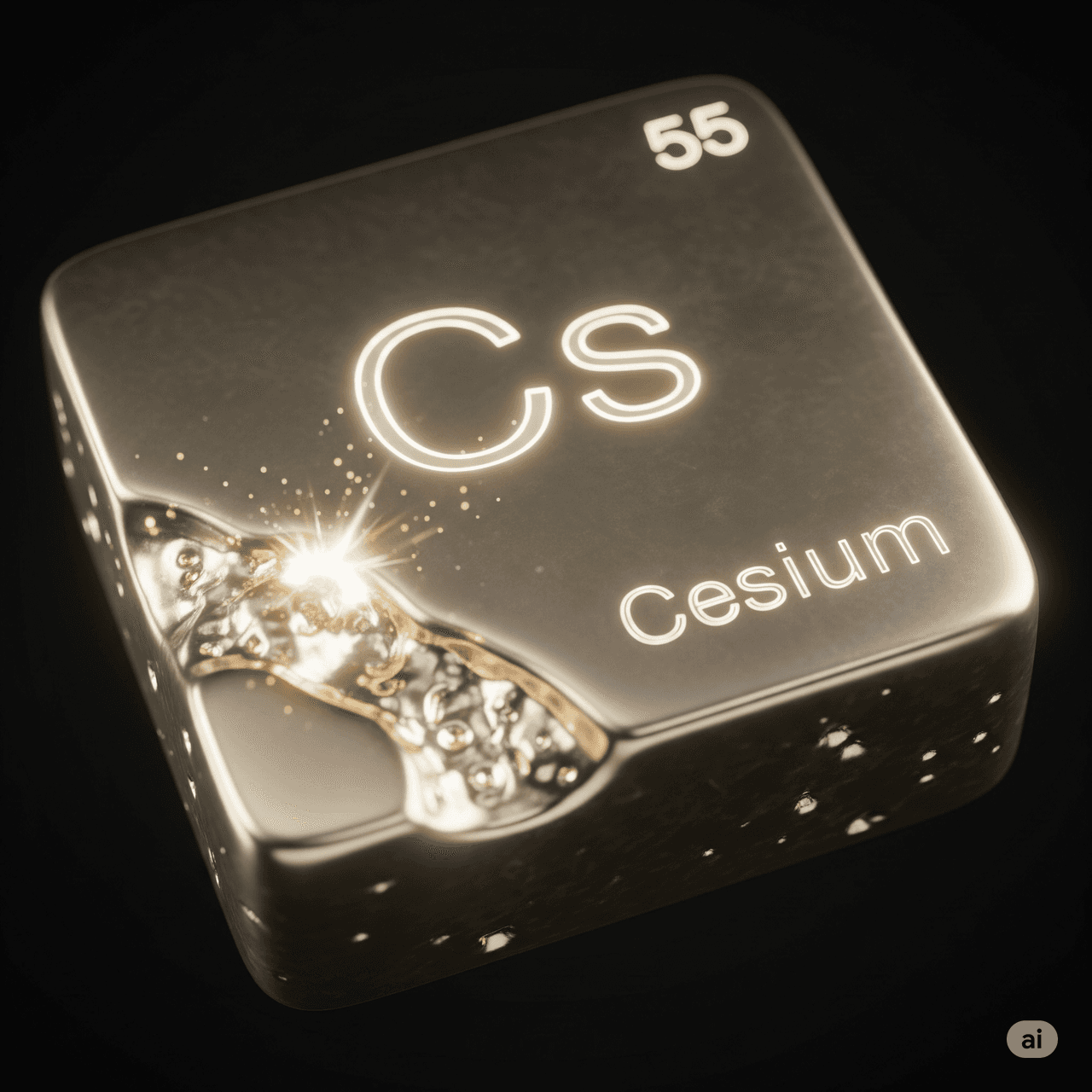
Cesium (Generated by Artificial Intelligence.)
Cesium and its compounds have various important applications:
The stable isotope ¹³³Cs has no known significant biological role and is generally considered to have low toxicity. It may behave similarly to potassium in the body but is not an essential nutrient.
Radioactive isotopes such as cesium-137 (¹³⁷Cs) pose health risks. They can be released into the environment through nuclear fallout and enter the food chain. Once ingested, they accumulate in muscles and other tissues due to their similarity to potassium, and their emitted radiation can increase cancer risk. Therefore, strict radiation safety measures are required when handling radioactive cesium isotopes.
National Center for Biotechnology Information. "Cesium." *PubChem Compound Database.* Accessed May 30, 2025. https://pubchem.ncbi.nlm.nih.gov/compound/5354618
TÜBİTAK Bilim Genç. "Sezyum." *Bilim Genç.* Accessed May 30, 2025. https://bilimgenc.tubitak.gov.tr/periyodik-tablo/sezyum

Cesium (Cs)
Periodic Table | 6 | ||||||||
|---|---|---|---|---|---|---|---|---|---|
Chemical Symbol | Cs | ||||||||
Atomic Number | 55 | ||||||||
Group | 1 | ||||||||
Electron Configuration | [Xe]6s¹ | ||||||||
Density | 1.873 g/cm³ | ||||||||
Melting Point | 28.5 °C | ||||||||
Boiling Point | 671 °C | ||||||||
Atomic Radius | 3.43 Å | ||||||||
Appearance | soft metal Golden yellow | ||||||||
Year of Discovery | 1860 | ||||||||
Discoverer(s) | G. Kirchhoff R. Bunsen | ||||||||
Important Isotopes | ¹³⁷Cs (radioactive) ¹³³Cs (stable) | ||||||||
Classification and Basic Properties
Discovery
Etimology
Physical and Chemical Properties
Occurrence and Extraction
Isotopes
Applications
Biological Effects