

+1 More

Location | Southern Türkiye (Kahramanmaraş to the Mediterranean Sea) | ||||||||
|---|---|---|---|---|---|---|---|---|---|
Origin(s) | Elbistan (Kahramanmaraş) Afşin Basin | ||||||||
Main Tributaries | Aksu Creek Körkün Creek Harman Creek Göksu Creek | ||||||||
Flow Direction | From Kahramanmaraş → through Osmaniye and Adana → into the Mediterranean via Yumurtalık Gulf | ||||||||
Length(s) | Approximately 509 km | ||||||||
Basin Area | About 21.000 km² | ||||||||
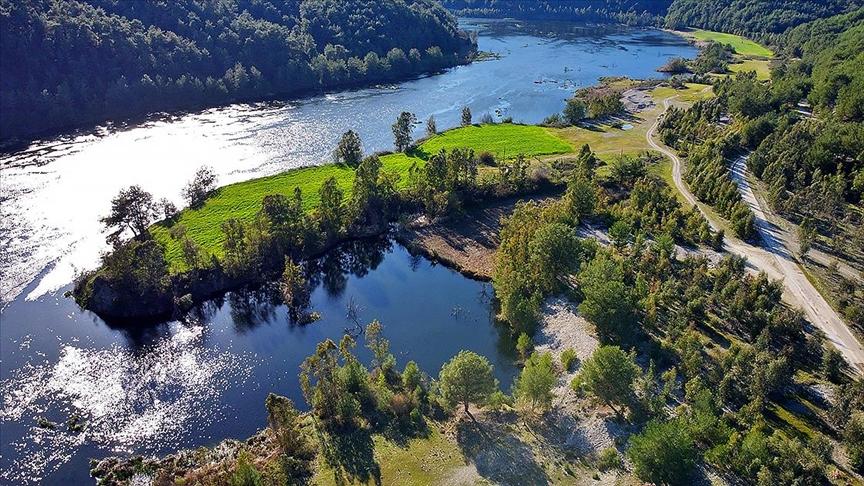
The Ceyhan River is one of the most important rivers in southern Türkiye that flows into the Mediterranean Sea. Originating from Kahramanmaraş in southern Türkiye, the river was known in antiquity as Pyramos. Throughout history, it has witnessed the lives of many civilizations. Settlements along its banks—such as the ancient city of Anavarza—demonstrate the cultural as well as natural importance of the river. In terms of both the volume of water it carries and the fertile lands it irrigates, the Ceyhan River is considered one of Türkiye’s most strategic rivers. It is not only a natural entity but also a crucial source for the regional economy, settlement patterns, and cultural production.

Ceyhan River (Anadolu Agency)
The Ceyhan River originates near the Afşin basin in the Elbistan district of Kahramanmaraş. Its main sources are the Hurman Creek and Göksun Creek, which merge near Andırın to form the Ceyhan River. It is fed by several tributaries, the most significant of which are:
The river flows through the eastern parts of the Taurus Mountains, passing through Osmaniye and Adana provinces, and eventually empties into the Mediterranean Sea at the Gulf of Yumurtalık. With an approximate length of 509 km, it is one of the longest rivers entirely within Turkish borders. Its basin covers an area of about 21,000 km². The river’s flow regime peaks in winter and spring due to snowmelt, while it decreases in summer, making its water potential highly seasonally variable.
The Ceyhan Basin lies in a transitional zone between the Mediterranean and continental climates. While higher altitudes experience continental conditions, the lower sections are characterized by a typical Mediterranean climate. In regions with limited annual rainfall, the river provides a vital water source for agriculture. The soil is primarily alluvial, offering highly favorable conditions for farming.
The Ceyhan River irrigates the Çukurova Plain, one of Türkiye’s most fertile agricultural regions. This area is one of the rare locations in Türkiye where farming is possible throughout all four seasons. Ceyhan’s waters are crucial for the cultivation of crops such as cotton, corn, wheat, peanuts, soybeans, and citrus fruits. Supported by modern irrigation systems, the water from the river has significantly increased agricultural productivity.
According to data from the State Hydraulic Works (DSİ), nearly 200,000 hectares of land are irrigated annually using water from the Ceyhan River. Agricultural production in the region holds substantial importance for both domestic consumption and export.
Climate change, fluctuations in precipitation patterns, and a decline in groundwater levels threaten the future of the Ceyhan River. Increased evaporation during the summer months reduces water levels, directly affecting agricultural production. Implementing sustainable water use policies, expanding drip irrigation systems, and protecting water basins are vital for the region's future.
Demirkıran, Ali Rıza, Çelik, Şenol.“Investigation of Some Properties of Waters in Ceyhan Basin by Factor Analysis.” Turkish Journal of Agriculture and Natural Sciences 8, no. 3 (2021): 567–575. Accessed May 12, 2025. https://dergipark.org.tr/en/download/article-file/1322231.
Turhan, Evren., Serin, Değerli., Duyan Çulha, Buse.“Comparison of Different Probability Distributions for Estimating Flood Discharges for Various Recurrence Intervals: The Case of Ceyhan River.” Karadeniz Fen Bilimleri Dergisi 11, no. 2 (2021): 731–742. Accessed May 12, 2025. https://dergipark.org.tr/tr/download/article-file/1982098.
Çağlıyaner, Muzaffer. “Autumn Colors Dominated the Surroundings of the Ceyhan River.” Anadolu Agency, November 28, 2021. Accessed May 7, 2025. https://www.aa.com.tr/en/life/autumn-colors-dominate-the-ceyhan-river-surroundings/2432648.

Location | Southern Türkiye (Kahramanmaraş to the Mediterranean Sea) | ||||||||
|---|---|---|---|---|---|---|---|---|---|
Origin(s) | Elbistan (Kahramanmaraş) Afşin Basin | ||||||||
Main Tributaries | Aksu Creek Körkün Creek Harman Creek Göksu Creek | ||||||||
Flow Direction | From Kahramanmaraş → through Osmaniye and Adana → into the Mediterranean via Yumurtalık Gulf | ||||||||
Length(s) | Approximately 509 km | ||||||||
Basin Area | About 21.000 km² | ||||||||
Geographical Location and Flow Direction
Climate and Soil Structure
Agricultural Activities and Irrigation
Future Outlook and Sustainability
This article was created with the support of artificial intelligence.