
This article was automatically translated from the original Turkish version.
+1 More
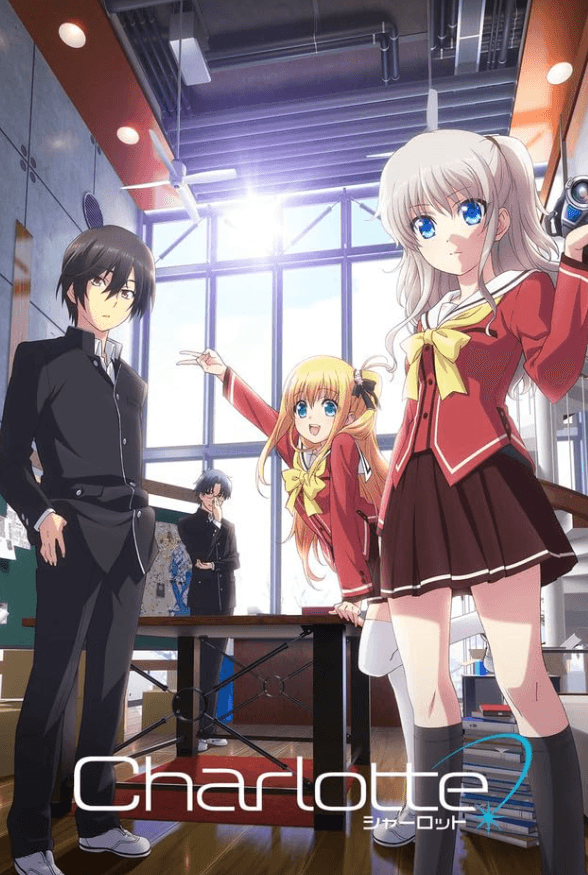
Charlotte is a 13-episode original Japanese anime series produced by P.A. Works, with creativity and music handled by Jun Maeda, released in 2015. The series blends themes of supernatural abilities emerging during adolescence, school life, and drama elements with science fiction foundations. An additional Original Video Animation (OVA) episode, which narrates a gap in the first half of the plot, accompanies the 13-episode series【1】.
Charlotte Trailer (Crunchyroll)
The story centers on Yuu Otosaka, a high school student who possesses the ability to temporarily enter the minds and bodies of others for only five seconds. Yuu uses this power selfishly and unethically—for example, to cheat on exams and become the top student. He is caught in the act by Nao Tomori, president of the student council at Hoshinoumi Academy. Under pressure from Nao, Yuu is forced to transfer to the school and join the student council. The council’s primary mission is to identify students who misuse their supernatural abilities for personal gain and warn them against such behavior. However, as council members investigate the origins of these powers and encounter new users, they are drawn into a complex, tragic, and global struggle beyond their expectations. The second half of the plot shifts away from the ordinary high school life of the first half into a more dramatic, darker, and high-stakes survival and world-saving adventure【2】.
Charlotte’s universe is shaped by radiation emitted from a short-period comet named Charlotte, which affects children before they reach adolescence. A small fraction of these affected children develop various supernatural abilities as they enter puberty. These abilities manifest as a temporary syndrome that vanishes entirely once puberty ends. Users of these powers face the risk of being captured by scientists and underground organizations who subject them to cruel laboratory experiments. To protect these gifted children from this global threat, Hoshinoumi Academy was constructed as a facility designed to identify and safeguard them【3】.

Yuu Otosaka (IMDB)
The protagonist and a first-year student. Initially selfish, narcissistic, and condescending, Yuu uses his power to briefly take control of others’ bodies for personal gain, such as cheating on exams. However, as the series progresses, it is revealed that his true ability is not merely temporary possession but a far more dangerous power called "Plunder," which allows him to permanently steal others’ abilities. At the end of the series, he decides to gather all supernatural abilities on the planet into his own body to save gifted youths from laboratory experiments, sacrificing his own memories in the process【4】.

Nao Tomori (IMDB)
A first-year student at Hoshinoumi Academy and president of the student council. Nao is a devoted fan of the post-rock band Zhiend and possesses a strong, intelligent, and diligent personality. She has the unique ability to become invisible to only one person of her choosing. She plays the most significant role in redirecting Yuu’s powers toward noble purposes and guiding him toward emotional maturity beyond his selfish nature【5】.
Yuu’s younger sister. She has a pure, kind, and energetic personality and is fascinated by stars. She is also a devoted fan of the famous idol Yusa Nishimori. Ayumi possesses the ability called "Collapse," which causes everything around her to disintegrate. Her power is triggered when a jealous classmate corners her at school, resulting in her being buried under the collapsing building and killed. Later, Yuu uses his brother’s power to travel back in time and save her from this fate【6】.
A member of the student council. He possesses extraordinary speed, appearing as if he is teleporting, but cannot control where he stops or collides, so he always wears protective gear under his school uniform to avoid injury. He willingly allows Yuu to steal his ability to ensure the success of Yuu’s plan to save humanity【7】.

Charlotte animesinin temel karakterleri. (IMDB)
A first-year student and lead vocalist of the popular music group "How-Low-Hello." She possesses the ability to communicate with spirits (mediumship). Her body is frequently taken over by the spirit of her deceased older sister, Misa, who has pyrokinetic powers and died in a traffic accident. When possessed, her eyes change from blue to red. After learning of Yuu’s plan through Nao, Misa consents to having her power stolen by Yuu【8】.
Yuu and Ayumi’s older brother. He possesses the ability to leap through time. In the past, while he and his siblings were held captive in scientific research facilities, he repeatedly traveled back in time to rescue his siblings and other gifted youths, establishing a safe academy for them. The excessive use of this ability caused him to lose his vision completely【9】.
Charlotte anime intricately explores the psychological growth and maturation of its protagonist, Yuu Otosaka, alongside its supernatural narrative. Academic analyses interpret Yuu’s psychological transformation through the lens of Swiss psychoanalyst Carl Gustav Jung’s theory of the "individuation process." According to Jung, individuation is the effort to recognize and integrate the unconscious and conscious elements of the psyche—persona, shadow, anima, and the Self—to achieve full spiritual wholeness【10】.
In Jungian analysis, the persona is a mask adopted by an individual to adapt to social environments or meet external expectations. At the beginning of the series, Yuu conceals his narcissistic, selfish, and manipulative inner nature by presenting himself to teachers and peers as an intelligent, successful "model student." Although he uses his powers to cheat on exams or escape unwanted people, this constructed persona grants him social credibility. However, Nao Tomori’s clever maneuvers expose his deception, shattering his false identity. His decision to leave behind his old life and join the student council to help other gifted individuals marks his first step toward discovering his authentic self【11】.

Charlotte animesinden bir sahne (IMDB)
The Shadow represents the repressed, primitive, and socially unacceptable aspects of the human psyche. Yuu’s suppressed shadow archetype emerges clearly after the tragic death of his sister Ayumi. Plunged into deep trauma and depression, Yuu cuts off all communication with others, isolates himself at home, neglects his health through poor nutrition, and violently rejects offers of help. This destructive outburst, during which Yuu hysterically attacks those around him, demonstrates that his shadow has taken control. Over time, Nao’s patient intervention and the weight of moral responsibility compel Yuu to stop denying this dark side. His acceptance of his own selfishness and weaknesses signifies his full embrace of the Shadow as part of his whole self【12】.
The Anima is the feminine aspect within a man’s psyche, representing sensitivity, empathy, and compassion. At the start of the series, Yuu is emotionally apathetic toward others. His Anima awakens and develops through his bond with Nao Tomori. Initially, Yuu rejects feelings of compassion or empathy as foreign to himself, but over time he comes to accept them. His growing concern for other gifted individuals, his introduction of the blind post-rock artist Sala to Nao’s hospitalized brother, and ultimately his heartfelt confession of love to Nao demonstrate the successful integration of his repressed compassionate side (Anima)【13】.
The Self symbolizes the culmination of individuation—the final stage of spiritual maturity where all opposing forces within the psyche (good and evil, conscious and unconscious) are balanced. Near the end of the series, Yuu assumes the responsibility of gathering all supernatural abilities on Earth into his own body to free gifted youths from becoming laboratory subjects. He accepts this extraordinary cost not for external validation (Persona) or ego gratification (Shadow), but solely through his own will and internal moral values. Despite losing all his memories and past experiences as he assimilates thousands of powers, his unwavering determination to save humanity confirms that Yuu has attained the Jungian state of true "Self"【14】.

Charlotte animesinden bir sahne (IMDB)
Charlotte, when subjected to literary and linguistic analysis, draws particular attention to the structure of its Japanese vocabulary around the concept of "Gairaigo" (loanwords from foreign languages). In Japanese, words are generally categorized into three main types: Wago (native Japanese words), Kango (words of Chinese origin), and Gairaigo (words borrowed from English and other languages). Gairaigo words are integrated into the language through phonological, morphological, or semantic adaptations to express actions, objects, or contemporary expressions that lack direct native equivalents.
Academic research demonstrates that in Charlotte’s dialogues, such foreign loanwords undergo specific semantic expansions and contractions. For example, the term manshon (マンション), derived from the English word "mansion," which in English denotes a large, luxurious estate, has undergone semantic adaptation in the anime’s dialogue and modern Japanese usage to mean "apartment." This illustrates how Charlotte provides a linguistic lens into how foreign words are adapted to reflect Japan’s contemporary socio-cultural dynamics【15】.
Charlotte received widespread critical acclaim upon its release in 2015 and 2016 for its visual quality, artistic direction, narrative depth, and voice acting performances. It was nominated for and won numerous international awards. According to IMDb official data, the production won five awards and received eleven nominations across various categories【16】.
IMDb. "Charlotte (TV Mini Series 2015-2016) - Plot." Accessed March 13, 2026. https://www.imdb.com/title/tt4574736/plotsummary/.
IMDb. "Charlotte (TV Mini Series 2015–2016) - Awards." Accessed March 13, 2026. https://www.imdb.com/title/tt4574736/awards/.
Maharani, Anastasia Widya Putri, and Sri Oemiati. "Proses Individuasi Diri Tokoh Otosaka Yuu Dalam Anime 'Charlotte': Psikoanalisis Carl Gustav Jung." *Kiryoku: Jurnal Studi Kejepangan* 9, no. 2 (2025): 342-357. Accessed March 13, 2026. https://ejournal.undip.ac.id/index.php/kiryoku
MyAnimeList. "Ayumi Otosaka (Charlotte)." Accessed March 13, 2026. https://myanimelist.net/character/129120/Ayumi_Otosaka
MyAnimeList. "Charlotte (TV 2015) - Characters & Staff." Accessed March 13, 2026. https://myanimelist.net/anime/28999/Charlotte/characters.
MyAnimeList. "Charlotte (TV 2015)." Accessed March 13, 2026. https://myanimelist.net/anime/28999/Charlotte
MyAnimeList. "Joujirou Takajou (Charlotte)." Accessed March 13, 2026. https://myanimelist.net/character/125355/Joujirou_Takajou.
MyAnimeList. "Nao Tomori (Charlotte)." Accessed March 13, 2026. https://myanimelist.net/character/122211/Nao_Tomori.
MyAnimeList. "Yusa Kurobane (Charlotte)." Accessed March 13, 2026. https://myanimelist.net/character/124037/Yusa_Kurobane.
MyAnimeList. "Yuu Otosaka (Charlotte)." Accessed March 13, 2026. https://myanimelist.net/character/122209/Yuu_Otosaka.
Sekolah Tinggi Bahasa Asing JIA. "BAB I PENDAHULUAN." Bachelor's thesis, 2022. Accessed March 13, 2026. https://repository.stba-jia.ac.id/743/2/S1-2022-43131520180040-BAB%20I.pdf
[1]
MyAnimeList. "Charlotte (TV 2015)." Access date 13 March 2026. https://myanimelist.net/anime/28999/Charlotte.
[2]
IMDb. "Charlotte (TV Mini Series 2015-2016) - Plot." Access date 13 March 2026. https://www.imdb.com/title/tt4574736/plotsummary/.
[3]
MyAnimeList. "Charlotte (TV 2015)." Access date 13 March 2026. https://myanimelist.net/anime/28999/Charlotte.
[4]
MyAnimeList. "Yuu Otosaka (Charlotte)." Access date 13 March 2026. https://myanimelist.net/character/122209/Yuu_Otosaka.
[5]
MyAnimeList. "Nao Tomori (Charlotte)." Access date 13 March 2026. https://myanimelist.net/character/122211/Nao_Tomori.
[6]
MyAnimeList. "Ayumi Otosaka (Charlotte)." Access date 13 March 2026. https://myanimelist.net/character/129120/Ayumi_Otosaka.
[7]
MyAnimeList. "Joujirou Takajou (Charlotte)." Access date 13 March 2026. https://myanimelist.net/character/125355/Joujirou_Takajou.
[8]
MyAnimeList. "Yusa Kurobane (Charlotte)." Access date 13 March 2026. https://myanimelist.net/character/124037/Yusa_Kurobane.
[9]
MyAnimeList. "Charlotte (TV 2015) - Characters & Staff." Access date 13 March 2026. https://myanimelist.net/anime/28999/Charlotte/characters.
[10]
Maharani, Anastasia Widya Putri, ve Sri Oemiati. "Proses Individuasi Diri Tokoh Otosaka Yuu Dalam Anime 'Charlotte': Psikoanalisis Carl Gustav Jung." Kiryoku: Jurnal Studi Kejepangan 9, sy. 2 (2025): 342-357. Erişim tarihi 13 Mart 2026. https://ejournal.undip.ac.id/index.php/kiryoku.
[11]
Maharani, Anastasia Widya Putri, ve Sri Oemiati. "Proses Individuasi Diri Tokoh Otosaka Yuu Dalam Anime 'Charlotte': Psikoanalisis Carl Gustav Jung." Kiryoku: Jurnal Studi Kejepangan 9, sy. 2 (2025): 342-357. Erişim tarihi 13 Mart 2026. https://ejournal.undip.ac.id/index.php/kiryoku.
[12]
Maharani, Anastasia Widya Putri, ve Sri Oemiati. "Proses Individuasi Diri Tokoh Otosaka Yuu Dalam Anime 'Charlotte': Psikoanalisis Carl Gustav Jung." Kiryoku: Jurnal Studi Kejepangan 9, sy. 2 (2025): 342-357. Erişim tarihi 13 Mart 2026. https://ejournal.undip.ac.id/index.php/kiryoku.
[13]
Maharani, Anastasia Widya Putri, ve Sri Oemiati. "Proses Individuasi Diri Tokoh Otosaka Yuu Dalam Anime 'Charlotte': Psikoanalisis Carl Gustav Jung." Kiryoku: Jurnal Studi Kejepangan 9, sy. 2 (2025): 342-357. Erişim tarihi 13 Mart 2026. https://ejournal.undip.ac.id/index.php/kiryoku.
[14]
Maharani, Anastasia Widya Putri, ve Sri Oemiati. "Proses Individuasi Diri Tokoh Otosaka Yuu Dalam Anime 'Charlotte': Psikoanalisis Carl Gustav Jung." Kiryoku: Jurnal Studi Kejepangan 9, sy. 2 (2025): 342-357. Erişim tarihi 13 Mart 2026. https://ejournal.undip.ac.id/index.php/kiryoku.
[15]
Sekolah Tinggi Bahasa Asing JIA. "BAB I PENDAHULUAN." Undergraduate Thesis, 2022. Access date 13 March 2026. https://repository.stba-jia.ac.id/743/2/S1-2022-43131520180040-BAB%20I.pdf.
[16]
IMDb. "Charlotte (TV Mini Series 2015-2016) - Awards." Access date 13 March 2026. https://www.imdb.com/title/tt4574736/awards/.
[17]
IMDb. "Charlotte (TV Mini Series 2015-2016) - Awards." Access date 13 March 2026. https://www.imdb.com/title/tt4574736/awards/.

No Discussion Added Yet
Start discussion for "Charlotte (TV Series)" article
Plot Summary
Theme and Fictional Universe
Characters
Yuu Otosaka
Nao Tomori
Ayumi Otosaka
Joujirou Takajou
Yusa Kurobane
Shunsuke Otosaka
Psychological and Thematic Analysis
Persona (Social Mask)
Shadow
Anima
Self
Linguistic Analysis
Awards and Nominations
Awards Won
Nominations