

This article was automatically translated from the original Turkish version.
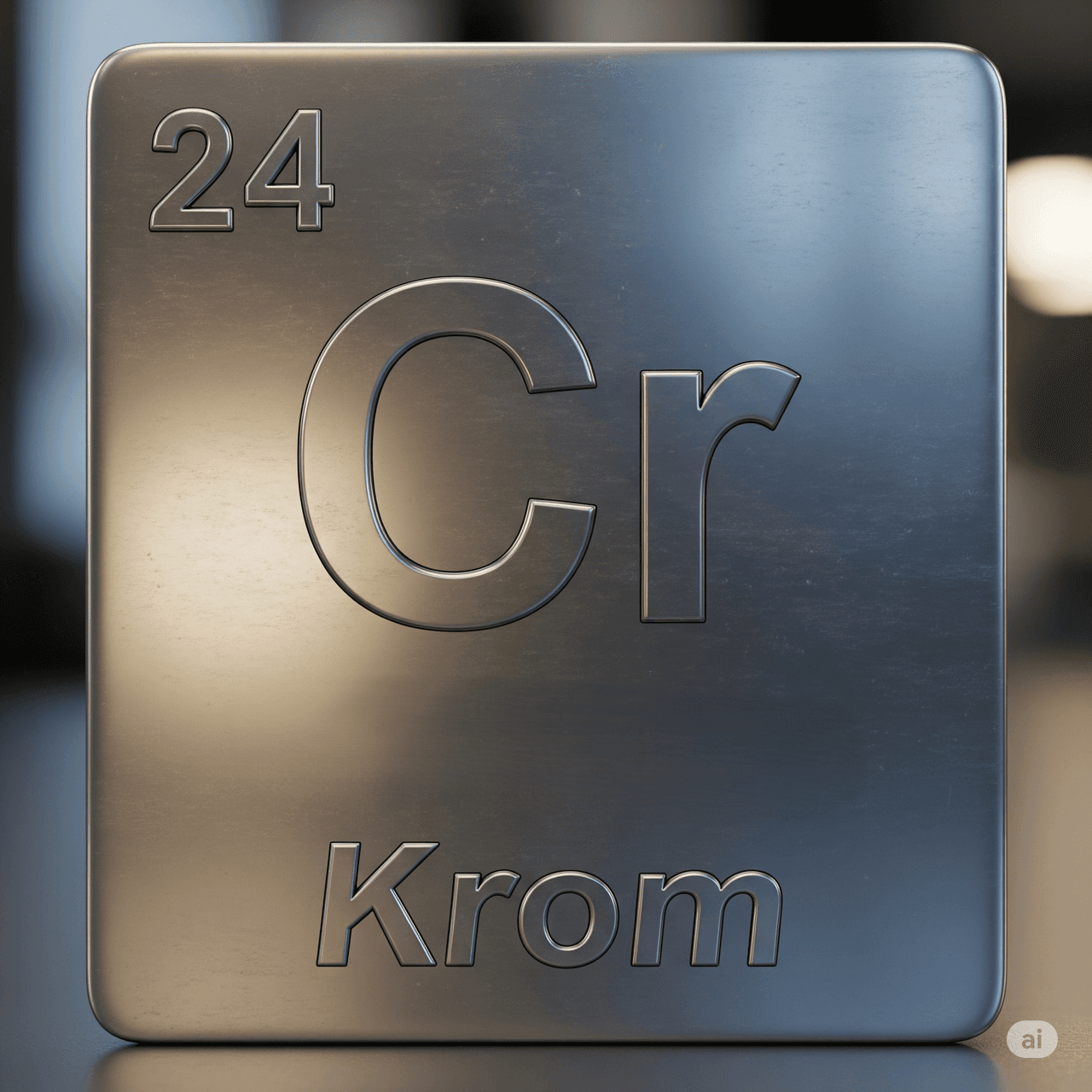
Chromium (Cr) (generated with artificial intelligence)
Group / Period | 6B / 4 | ||||||||
|---|---|---|---|---|---|---|---|---|---|
Element Class | Transition Metal | ||||||||
Electron Configuration | [Ar] 3d⁵ 4s¹ | ||||||||
Crystal Structure | BCC (Body-Centered Cubic) | ||||||||
Melting Point | 1907 °C | ||||||||
Boiling Point | 2671 °C | ||||||||
Electronegativity | 1.66 (Pauling) | ||||||||
Density | 7.15 g/cm³ | ||||||||
Isotopes | ⁵⁴Cr (Stable) ⁵³Cr ⁵²Cr ⁵⁰Cr | ||||||||
Area(s) of Use | Catalyst) Chemical Industry (Oxidizing Coating Pigment Stainless Steel | ||||||||
Chromium is a transition metal with atomic number 24 located in group 6 of the periodic table. This element is recognized for its shiny surface high hardness and resistance to corrosion and plays important roles in both industrial and biological systems. Its name is derived from the Greek word “chroma” meaning color because its compounds exhibit a wide variety of vivid colors. Chromium is indispensable especially in stainless steel production plating technologies and the pigment industry.
Chromium was first discovered in 1797 by the French chemist Nicolas Louis Vauquelin. Vauquelin successfully isolated chromium from the red lead chromate mineral crocoite. This discovery quickly attracted scientific attention due to the striking properties of chromium’s colorful compounds. Vauquelin’s work laid the foundation for understanding the chemical behavior of chromium.
Chromium belongs to the class of transition metals and is a d-block element. With an atomic number of 24 and the symbol Cr its electron configuration is [Ar] 3d⁵ 4s¹. It exists as a solid at room temperature and has a body-centered cubic crystal structure. It is located in the fourth period of the periodic table and exhibits chemical similarities to elements such as manganese and molybdenum.

Representative Image of the Chromium Element (Generated by artificial intelligence.)
Chromium is a silvery white bright and relatively hard metal. It has a hardness of approximately 8.5 on the Mohs scale. Its melting point is around 1907 °C and its boiling point is approximately 2671 °C. Its density is 7.15 g/cm³. Its resistance to high temperatures and oxidation makes it a preferred material in industrial applications. Chromium forms stable compounds primarily in the +3 and +6 oxidation states.
The electronegativity of chromium is 1.66 on the Pauling scale. This value indicates that chromium has a moderate tendency to attract electrons. The most common oxidation states of chromium are Cr³⁺ and Cr⁶⁺. Cr⁶⁺ compounds exhibit strong oxidizing properties while Cr³⁺ compounds are more stable and safer in biological systems. Chromium displays different reactivities in acidic and basic environments which enables its use in various chemical processes.
Chromium has four naturally occurring stable isotopes: ⁵⁰Cr ⁵²Cr ⁵³Cr and ⁵⁴Cr. Among these ⁵²Cr is the most abundant and is widely used in isotopic analyses. Chromium isotopes are evaluated in environmental monitoring and biological tracing studies. Radioactive isotopes do not occur naturally therefore the isotopic composition of chromium is stable.
Chromium is found in nature primarily in the mineral chromite (FeCr₂O₄). This mineral is common in ultrabasic rocks and serpentinite terrains. Chromium compounds include chromium(III) oxide (Cr₂O₃) chromium(VI) oxide (CrO₃) chromates (CrO₄²⁻) and dichromates (Cr₂O₇²⁻). Cr(III) compounds are generally stable and less toxic biologically whereas Cr(VI) compounds pose environmental and health risks. Chromium compounds are used as pigments catalysts and oxidizing agents.
Türkiye holds a significant position globally in terms of chromite deposits. Particularly the ultrabasic rocks around Elazığ Muğla Eskişehir and Bursa are rich in chromite. According to data from the General Directorate of Mineral Research and Exploration (MTA) Türkiye’s chromite ore reserves possess high potential both in quantity and quality. These reserves are of strategic importance for both domestic consumption and export.
Chromium especially in its trivalent form (Cr³⁺) is an essential trace element in human metabolism. It plays a role in glucose metabolism and is defined as a cofactor that enhances the action of insulin. The recommended daily intake is approximately 1 mg. The Cr³⁺ form is used in dietary supplements and some pharmaceutical products while the Cr⁶⁺ form is toxic and carcinogenic and must be carefully controlled in cases of industrial exposure.
Hexavalent chromium compounds (Cr⁶⁺) pose serious environmental toxicity risks. These compounds have been associated with respiratory diseases skin irritation and carcinogenic effects. Uncontrolled release of industrial waste into the environment can lead to chromium contamination of groundwater and agricultural land. Scientific studies have demonstrated that reducing Cr⁶⁺ compounds to the Cr³⁺ form can mitigate environmental risks.
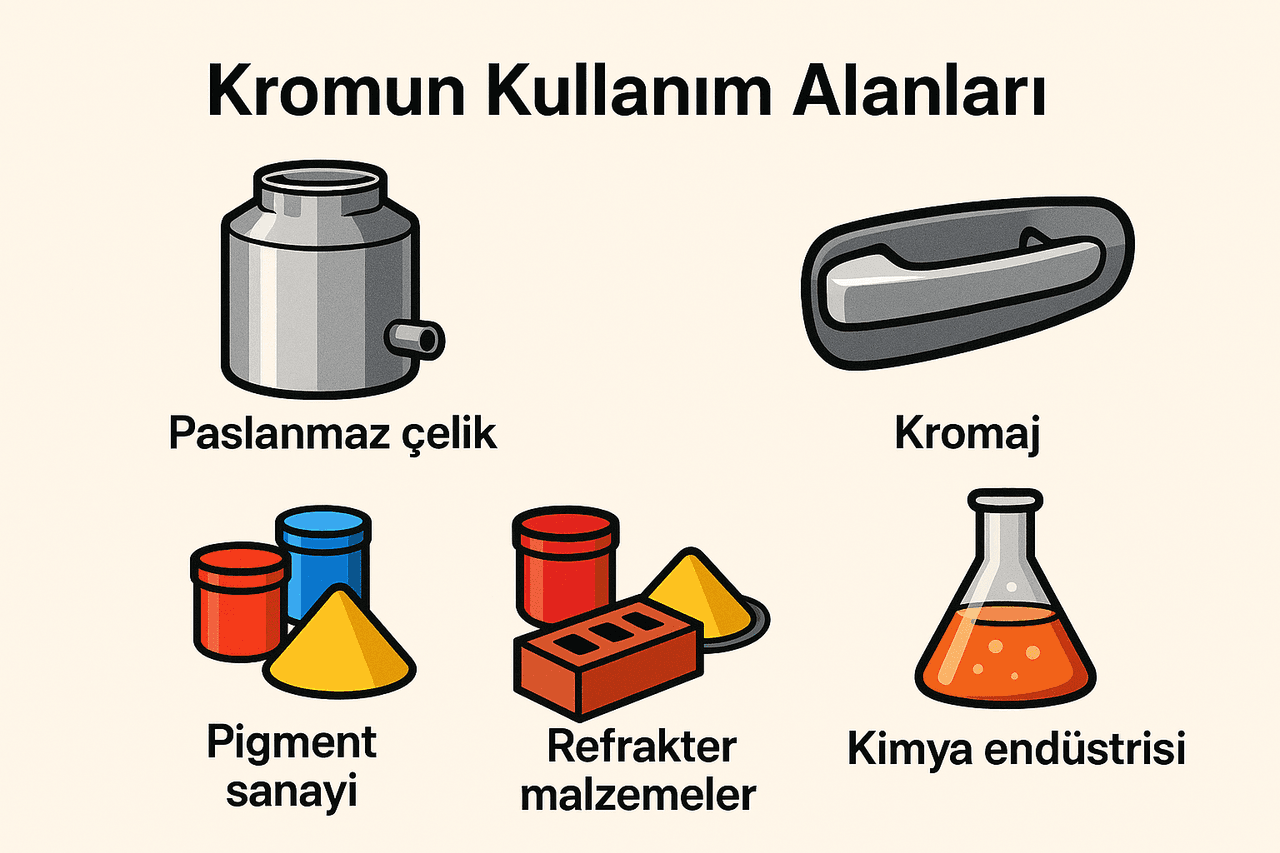
Applications of the Chromium Element (Generated by artificial intelligence.)
The main applications of chromium include stainless steel production chromium plating pigment manufacturing leather tanning and refractory material production. In stainless steel chromium enhances corrosion resistance. Chromium plating provides aesthetic appeal and durability for automotive and decorative metal surfaces. Chromium compounds are used as green red and yellow pigments in the paint and ceramics industries. Chromium salts used in leather tanning impart flexibility and durability to leather; however alternative methods are being developed due to environmental concerns.
In the chemical industry chromium(VI) compounds are valued as strong oxidizing agents. Chromic acid and dichromates are widely used in organic synthesis and laboratory analyses. Additionally chromium compounds play important roles in surface treatment and catalyst production.
Flora, Swaran J.S. “Chapter 29 - Metals.” In *Biomarkers in Toxicology*, 485-519. ScienceDirect, 2014. Accessed August 19, 2025. https://www.sciencedirect.com/science/article/abs/pii/B9780124046306000294.
Langman, Loralie J., and Paul J. Jannetto. “Chapter 52 - Toxicology and the clinical laboratory.” In *Contemporary Practice in Clinical Chemistry (Fourth Edition)*, 917-951. ScienceDirect, 2020. Accessed August 19, 2025. https://www.sciencedirect.com/science/article/abs/pii/B9780128154991000521.
Mineral Research and Exploration General Directorate (MTA). "Krom." Metallic Minerals. Accessed August 19, 2025. https://www.mta.gov.tr/v3.0/metalik-madenler/krom.
PubChem. "Chromium." National Center for Biotechnology Information. Accessed August 19, 2025. https://pubchem.ncbi.nlm.nih.gov/compound/chromium#section=NCI-Thesaurus-Code.
TÜBİTAK Bilim Genç. "Krom." Bilim Genç Periyodik Tablo. Accessed August 19, 2025. https://bilimgenc.tubitak.gov.tr/periyodik-tablo/krom.

Chromium (Cr) (generated with artificial intelligence)
Group / Period | 6B / 4 | ||||||||
|---|---|---|---|---|---|---|---|---|---|
Element Class | Transition Metal | ||||||||
Electron Configuration | [Ar] 3d⁵ 4s¹ | ||||||||
Crystal Structure | BCC (Body-Centered Cubic) | ||||||||
Melting Point | 1907 °C | ||||||||
Boiling Point | 2671 °C | ||||||||
Electronegativity | 1.66 (Pauling) | ||||||||
Density | 7.15 g/cm³ | ||||||||
Isotopes | ⁵⁴Cr (Stable) ⁵³Cr ⁵²Cr ⁵⁰Cr | ||||||||
Area(s) of Use | Catalyst) Chemical Industry (Oxidizing Coating Pigment Stainless Steel | ||||||||
Discovery
Classification and Fundamental Properties
Physical and Chemical Properties
Electronegativity and Reactivity
Isotopes
Natural Occurrence and Compounds
Chromite Deposits and Reserves in Türkiye
Biological Role and Importance to Living Organisms
Environmental and Toxicological Effects
Applications