


This article was automatically translated from the original Turkish version.
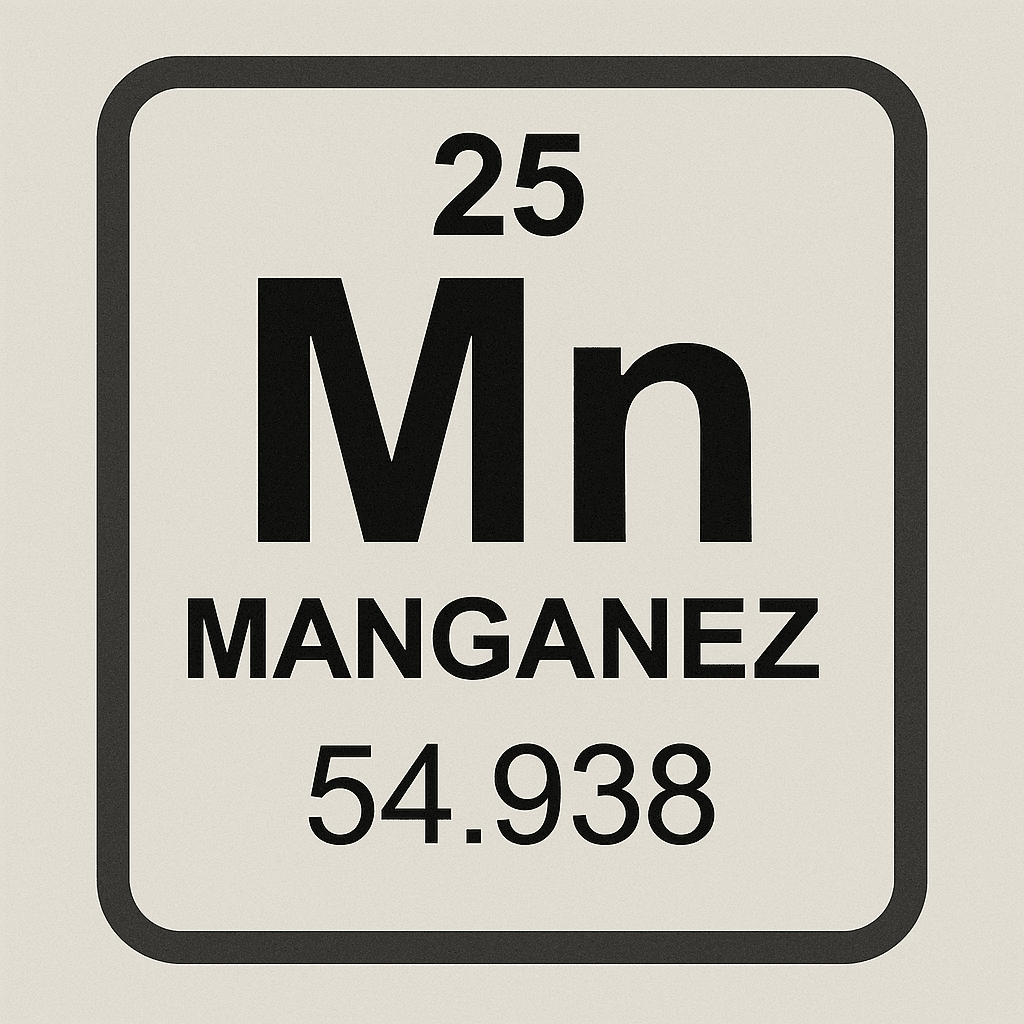
Manganese (Mn) (Generated by Artificial Intelligence.)
Group / Period | 7 / 4 | ||||||||
|---|---|---|---|---|---|---|---|---|---|
Electron Configuration | [Ar] 3d⁵ 4s² | ||||||||
Melting Point | 1246 °C | ||||||||
Boiling Point | 2061 °C | ||||||||
Density | 7.21 g/cm³ | ||||||||
Electronegativity (Pauling) | 1.55 | ||||||||
Applications | Agriculture Chemistry Ceramics Glass Batteries Steel | ||||||||
Oxidation States | +7 +6 +4 +3 +2 | ||||||||
Stable Isotope | 55Mn | ||||||||
Manganese is an element with atomic number 25 and belongs to the transition metals group in the periodic table. This widely occurring metal plays critical roles in both industrial and biological systems. Manganese, with its historical discovery, chemical properties, isotopes, biological functions, and technological applications, merits comprehensive study, particularly due to its prominent use in steel production and energy technologies.
Manganese was isolated in its pure metallic form in 1774 by the Swedish chemist Johan Gottlieb Gahn through the reduction of the mineral pyrolusite. However, manganese minerals had been used since ancient times as decolorizing agents in glass production. This indicates that the element was indirectly recognized and functionally utilized long before its official discovery. Gahn’s work marked a turning point in understanding manganese’s chemical nature and paved the way for its systematic study.
Manganese is a transition metal located in group 7 and period 4 of the periodic table. Its electron configuration is [Ar] 3d⁵ 4s². This structure enables the element to exhibit multiple oxidation states. Manganese shows chemical similarities to iron and is therefore commonly found alongside iron ores. It rarely occurs in nature as a free metal; instead, it is typically found in the form of oxides, carbonates, and hydroxides.

Manganese Element (Generated by Artificial Intelligence.)
Manganese is a brittle, hard, gray-white metal. It has a melting point of 1246 °C and a boiling point of 2061 °C. With a density of 7.21 g/cm³, manganese exhibits stable structural properties at high temperatures. Chemically, it is highly versatile and can form compounds in various oxidation states including +2, +3, +4, +6, and +7. Its most stable compounds are generally found in the +2 and +4 oxidation states. The permanganate ion (MnO₄⁻) in the +7 oxidation state is widely used in the chemical industry as a strong oxidizing agent.
The electronegativity value of manganese is 1.55, indicating that it is a moderately electropositive element. It readily reacts with oxygen in the air to form an oxide layer on its surface. When reacting with acids, it releases hydrogen gas. In higher oxidation states, particularly through permanganate compounds, it exhibits strong oxidizing properties. This reactivity enables manganese to be used in various chemical processes in both industrial and laboratory settings.
The only stable isotope of manganese found in nature is ^55Mn. In addition, several short-lived radioactive isotopes have been synthesized artificially. Notably, the isotope ^54Mn is used as a tracer in environmental monitoring and nuclear science. These isotopes enhance the traceability of manganese and serve as important tools in studies of environmental toxicity.
Manganese constitutes approximately 0.1% of the Earth’s crust. In nature, it is most commonly found in minerals such as pyrolusite (MnO₂), braunite (Mn₂O₃), rhodochrosite (MnCO₃), and manganite (MnOOH). Türkiye possesses a rich potential for manganese deposits, with significant reserves located in the Eastern Anatolia, Black Sea, and Southeastern Anatolia regions. Turkish manganese ores are generally low-grade and therefore require enrichment processes. Industrially, manganese compounds are utilized in oxide, carbonate, and sulfate forms.
Manganese is an essential trace mineral for living organisms. It functions as a cofactor in enzymatic reactions, particularly in the enzyme superoxide dismutase, which plays a role in reducing oxidative stress. Manganese is vital for bone development, immune system function, and carbohydrate metabolism. Deficiency can lead to growth retardation, reproductive disorders, and neurological problems. However, at high doses, it can exhibit toxic effects, leading to a neurotoxic condition known as manganism. Manganism is a disease characterized by Parkinson’s-like symptoms and is particularly prevalent among individuals working in the mining industry.
Manganese is used in numerous industrial sectors, primarily in metallurgy. When alloyed with iron, it enhances the hardness, durability, and wear resistance of steel. In stainless steel production, manganese is considered an alternative to nickel. In battery technology, particularly in lithium-ion and alkaline batteries, manganese oxide compounds serve as active cathode materials. In the glass and ceramics industries, it functions as a decolorizer and pigment. In the chemical industry, permanganate compounds are used as disinfectants and oxidizing agents. Additionally, manganese is employed in agriculture as a fertilizer additive and in water treatment systems as an oxidizing cleaner.
Manganese is recognized as a strategic element. Its critical role in energy storage technologies has positioned it among key minerals. For developing countries such as Türkiye, evaluating manganese deposits holds both economic and technological importance. Global manganese production is led by countries such as South Africa, China, Australia, and Gabon. Assessing Türkiye’s potential in this area is viewed as a strategic objective for enhancing domestic production capacity.
Although manganese is biologically essential at low doses, it can be toxic at high concentrations. Inhaled manganese particles can accumulate in the central nervous system and cause neurological disorders. Manganism, resulting from this toxic accumulation, manifests with symptoms similar to Parkinson’s disease. Therefore, it is of great importance to subject workers exposed to manganese to regular health screenings and implement occupational safety measures.
Eroğlu, Gonca, and Mesut Şahiner. “Üretimden Ticarete Manganez.” *MTA Bülteni*, no. 165 (2022): 405–420. Accessed August 16, 2025. https://bulten.mta.gov.tr/dosyalar/makaleler/405/tr_20221023202432_405_3_92e7ecbb.pdf
National Center for Biotechnology Information. “Manganese, Compound Summary.” *PubChem.* Accessed August 2025.
National Center for Biotechnology Information. “Manganese, Element Profile.” *PubChem.* Accessed August 16, 2025.
TÜBİTAK Bilim Genç. "Manganez." Bilim Genç. Accessed August 16, 2025.
Öztürk, Hüseyin. “Türkiye Manganez Yatakları: Oluşumları ve Tipleri.” *Journal of Multidisciplinary Developments* 2, no. 2 (2022): 45–56. Accessed August 16, 2025.
İstanbul Maden İhracatçıları Birliği (İMİB). *Manganez Yataklarının Durumu, İşletmeciliği ve Geleceği*. Accessed August 16, 2025.

Manganese (Mn) (Generated by Artificial Intelligence.)
Group / Period | 7 / 4 | ||||||||
|---|---|---|---|---|---|---|---|---|---|
Electron Configuration | [Ar] 3d⁵ 4s² | ||||||||
Melting Point | 1246 °C | ||||||||
Boiling Point | 2061 °C | ||||||||
Density | 7.21 g/cm³ | ||||||||
Electronegativity (Pauling) | 1.55 | ||||||||
Applications | Agriculture Chemistry Ceramics Glass Batteries Steel | ||||||||
Oxidation States | +7 +6 +4 +3 +2 | ||||||||
Stable Isotope | 55Mn | ||||||||
Discovery and Historical Background
Classification and Fundamental Properties
Physical and Chemical Properties
Electronegativity and Reactivity
Isotopes
Occurrence in Nature and Compounds
Biological Role and Importance to Living Organisms
Applications
Environmental and Geopolitical Significance
Toxicological Assessment and Occupational Health