

This article was automatically translated from the original Turkish version.
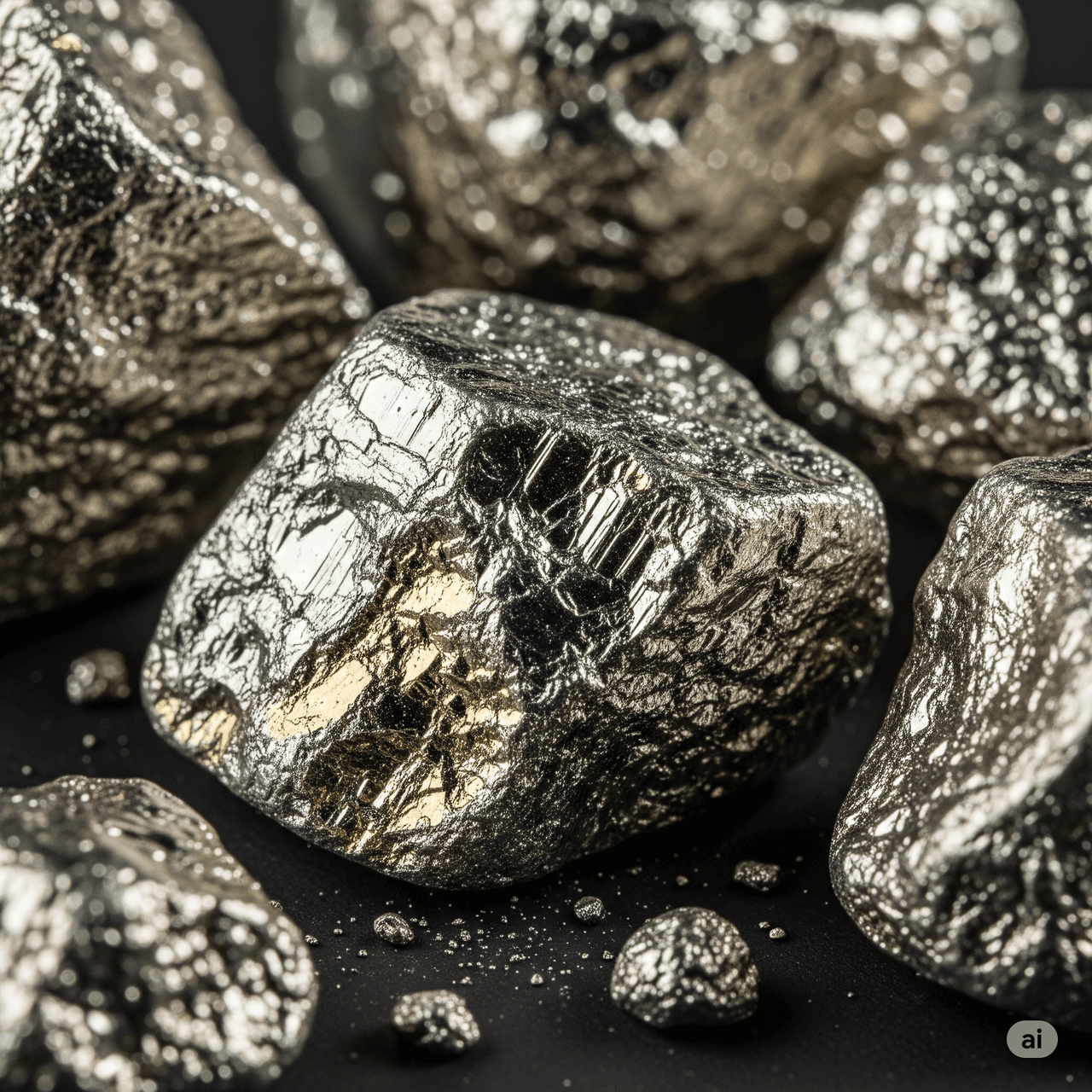
Nickel (Ni) (generated with artificial intelligence)
Atomic Mass | 58.69 g/mol | ||||||||
|---|---|---|---|---|---|---|---|---|---|
Crystal Structure | Face-centered cubic (FCC) | ||||||||
Melting Point | 1455 °C | ||||||||
Boiling Point | 2913 °C | ||||||||
Electronegativity (Pauling) | 1.91 | ||||||||
Isotopes | ^64Ni ^62Ni ^61Ni ^60Ni ^58Ni | ||||||||
Applications | coin alloy glass catalyst batteries electroplating Stainless steel | ||||||||
Class | Transition metal (d-block) | ||||||||
Oxidation States | +4 +3 +2 (most common) | ||||||||
Nickel is one of the transition metals that serve as fundamental building blocks of modern industry. Thanks to its chemical resistance and physical properties, it offers a wide range of applications from alloy technology to biochemical processes. Throughout history, this element, noted for both its natural occurrence and technological applications, is the 28th member of the periodic table.
Nickel was first discovered in 1751 by the Swedish chemist Axel Fredrik Cronstedt. While examining a green mineral called "kupfernickel," he identified a new metal that did not contain arsenic. This discovery led to nickel being recognized as a distinct element. Historically, nickel-containing alloys were mistaken for a non-rusting form of iron and were used by ancient civilizations as if they were silver. In particular, indigenous peoples in Peru used nickel alloys, believing them to be silver, in jewelry and decorative objects.
Nickel (Ni) is a transition metal with an atomic number of 28. It is located in the 4th period and the 10th group of the periodic table and is classified as a d-block element. Its atomic mass is approximately 58.69 g/mol. Its electron configuration is [Ar] 3d⁸ 4s². At room temperature, nickel exists as a solid and belongs to the metal class, typically forming stable compounds in the +2 oxidation state.
Nickel is a silvery-white, hard and malleable metal. Its melting point is 1455 °C and its boiling point is 2913 °C. Its density is 8.90 g/cm³ and its atomic radius is approximately 1.97 Å. When exposed to air, it forms a thin oxide layer on its surface, providing resistance to corrosion.
Nickel has a face-centered cubic (FCC) crystal structure. This arrangement allows metallic bonds to form in a regular and symmetric manner, giving nickel high mechanical strength and malleability. According to PubChem data, single-crystal structures of nickel are represented by various samples accessible through the Crystallography Open Database (COD). These structures are used to detail nickel’s atomic-level organization and coordination geometry.
Nickel has a Pauling electronegativity value of 1.91, making it a moderately electronegative element. Its ionization energies are 737.1 kJ/mol (first), 1753.0 kJ/mol (second), and 3395.3 kJ/mol (third). It dissolves in acidic environments to form nickel salts and reacts with sulfur, oxygen, and halogens to produce various compounds. Nickel(II) ions form important complexes in coordination chemistry.
Natural nickel consists of five stable isotopes: ^58Ni, ^60Ni, ^61Ni, ^62Ni, and ^64Ni. Among these, ^58Ni is the most abundant, constituting approximately 68% of natural nickel. Radioactive isotopes such as ^65Ni have also been identified; these have limited applications in nuclear tracing and research.
Nickel is found in the Earth’s crust at approximately 0.008% and typically occurs in sulfide and oxide minerals. Its most common minerals include pentlandite ((Fe,Ni)_9S_8), garnierit ((Ni,Mg)_3Si_2O_5(OH)_4), and millerite (NiS). Approximately 15% of the world’s nickel is extracted from the Ontario region of Canada, an area enriched in nickel due to a meteorite impact millions of years ago. Nickel is also found in meteorites alongside iron.
Nickel is required in trace amounts by some microorganisms and plants. It plays a role in nitrogen metabolism as a component of the enzyme urease. Although not an essential nutrient for humans, it can be ingested through food, particularly in foods such as dried beans. Excessive nickel exposure can lead to toxic effects; some of its compounds may be carcinogenic when inhaled. Nickel allergy is also a common dermatological reaction.

Applications of the Nickel Element (generated by artificial intelligence.)
The industrial use of nickel is extensive:
Denkhaus, E., and K. Salnikow. “Nickel Essentiality, Toxicity, and Carcinogenicity.” *Toxicology and Applied Pharmacology* 183, no. 1 (2002): 1–14. Accessed August 16, 2025. https://doi.org/10.1006/taap.2001.9310
PubChem. "Nickel." National Center for Biotechnology Information. Accessed August 16, 2025. https://pubchem.ncbi.nlm.nih.gov/compound/nickel
TÜBİTAK Bilim Genç. "Nikel." *Periyodik Tablo*. Accessed August 16, 2025. https://bilimgenc.tubitak.gov.tr/periyodik-tablo/nikel

Nickel (Ni) (generated with artificial intelligence)
Atomic Mass | 58.69 g/mol | ||||||||
|---|---|---|---|---|---|---|---|---|---|
Crystal Structure | Face-centered cubic (FCC) | ||||||||
Melting Point | 1455 °C | ||||||||
Boiling Point | 2913 °C | ||||||||
Electronegativity (Pauling) | 1.91 | ||||||||
Isotopes | ^64Ni ^62Ni ^61Ni ^60Ni ^58Ni | ||||||||
Applications | coin alloy glass catalyst batteries electroplating Stainless steel | ||||||||
Class | Transition metal (d-block) | ||||||||
Oxidation States | +4 +3 +2 (most common) | ||||||||
Discovery
Classification and Fundamental Properties
Physical and Chemical Properties
Crystal Structure and Structural Properties
Electronegativity and Reactivity
Isotopes
Occurrence in Nature and Compounds
Biological Role and Importance to Living Organisms
Applications