


This article was automatically translated from the original Turkish version.
+2 More
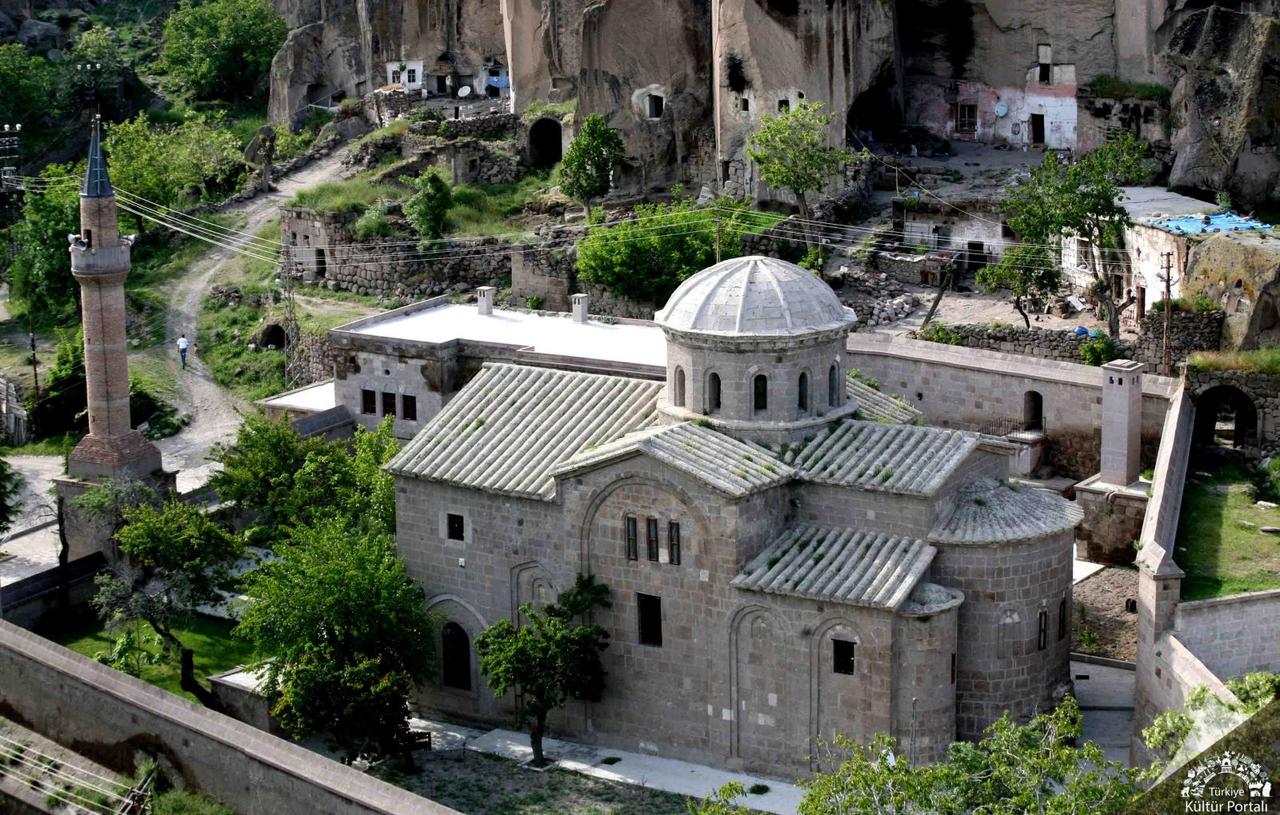
Church Mosque (Church of Saint Gregory)
Location | Güzelyurt Türkiye Aksaray | ||||||||
|---|---|---|---|---|---|---|---|---|---|
Historical Name | Aziz Gregorios Kilisesi | ||||||||
Construction | AD 379–385, Byzantine Emperor Theodosius I | ||||||||
Architectural Type | Originally a closed cross plan; converted to a three-aisle basilica in 1835 | ||||||||
Material(s) | Cut stone wood | ||||||||
Transformation | Converted into a mosque in 1924 | ||||||||
Minaret | The old bell tower was converted in 1924 | ||||||||
Wooden Decorations | Grape clusters, vine leaves, stars, and the Seal of Solomon motifs | ||||||||
Pulpit | Sent by Tsar Nicholas II of Russia | ||||||||
Additional Structures | Chapel, holy spring, guesthouse, oven | ||||||||
Current Use | Mosque open for worship | ||||||||
Distance(s) | 38 km from Aksaray center | ||||||||
Kilise Camii, formerly known as the Church of Saint Gregory, is located in the Güzelyurt district (historically known as Gelveri) of Aksaray Province, Türkiye. Güzelyurt, with its natural and cultural landscape characteristic of the Cappadocia region, provided an ideal environment for monastic life during the early Christian period due to its soft tuff rock formations. In this context, Kilise Camii is one of the medieval structures of the region and dates back to the Byzantine Empire.

Kilise Camii (Türkiye Culture Portal)
Kilise Camii was originally constructed between 379 and 385 AD by Byzantine Emperor Theodosius I in honor of Saint Gregory the Theologian. The building’s purpose was to serve as the center of monastic life in the region and to provide religious education. Under the influence of Saint Gregory, the foundations of the Orthodox faith were established in the area.
Initially built with a closed cross plan, the structure was converted into a three-aisle basilica during renovations carried out in 1835 by the architect Grigorius Madenci of Kelivar. Following the 1924 population exchange between Türkiye and Greece, the building was transformed into a mosque and acquired its current name, Kilise Camii. During this conversion, interior modifications were made: frescoes were covered, and the bell tower was converted into a minaret.
%2520kopya.jpg&w=1280&q=75)
Kilise Camii (Türkiye Culture Portal)
The structure was built using cut stone and follows a three-aisle basilica plan with a large central dome. The western facade contains the main entrance, above which the minaret was added after its conversion into a mosque. The southern facade was aligned as the qibla direction, where the mihrab and minbar were installed.
Lighting is provided by a total of twelve windows. Functional distinctions within the interior were created by the addition of a women’s gallery on the northern wall, accessed by a wooden staircase. The mihrab wall features wooden decorations, inscriptions, and elements from the building’s transformation process. Among these, the Hadith inscription “The Qur’an is beneficial only through knowledge” stands out.
One of the most striking features of the structure is its interior wooden decorations. The wooden panel, originally serving as an iconostasis during its time as a church, was repurposed during its conversion into a mosque to form the mihrab and minbar. Motifs used in the decorations include “bunches of grapes,” “vine leaves,” “botanical star motifs,” “Seal of Solomon,” and “sun/sun-facing” designs, executed using carving, perforation, and appliqué techniques. Coloring was achieved using red pigment derived from the local “cevri” plant, along with green and yellow root dyes.
The minbar panels feature a six-pointed star motif, twisted branches, and spiral columns. It is believed that these wooden panels were sourced from the original iconostasis of the building. The same motifs and techniques are also found on the railings of the women’s gallery.
The bell tower located at the courtyard entrance was converted into a minaret during the mosque transformation. The garden contains a chapel, guesthouse, oven, and an ayazma accessible via a 35-step staircase. Additionally, within the building is a wooden ambon gifted by Russian Tsar Nicholas II. This ambon was mounted above the northwest corner of the women’s gallery. Its decorations differ from other wooden elements, featuring rich botanical motifs.

Staircase to the Ayazma (Türkiye Culture Portal)
%2520kopya%2520logolu.jpg&w=1280&q=75)
Wooden Ambon (Türkiye Culture Portal)
Kilise Camii is currently in active use as a mosque and also attracts domestic and international visitors as a cultural heritage site. Some of the interior frescoes have been covered with plaster for preservation purposes. The building, with its architectural plan, wooden decorations, and transformation history, is a subject of research in the context of early Christian and Turkish-Islamic architecture.
Kilise Camii is located in the center of Güzelyurt district, 38 kilometers from the city center of Aksaray. The region is situated on a landscape of soft tuff rock formations similar to those of Cappadocia. This geological characteristic influenced both the materials used in construction and the architectural approach of the building.
Aksaray Üniversitesi. "Aksaray Güzelyurt Gelveri Kilise Cami Ahşap Bezeme Özellikleri." e-Şehir Aksaray. Accessed May 12, 2025. https://e-sehir.aksaray.edu.tr/2023/05/16/aksaray-guzelyurt-gelveri-kilise-cami-ahsap-bezemeleri/.
Ministry of Culture and Tourism of the Republic of Turkey. “Kilise Camii (Aziz Gregorius Kilisesi).” *Kültür Portalı*. Accessed May 12, 2025. https://www.kulturportali.gov.tr/turkiye/aksaray/gezilecekyer/kilise-cami-aziz-gregorius-kilisesi.

Church Mosque (Church of Saint Gregory)
Location | Güzelyurt Türkiye Aksaray | ||||||||
|---|---|---|---|---|---|---|---|---|---|
Historical Name | Aziz Gregorios Kilisesi | ||||||||
Construction | AD 379–385, Byzantine Emperor Theodosius I | ||||||||
Architectural Type | Originally a closed cross plan; converted to a three-aisle basilica in 1835 | ||||||||
Material(s) | Cut stone wood | ||||||||
Transformation | Converted into a mosque in 1924 | ||||||||
Minaret | The old bell tower was converted in 1924 | ||||||||
Wooden Decorations | Grape clusters, vine leaves, stars, and the Seal of Solomon motifs | ||||||||
Pulpit | Sent by Tsar Nicholas II of Russia | ||||||||
Additional Structures | Chapel, holy spring, guesthouse, oven | ||||||||
Current Use | Mosque open for worship | ||||||||
Distance(s) | 38 km from Aksaray center | ||||||||
No Discussion Added Yet
Start discussion for "Church Mosque (Church of Saint Gregory)" article
History
Architectural Features
Wooden Decorative Elements
Additional Structures and Elements
Conservation and Use
Geographical Location and Access