


This article was automatically translated from the original Turkish version.
+2 More
Location | Nevşehir entrance to Çavuşin Village Avanos | ||||||||
|---|---|---|---|---|---|---|---|---|---|
Period(s) | 964–965 Byzantine period | ||||||||
Founder(s) | Emperor Nikephoros II Phokas | ||||||||
Floors | Two-story; monk cells on the lower level, church on the upper level | ||||||||
Protection | 1985 UNESCO World Heritage Site (within the Cappadocia region) | ||||||||
The Church of Çavuşin is located at the entrance to the village of Çavuşin, which belongs to the Avanos district of Nevşehir, approximately 2.5 kilometers from Göreme along the Göreme-Avanos road. The church, carved directly into the natural rock, is constructed in two levels within the rock formation. The lower level contains monk cells, while the upper level houses the worship space. The original natural staircase leading to the upper level has collapsed, and access is now provided by a later-added iron staircase. The church is a single-nave structure with a barrel vault and three apses. The narthex on the western side has been destroyed.
%2520kopya.jpg&w=1280&q=75)
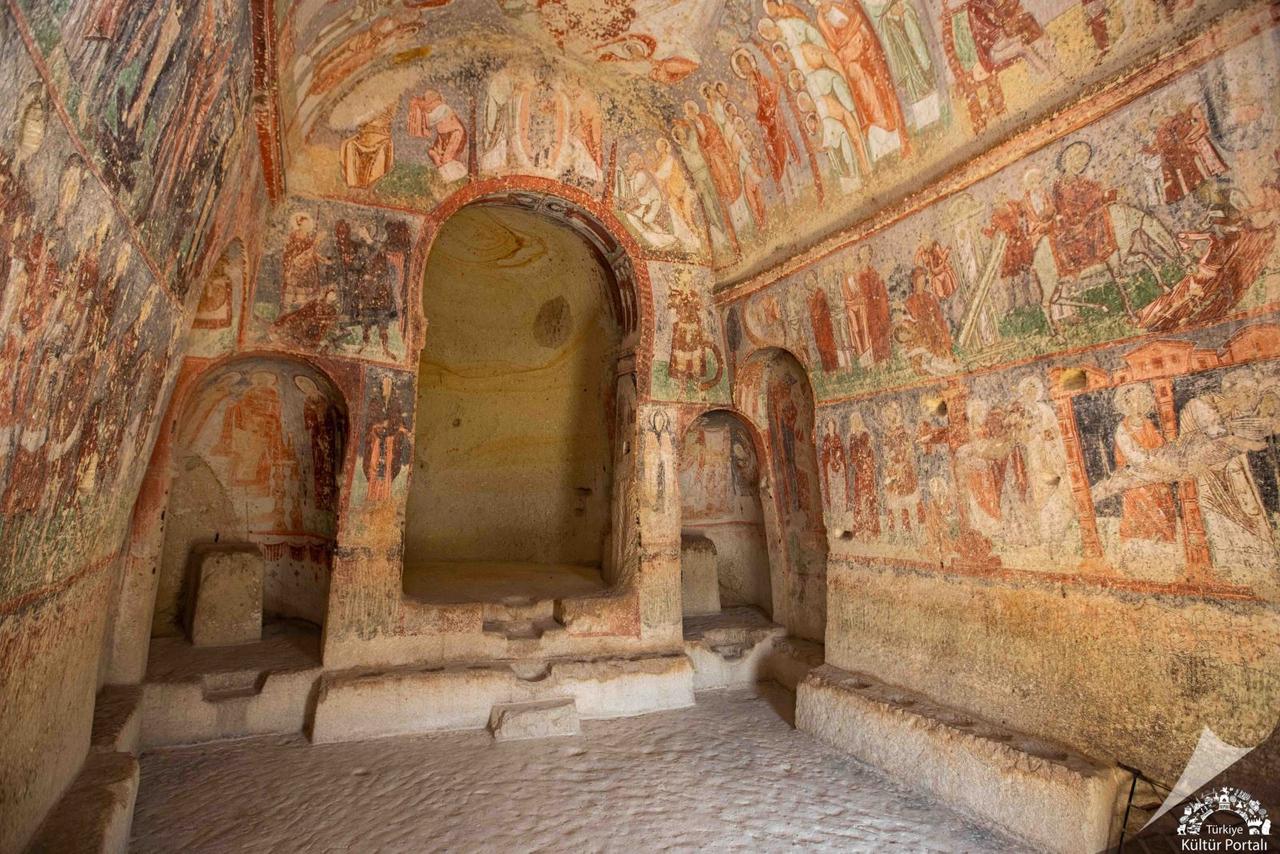
Church of Çavuşin (Türkiye Culture Portal)
The Church of Çavuşin is associated with the Byzantine Emperor Nikephoros II Phokas (reigned 963–969) and dates to the period between 964 and 965 during his reign. It was constructed to honor pious rulers and soldiers who participated in the Cilician campaigns against the Arabs, during which the imperial family frequently stayed in the region. This structure in Cappadocia was inscribed on the UNESCO World Heritage List on December 6, 1985.
The church plan is a near-square rectangle carved into the rock along a northeast-southwest axis. The entrance is situated on the southwest side, slightly off the central axis. The naos is covered by a barrel vault. There are three apses on the eastern side, with the central apse being wider, deeper, and longer than the side apses. The central apse has a circular interior plan and is raised above the naos. Steps lead up to the central apse, making its floor higher than those of the side apses. Seating steps are present within the side apses. The narthex on the western side has been destroyed, and access to the naos is now via an iron staircase.
The interior walls of the church are adorned with figural frescoes depicting biblical scenes related to Christ and the Virgin Mary, Old Testament prophets, Church Fathers, Christian saints, angels, and representations of the emperor and his retinue. Various scenes from the Gospels are painted on the vault and side walls, including the Annunciation, Joseph’s second dream, the Journey to Bethlehem, the Nativity of Christ, the Three Magi, the Flight into Egypt, the Massacre of the Innocents, the Raising of Lazarus, the Transfiguration, the Last Supper, the Betrayal by Judas, the Crucifixion, and the Ascension. Along the central axis of the vault on the western side, portraits of four prophets—Jeremiah, Daniel, Habakkuk, and Amos—are depicted. On the northern wall, beneath the scenes related to Christ, there is a depiction of forty Christian martyrs.
%2520kopya.jpg&w=1280&q=75)
Church of Çavuşin (Türkiye Culture Portal)
In the niche of the northern apse, Emperor Nikephoros II Phokas, his wife Theophano, his father Bardas Phokas, his brother Leo Phokas, and possibly Leo’s wife are depicted together. An inscription within the niche reads: “My God, always protect our pious emperors Nikephoros and Theophano and our despoina.” The figures hold crosses, which allude to the holy crosses brought to Constantinople after Nikephoros’s victory over the Arabs in 965. The imperial portrait establishes a symbolic link between Constantine the Great and Nikephoros, emphasizing Nikephoros’s legitimacy and piety within the framework of Byzantine political ideology.
On the eastern end of the northern wall, Nikephoros’s commanders Melias and possibly John Tzimiskes are depicted on horseback. The inscription was altered after John Tzimiskes became emperor, granting him the title “basileios” (ruler) and calling upon Melias to assist the magistros.
Within the main apse niche, the Patriarch of Constantinople Germanos I, Saint Hypatios, the Patriarch of Constantinople Proklos, Saint Epiphanius, two unidentified Church Fathers, Saint Basil, Emperor Constantine the Great, and his mother Helena are depicted. In the niche at the northeast corner, the Archangel Michael is portrayed; in the southeast corner, the Archangel Gabriel is depicted. At the feet of Michael, two donor figures are shown kneeling, though their identities remain undetermined.
The Church of Çavuşin is one of the most important and securely dated examples of monumental Byzantine wall painting from the 10th century to survive to the present day. The narthex has been destroyed, and access to the interior is now via an iron staircase. Part of the wall paintings has been damaged. The Cappadocia region, in which the church is located, was added to the UNESCO World Heritage List in 1985. Some researchers have suggested that other rock-cut spaces within the same rock massif belonged to a monastery and that imperial patronage played a role in their construction.
Kaya, İlkgül. “Çavuşin (Nikeforos Fokas/Kuşluk/Büyük Güvercinlik) Kilisesi.” Türkiye Turizm Ansiklopedisi. Accessed June 18, 2025. https://turkiyeturizmansiklopedisi.com/cavusin-nikeforos-fokaskuslukbuyuk-guvercinlik-kilisesi
Turkish Museums. "Nevşehir Çavuşin Kilisesi." Turkish Museums. Accessed June 18, 2025. https://www.turkishmuseums.com/museum/detail/2202-nevsehir-cavusin-kilisesi/2202/1
Türkiye Kültür Portalı. "Çavuşin Kilisesi - Nevşehir." T.C. Kültür ve Turizm Bakanlığı. Accessed June 18, 2025. https://www.kulturportali.gov.tr/turkiye/nevsehir/gezilecekyer/cavusin-kilisesi

Location | Nevşehir entrance to Çavuşin Village Avanos | ||||||||
|---|---|---|---|---|---|---|---|---|---|
Period(s) | 964–965 Byzantine period | ||||||||
Founder(s) | Emperor Nikephoros II Phokas | ||||||||
Floors | Two-story; monk cells on the lower level, church on the upper level | ||||||||
Protection | 1985 UNESCO World Heritage Site (within the Cappadocia region) | ||||||||
Historical and Cultural Context
Architectural Features
Wall Paintings and Iconography
Imperial Portraits and Inscriptions
Other Figures and Depictions
Significance and Conservation Status