

This article was automatically translated from the original Turkish version.
+1 More
Location | Göreme Open Air Museum Türkiye Nevşehir | ||||||||
|---|---|---|---|---|---|---|---|---|---|
Date(s) | 11th century | ||||||||
Plan | Rectangle Three Apse | ||||||||
The Church of Saint Basil is located at the entrance of the Göreme Open-Air Museum in the Göreme district of Nevşehir and dates back to the 11th century. It is one of the most important Byzantine-era rock churches in the region.
The structure has a rectangular plan with the nave covered by a transverse barrel vault and three apses. The narthex is divided by columns and contains burial pits believed to belong to the church’s donor and his family.
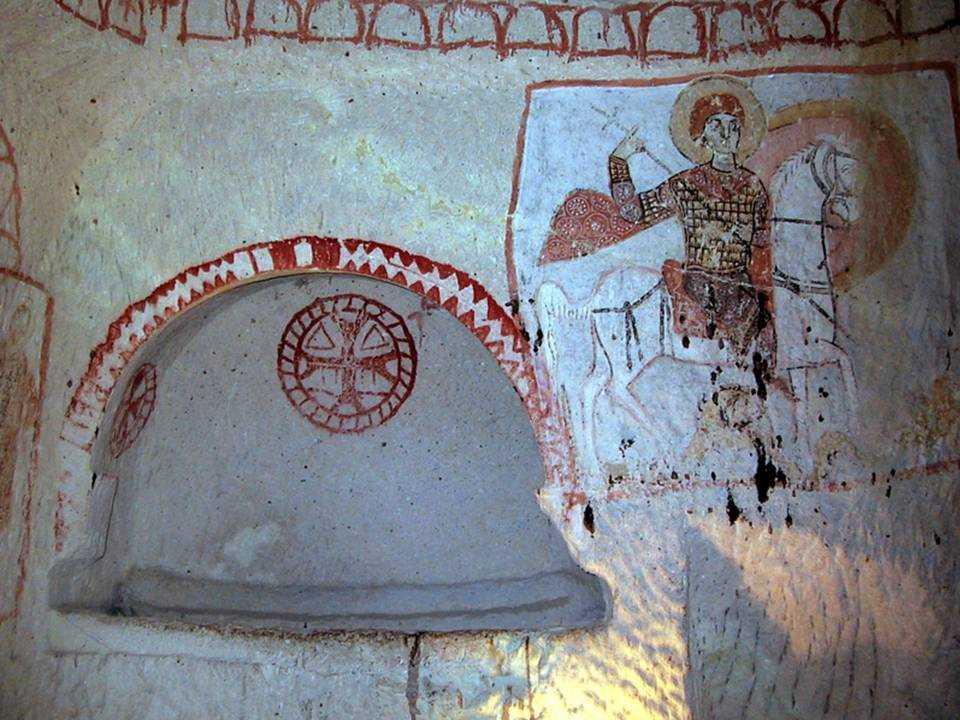
In the tomb niche within the nave, three Maltese crosses are carved into the vault. These symbols are accepted to represent God (the Father), Jesus (the Son), and the Holy Spirit.
The chapel combines geometric decorations incised into the main rock surface using red wash with religious scenes executed in secco technique. In the main apse, figures of Jesus, Mary, and the Child Jesus are depicted; on the north wall, Saint Theodore on horseback; and on the south wall, Saint George battling a dragon, Saint Demetrius, and two female saints.
To prevent natural erosion of the rock mass, the church was covered with stone cladding and coated with hydraulic lime plaster. This method resembles conservation work carried out at the Church of Saint Barbara and the Elmalı Church.
The chapel is dedicated to Saint Basil, a bishop who lived in the 4th century and organized the monastic system in the Cappadocia region. Saint Basil is renowned for his contributions to Christian theology, his monastic rules, and his role in shaping the doctrine of the Holy Trinity (Father, Son, Holy Spirit).
Saint Basil organized monastic life around communal worship, labor, charity, and social solidarity. He transformed monasteries into social centers serving the public good. His rules established a model between eremitic and cenobitic monasticism.
Karacaoğlu, Sıla. "Aziz Basil Şapeli." Türkiye Turizm Ansiklopedisi. Accessed June 24, 2025. https://turkiyeturizmansiklopedisi.com/aziz-basil-sapeli.
Kültür Portalı. "Aziz Basil Şapeli." Accessed June 24, 2025. https://www.kulturportali.gov.tr/turkiye/nevsehir/gezilecekyer/aziz-basil-sapeli

Location | Göreme Open Air Museum Türkiye Nevşehir | ||||||||
|---|---|---|---|---|---|---|---|---|---|
Date(s) | 11th century | ||||||||
Plan | Rectangle Three Apse | ||||||||
No Discussion Added Yet
Start discussion for "Saint Basil the Younger" article
Architectural Features
Tombs and Symbols
Frescoes and Painting Techniques
Conservation and Stabilization Efforts
The Life and Religious Significance of Saint Basil
Contributions to Monastic Life