


This article was automatically translated from the original Turkish version.
+1 More
Location | Göreme Open-Air Museum Türkiye Nevşehir | ||||||||
|---|---|---|---|---|---|---|---|---|---|
History | Second half of the 11th century | ||||||||
Architectural Plan | Cruciform plan, two-column | ||||||||
The church is located behind the rock formation housing the Elmalı Church within the Göreme Open-Air Museum, approximately 10 kilometers from the center of Nevşehir. The structure, carved into a natural rock formation, is considered one of the typical rock churches of Cappadocia.

Chapel of Saint Barbara (Türkiye Culture Portal
Based on its architectural plan, decorative technique and iconographic features, the church is dated to the second half of the 11th century. It is one of the important examples reflecting the development of Byzantine art in Cappadocia.
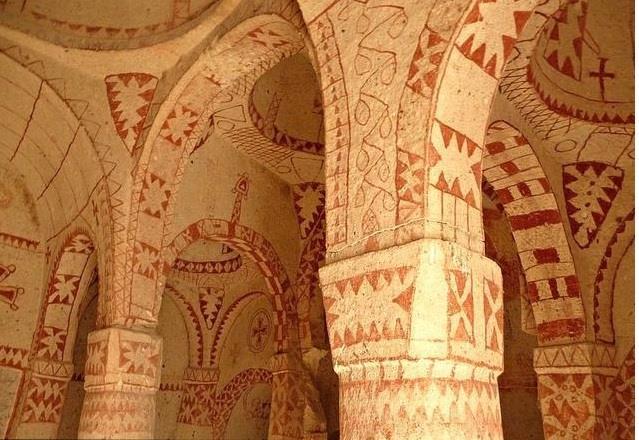
The church has a cross plan with two free-standing columns. The central bay and the eastern arm of the cross, along with the two corner spaces to the east, are covered by domes. The western, northern and southern arms of the cross are covered by barrel vaults. The plan is asymmetrical, with the arms differing in length and width.
There are three apses in total to the east: one large and two smaller ones. The interior spaces of the apses were carved directly from the rock. The main apse served as the liturgical center.
The church’s decorations were applied directly onto the rock surface using red wash paint, distinct from the fresco technique. This linear method was a commonly preferred early decorative style in the region.
The walls and dome surfaces feature geometric patterns (zigzags, crosses, rectangles), mythological animal figures (such as dragons), military symbols and drawings resembling stone textures. These motifs serve not only an aesthetic purpose but also carry symbolic meanings.
In the main apse, the scene of “Christ Pantocrator” (Ruler of the Universe) is depicted. Christ sits on a throne without a back, raising his right hand in blessing and holding a closed book on his left knee. In the northern arm of the cross, a striking scene shows Saint George and Saint Theodore riding white horses and battling a dragon with their lances. These figures are symbolized as protective saints.
The depiction of Saint Barbara, after whom the church is named, is shown life-size, standing and facing forward on the northern wall of the western arm. The martyr’s cross she holds symbolizes her status as a religious martyr. The Greek inscription beside her, “Hagia” (Saint), identifies her. This figure is a key element reflecting the church’s dedication.
Ministry of Culture and Tourism. "Azize Barbara Şapeli." Kültür Portalı. Accessed June 23, 2025. https://www.kulturportali.gov.tr/turkiye/nevsehir/gezilecekyer/azize-barbara-sapeli
Location | Göreme Open-Air Museum Türkiye Nevşehir | ||||||||
|---|---|---|---|---|---|---|---|---|---|
History | Second half of the 11th century | ||||||||
Architectural Plan | Cruciform plan, two-column | ||||||||
No Discussion Added Yet
Start discussion for "Saint Barbara of Şapeli" article
Dating
Architectural Plan
Apses
Decorative Technique
Motifs and Ornamentation
Iconographic Scenes (Main Apse and Northern Arm)
Depiction of Saint Barbara (Western Arm)