


This article was automatically translated from the original Turkish version.
+2 More
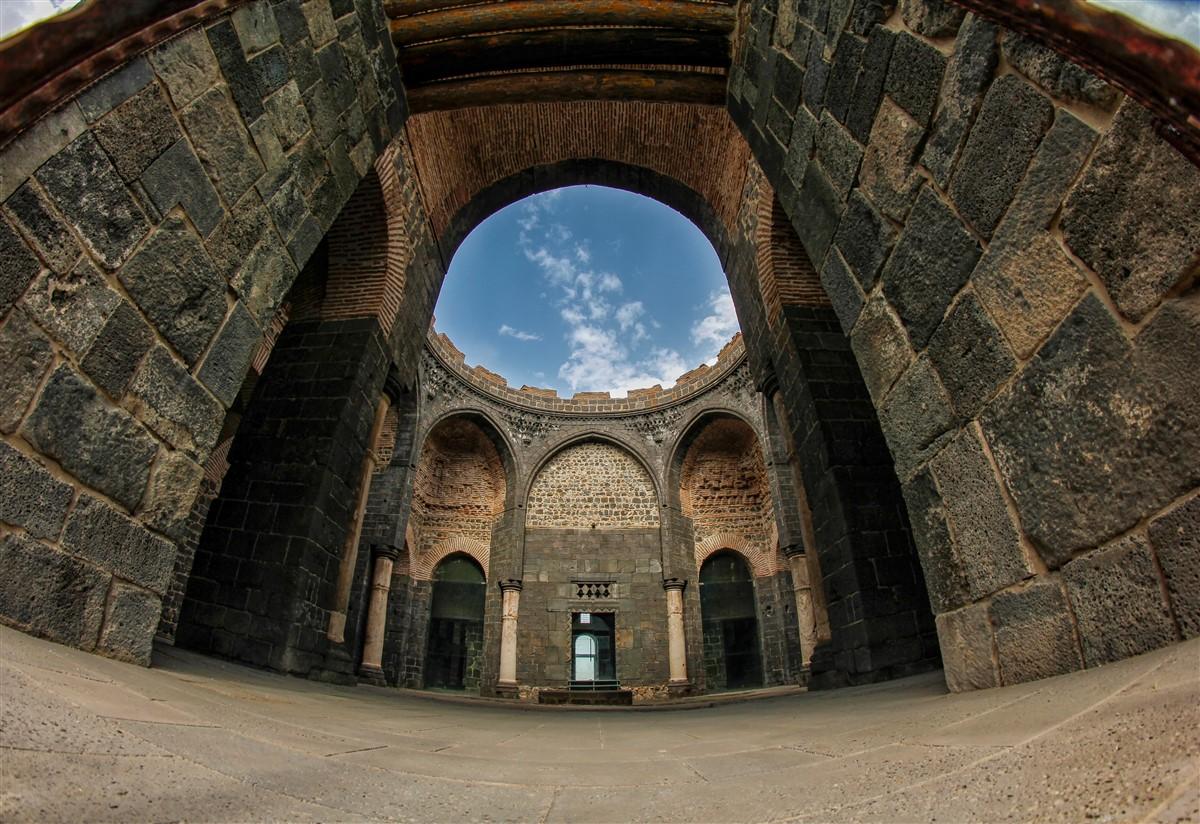
Saint George Church
Other Name(s) | Kara Papaz Church Mar Gevargis | ||||||||
|---|---|---|---|---|---|---|---|---|---|
Location | Cevat Paşa Neighborhood Diyarbakır Sur District İçkale Site | ||||||||
Registration Date | 19.01.1980 | ||||||||
Registration Decision | Board for the Protection of Cultural and Natural Heritage / 2082-A | ||||||||
Architectural Style(s) | Early Christian-Roman period Basilical plan | ||||||||
Materials Used | Basalt stone, rubble stone, brick | ||||||||
Plan Type | Three-aisled, basilical plan | ||||||||
Original Function | Church | ||||||||
Subsequent Functions | Madrasa, bathhouse, armory, storage | ||||||||
Restoration | 2015, Ministry of Culture and Tourism | ||||||||
Saint George Kilisesi is a registered cultural heritage site located within the İçkale settlement, in the Cevat Paşa neighborhood of the Sur district, Diyarbakır Province. This church, situated among the monumental structures of Diyarbakır—a city bearing traces of multiple civilizations—represents a significant example of early Christian architecture in terms of its structural characteristics and historical development.

Saint George Kilisesi (Republic of Türkiye, Diyarbakır Governorship)
The exact construction date of the building is unknown; however, based on its architectural features and the materials used in its construction, it is dated to the 2nd or 3rd century CE. Originally conceived as a civil structure from the Roman period, it was later converted into a church and acquired a religious function during periods when Christianity became more prominent in the region.
Over time, the building served various purposes in different eras. It underwent repairs in 518 CE as part of the urban development initiatives undertaken by the Eastern Roman Emperor Anastasius. During the Artuklid and Seljuk periods, a domed extension was added to its western facade. Although some scholars suggest this addition was designed as a bathhouse, the absence of key elements typical of classical bath layouts—such as changing rooms, hypocausts, and water systems—leads to the prevailing view that it was primarily used as a madrasa. In the Ottoman period, the structure was utilized as an armory and storage facility. After the 18th century, it suffered significant damage and lost its original roof. During the Republican period, the roof was reconstructed with an octagonal conical tile covering, and the building began to serve as an art gallery.
Saint George Kilisesi is a three-aisled basilical structure with approximate plan dimensions of 9.04 by 11.97 meters, forming a near-square rectangle. The building extends along an east-west axis, with its central nave covered by an elliptical dome. The aisles are separated by two rows of four columns each, with circular arches resting on the capitals of the columns and connecting to the side walls and other piers to create spatial continuity. The arches dividing the central nave are raised higher, while the side arches begin at the level of the column capitals.
The eastern end features a main apse flanked by two smaller apses (apsidiols). Additionally, two small rectangular pastophoria chambers are located in this section. The side aisles, covered by barrel vaults, are narrow, emphasizing the dominant form of the central nave. The structural system employs basalt stones, rubble stones, and bricks.

Saint George Kilisesi (Republic of Türkiye Diyarbakır Governorate)
A square-plan addition was appended to the western facade during the Artuklid period. This section, connected by pointed arches supported by eight piers, has lost its original roof. Various interpretations exist regarding its function, with structural evidence suggesting possible use as a bathhouse or madrasa during that era.
The building was officially registered as a protected cultural heritage site on 19 January 1980 by the Council for the Protection of Cultural and Natural Heritage and placed under the protection of the General Directorate of Foundations. Following restoration work completed in 2015 by the Ministry of Culture and Tourism, the structure acquired its current function as an art gallery.
Situated within the Diyarbakır City Walls, which are listed on UNESCO’s Tentative World Cultural Heritage List, Saint George Kilisesi is located in the northeast corner of İçkale and continues to fulfill its cultural role as an art gallery. Through its successive functional transformations, the building stands as an important architectural witness to the historical continuity of the region.
Baytak, İsmail. “Saint George Kilisesi.” Türkiye Turizm Ansiklopedisi. Accessed May 28, 2025. https://turkiyeturizmansiklopedisi.com/saint-george-kilisesi.
T.C. Diyarbakır Valiliği. "Saint George Kilisesi." Accessed May 28, 2025. http://www.diyarbakir.gov.tr/saint-george-kilisesi.
T.C. Ministry of Culture and Tourism. "Saint George Kilisesi." *Kültür Portalı*. Accessed May 28, 2025. https://www.kulturportali.gov.tr/turkiye/diyarbakir/gezilecekyer/saint-george-klses.

Saint George Church
Other Name(s) | Kara Papaz Church Mar Gevargis | ||||||||
|---|---|---|---|---|---|---|---|---|---|
Location | Cevat Paşa Neighborhood Diyarbakır Sur District İçkale Site | ||||||||
Registration Date | 19.01.1980 | ||||||||
Registration Decision | Board for the Protection of Cultural and Natural Heritage / 2082-A | ||||||||
Architectural Style(s) | Early Christian-Roman period Basilical plan | ||||||||
Materials Used | Basalt stone, rubble stone, brick | ||||||||
Plan Type | Three-aisled, basilical plan | ||||||||
Original Function | Church | ||||||||
Subsequent Functions | Madrasa, bathhouse, armory, storage | ||||||||
Restoration | 2015, Ministry of Culture and Tourism | ||||||||
No Discussion Added Yet
Start discussion for "Saint George Church" article
Historical Process and Functional Transformations
Architectural Features
Later Additions and Restoration
Current Condition