


This article was automatically translated from the original Turkish version.
+2 More
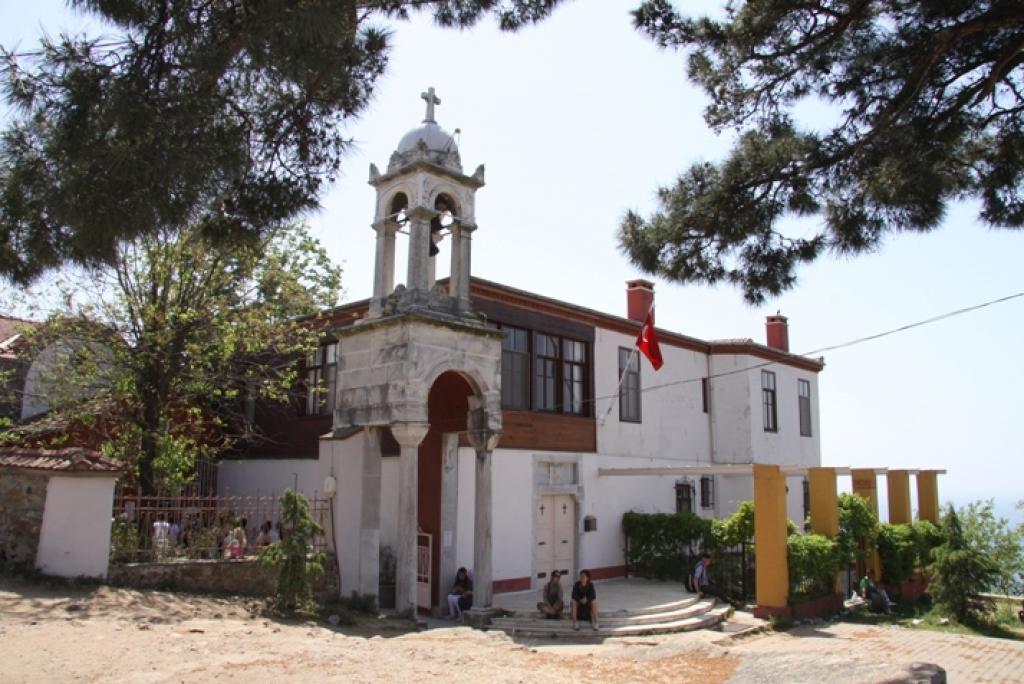
Church of Saint George
Other Name(s) | Ayios Georgios Monastery Ayios Georgios Kuduna Monastery | ||||||||
|---|---|---|---|---|---|---|---|---|---|
Type(s) | Orthodox Church | ||||||||
Location | Büyükada Türkiye Istanbul Adalar | ||||||||
Elevation(s) | 202 metres | ||||||||
Foundation Date | 963 (original construction) / 1906 (current structure) | ||||||||
Architectural Style(s) | Byzantine-influenced Orthodox architecture | ||||||||
Aya Yorgi Kilisesi is located at the highest point of Büyükada, part of Istanbul’s Adalar district (202 m), place. Greek is a multilayered religious, cultural and social Orthodox monastery complex. Built in 1906, church has served for centuries as a place of pilgrimage and prayer for both Christian and Muslim communities, important a Hajj. The church is known for annual pilgrimages involving thousands of visitors on 23 April and 24 September, April and September respectively.
According to legend, the church was built in 963 during the reign of Byzantine Emperor Nikephoros II Phokas. It was destroyed during the Crusade of 1204 or the Venetian attack of 1302, and its icons were buried and hidden. Centuries later, after a shepherd saw Aya Yorgi in a dream, sacred the icon reemerged and this event led to the revival of the monastery.
The current stone church was constructed to replace the older structure damaged in the 1894 Istanbul earthquake. Construction began in 1901 under the initiative of Patriarch Constantine V of the Rum Orthodox Church. The building was completed in 1906, consecrated in 1908, and the bell tower was added in 1909. This building forms part of the historic original church and monastery complex.
Aya Yorgi Kilisesi exhibits characteristics of traditional Byzantine-influenced Orthodox architecture.
Aya Yorgi Kilisesi is dedicated to Saint George (Aya Yorgi), a significant figure in Christianity. Saint George, through narratives symbolizing his battle with the dragon, appears in both Christian and Muslim people traditions, entering Islamic culture under the name Cercis Nebi.
Every year on 23 April (Saint George’s Day) and 24 September (Aya Thekla’s Day), both domestic locals and tourists climb the Aya Yorgi Yokuşu to make petitions and prayer. This tradition has evolved over time into a pilgrimage tradition, becoming a shared practice among Rum, Armenian, Syriac, Georgian, Moldovan, and Iraqi migrants, as well as secular Muslim women, common.
The church has become a symbolic space where different faith groups converge in their search for healing, hope and inner peace. Visitors worship according to their own beliefs by drinking from the holy spring, leaving notes in prayer boxes, or praying silently. In this way, Aya Yorgi stands as a living example of Istanbul’s pluralistic and multicultural religious life.
In the Modern period, Aya Yorgi has become not only a religious site but also a reflection of cultural, social and individual identity quests. It is a shared experience space where Christian adherents of various denominations, Muslim migrants and secular individuals freely express their personal beliefs.
Aya Yorgi Kilisesi is located at the summit of Büyükada, on Aya Yorgi Tepesi. Visitors can reach Büyükada by ferry or motorboat from the piers of Bostancı, Kadıköy, Eminönü and Beşiktaş in Istanbul, like via movement city lines.
The walk begins at the pier square and proceeds through the interior of the island to Lunapark Meydanı. From there, a steep approximately one-kilometer ascent known as the Aya Yorgi Yokuşu leads to the church.
The church is open year-round and experiences heavy visitor traffic especially on 23 April (Saint George’s Day) and 24 September (Aya Thekla’s Day). On these special days, tens of thousands of pilgrims climb the hill to reach the church. On regular days, the church is generally open until 16:00, but on Wednesdays it is closed to external visitors due to services held between 09:00 and 12:15. Entry is free, but appropriate attire and respect for silence are expected.
"Aya Yorgi Kilisesi." Büyükada.com.tr. Accessed April 22, 2025. https://buyukada.com.tr/tarihi-yerler/buyukada-aya-yorgi-kilisesi/.
"Aya Yorgi Kuduna Manastır Kilisesi." *Adalar Miras*. Accessed April 22, 2025. https://adalarmiras.com/detay/1/aya-yorgi-kuduna-manastir-kilisesi.
"Aya Yorgi Rum Manastırı - Yücetepe." Adalar Belediyesi. Accessed April 22, 2025. https://adalar.bel.tr/aya-yorgi-rum-manastiri-yucetepe/.
Aykıt, Dursun Ali. "Aya Yorgi Kilisesi ve Manastırı Üzerine Bir İnceleme." C.Ü. İlahiyat Fakültesi Dergisi 17, no. 1 (2013): 119-134. Accessed April 22, 2025. https://dergipark.org.tr/en/download/article-file/220954.
Diktaş, Mustafa. "Aya Yorgi of Büyükada: A Shared Pilgrimage-Shrine in Modern Turkey." *Net Journal of Social Sciences* 8, no. 1 (2020): 12–20. Accessed April 22, 2025. https://www.researchgate.net/profile/Mustafa-Diktas/publication/339096536_Aya_Yorgi_of_Buyukada_A_shared_pilgrimage-shrine_in_modern_Turkey/links/5f04454e458515505091bc1f/Aya-Yorgi-of-Bueyuekada-A-shared-pilgrimage-shrine-in-modern-Turkey.pdf

Church of Saint George
Other Name(s) | Ayios Georgios Monastery Ayios Georgios Kuduna Monastery | ||||||||
|---|---|---|---|---|---|---|---|---|---|
Type(s) | Orthodox Church | ||||||||
Location | Büyükada Türkiye Istanbul Adalar | ||||||||
Elevation(s) | 202 metres | ||||||||
Foundation Date | 963 (original construction) / 1906 (current structure) | ||||||||
Architectural Style(s) | Byzantine-influenced Orthodox architecture | ||||||||
No Discussion Added Yet
Start discussion for "Church of Saint George" article
History and Legendary Origins
Architectural Features
Religious and Cultural Significance
Pilgrimage Rituals and Belief Practices
Sociological and Social Dimension
Access and Visit Information