

This article was automatically translated from the original Turkish version.
+2 More
Church of Saint Pierre
Location | Antakya Türkiye Hatay | ||||||||
|---|---|---|---|---|---|---|---|---|---|
Geographical Feature | western slope of Habib Neccar Mountain | ||||||||
Building Type | rock-cut church / natural cave church | ||||||||
Period(s) | Early Christian period | ||||||||
Church of Saint Peter (Aziz Petrus Kilisesi) is located within the boundaries of the Antakya district in Hatay Province, in southern Türkiye. Built into a natural cave on the western slope of Mount Habib Neccar, along the Antakya-Reyhanlı road, the structure was carved directly into the rock.

Church of Saint Peter(Culture Portal)
The church holds a significant place in Christian history and has deep roots dating back to the early Christian period. It is believed that Saint Peter preached in this cave during the spread of Christianity. The church is regarded as one of the earliest Christian churches and was declared a pilgrimage site by Pope Paul VI in 1963.
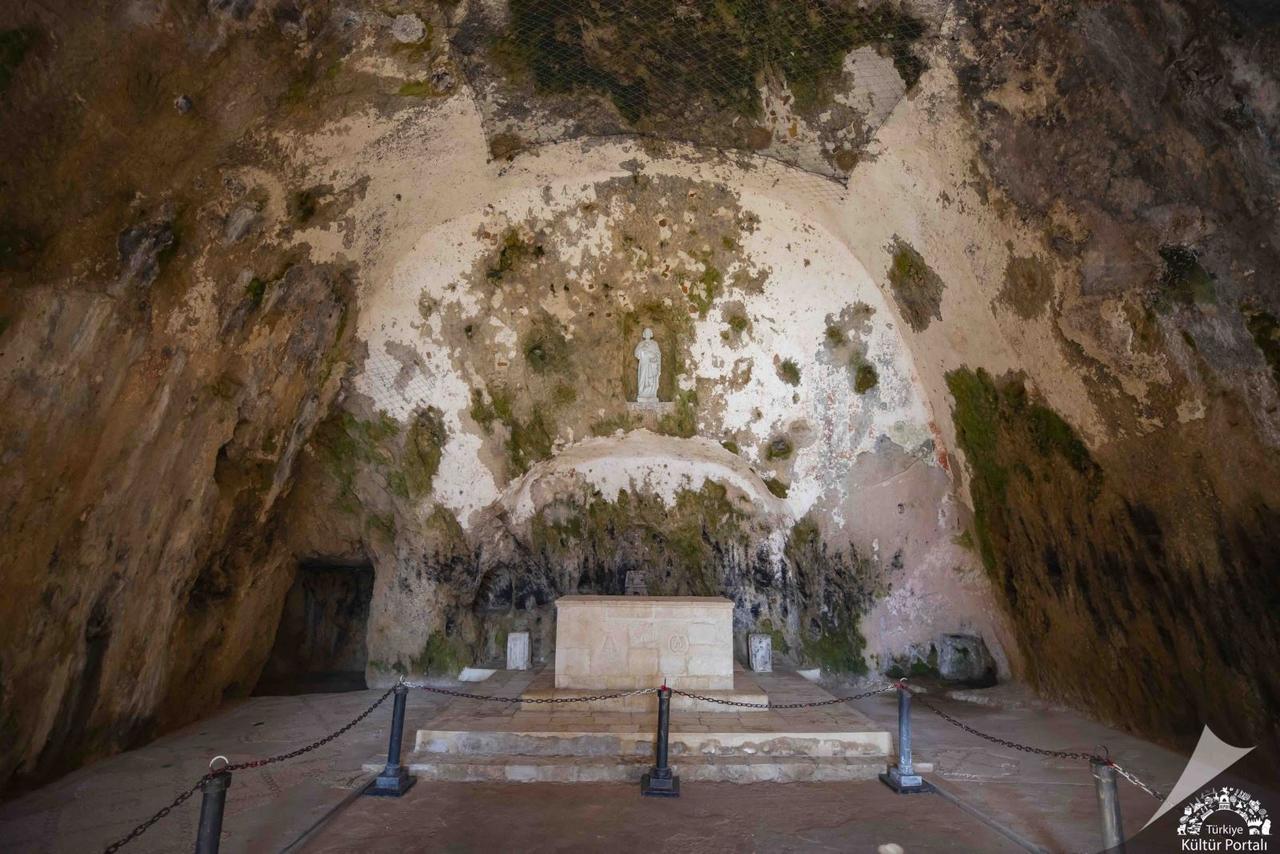
The church was created by expanding a natural cave, with its interior carved directly into the rock. Inside the structure, there is an apse, a staircase leading to the altar, and a baptistry. Wall decorations and remnants bear traces of the early Christian period. The church’s entrance gate and surrounding structures have been restored in various historical periods. The current façade was designed by Capuchin friars in the 19th century.

Church of Saint Peter(Culture Portal)
The Church of Saint Peter is an important structure both historically and archaeologically. In 1983, it was officially declared a “Monument Museum” by a decision of the Council of Ministers. Excavations conducted inside and around the building have uncovered artifacts from the early Christian period. Beyond its religious function, the church also holds cultural and touristic significance.
The Church of Saint Peter is under protection by the Ministry of Culture and Tourism. Its natural and historical structure has been preserved through various restoration efforts over time. Open to visitors, the church attracts both local and foreign tourists as well as pilgrims.
Directorate General of Cultural Heritage and Museums. "Hatay St.Pierre Kilisesi." Accessed June 20, 2025. https://kvmgm.ktb.gov.tr/TR-44421/hatay-st-pierre-kilisesi-hatay.html.
Ministry of Culture and Tourism. "Saint Pierre Kilisesi." *Kültür Portalı*. Accessed June 20, 2025. https://www.kulturportali.gov.tr/turkiye/hatay/gezilecekyer/saint-pierre-kilisesi.

Church of Saint Pierre
Location | Antakya Türkiye Hatay | ||||||||
|---|---|---|---|---|---|---|---|---|---|
Geographical Feature | western slope of Habib Neccar Mountain | ||||||||
Building Type | rock-cut church / natural cave church | ||||||||
Period(s) | Early Christian period | ||||||||
No Discussion Added Yet
Start discussion for "Church of Saint Pierre" article
History
Architectural Features
Archaeological and Cultural Value
Conservation and Current Status