

This article was automatically translated from the original Turkish version.
Weight(s) | 17–33 g | ||||||||
|---|---|---|---|---|---|---|---|---|---|
Family | Fringillidae | ||||||||
Conservation Status | LC (Low Risk) | ||||||||
Incubation Period | 11–14 days | ||||||||
Wingspan | 24–26 cm | ||||||||
Genus | 13–15 cm | ||||||||
Class | Aves | ||||||||
Realm | Animalia | ||||||||
Egg Count | 4–6 | ||||||||
Order | Chordata | ||||||||
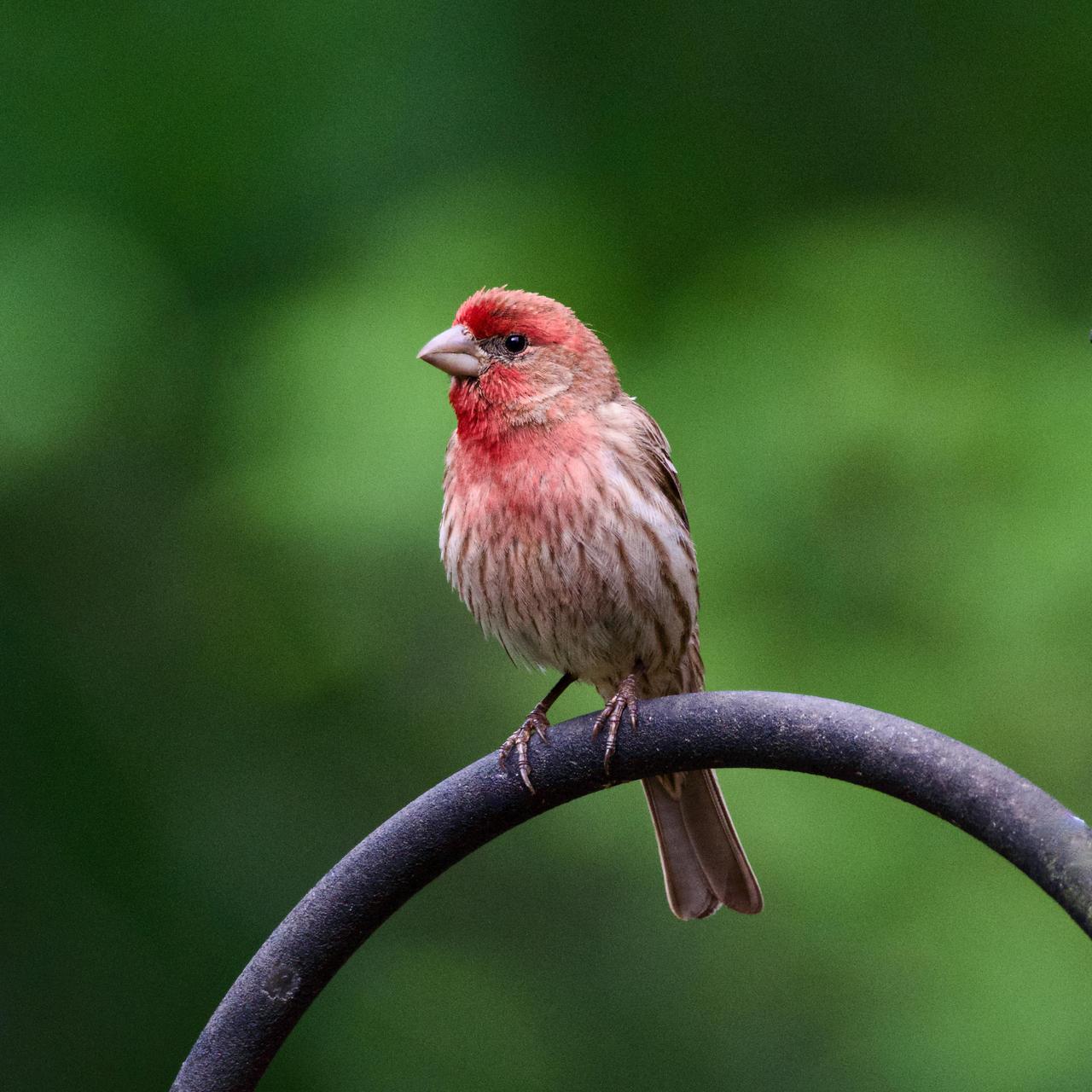
Crimson-winged Finch (Carpodacus erythrinus) is a medium-sized sparrow of the Fringillidae family, distinguished by its thick, short bill. It measures 13–15 cm in length and weighs approximately 17–33 g. The species is identified by its rounded head, relatively large and swollen-looking bill, and notched (slightly forked) tail.
The Crimson-winged Finch (Carpodacus erythrinus) is a species within the Fringillidae family. It was first described by Pallas in 1770 under the name Erythrina erythrina. However, in current classification it is placed within the genus Carpodacus.
Five subspecies have been recognized based on geographic variation: Carpodacus erythrinus erythrinus, Carpodacus erythrinus grebnitskii, Carpodacus erythrinus kubanensis, Carpodacus erythrinus ferghanensis and Carpodacus erythrinus roseatus. The main differences among these subspecies relate to the intensity and distribution of red plumage.
The Crimson-winged Finch (Carpodacus erythrinus) is a medium-sized sparrow measuring 13–15 cm in length and weighing approximately 17–33 g. Its wingspan is about 24–26 cm. The species is recognized by its short, robust bill, rounded head, and slightly forked tail. The bill is dark gray, gray-brown or olive-toned. Legs are brownish or pinkish-brown.
In males, a bright red patch extends from the forehead to the nape. Cheeks and ear coverts are brownish or reddish-brown, while the upperparts are generally brown. The back and rump show coloration ranging from pink to deep red. Wings are dark brown with pale tips on the median and greater coverts, forming two distinct wing bars. The tail is dark brown with pale edges. The underparts may show red or pinkish tones on the breast. The belly and undertail coverts are paler, whitish in color.
Females lack the bright red plumage. The head and upperparts are pale olive-brown with fine dark streaks. The face appears paler and some individuals show a faint pale eyebrow stripe. Wings are dark brown with pale edges and clearly defined double wing bars. The underparts vary from dirty white to pale brown and are marked with fine dark streaks.
Juveniles resemble females in overall appearance but exhibit more pronounced brownish tones on the head and face. The upperparts are more heavily streaked and the underparts are darker and more distinctly streaked. In young males, red plumage gradually develops on the head, breast and rump with age, becoming clearly visible by the end of the second summer.
The Crimson-winged Finch (Carpodacus erythrinus) has a wide Palaearctic distribution extending from Europe to Kamchatka. The species breeds across northern, central and eastern Europe and much of northern Asia. Its range extends from Portugal, Finland, Pomerania and Mecklenburg in the west to Siberia, Kamchatka, the Bering Sea region and Japan in the east. It is also found in the Caucasus, northern Iran, Afghanistan, Tibet, the western Himalayas, China and Central Asia.
The species is migratory. During winter it migrates southward to southern Iran, India, Nepal, Bhutan, Burma, Southeast Asia, northern Vietnam, Thailand and southern China. In Türkiye it is found in the Black Sea coastal region, the northwestern Marmara region, northern Central Anatolia, Eastern Anatolia and Southeastern Anatolia.
The Crimson-winged Finch inhabits a variety of habitats ranging from lowlands to high mountain areas. It occurs in moist forests, shrublands, riverbanks, willow thickets, alder groves, poplar stands, forest clearings, reedbeds, grasslands, gardens and the edges of agricultural fields. It is also found around oak, birch, fir, spruce and aspen forests. The species particularly favors moist and open habitats near watercourses.
In mountainous regions it lives in shrublands near the tree line, in dwarf willow communities and juniper thickets. In Europe it typically breeds below 200 m elevation, while in Central Asia it can reach 2500–3700 m and in the Himalayas up to 4550 m.
The Crimson-winged Finch is a shy species. It moves through low shrubs and wooded areas, hopping on the ground and perching at various levels in trees. During the breeding season it is usually seen alone or in pairs. However, during migration it may form small flocks. Most migration occurs at night, although daytime movements are also observed during spring migration.
Populations leave breeding areas from late summer to autumn and move southward and southeastward. They return to breeding grounds between late April and early June. During migration they roost in reedbeds, shrublands, coastal forests, gardens and agricultural fields.
Song behavior is prominent in this species. Males within the same local population often use similar song types. The song consists of a combination of different resonances, and individuals use these songs to establish territorial boundaries. The call is described as a rising, distinctive “shviih”, “too-ee” or “uueet”.
The Crimson-winged Finch (Carpodacus erythrinus) is primarily herbivorous. Its diet consists mainly of seeds, buds, shoots and fruits of various plants. It has also been observed feeding on nectar from flowers. During summer it feeds mostly on seeds, but also consumes insects, larvae and other arthropods. It also eats grains, grasses, reeds, millet and bamboo seeds.
The species forages both on the ground and on trees and shrubs. It hops along the ground and feeds in grasslands, low vegetation, shrubs and at various levels in trees. It removes the outer parts of buds and fruits to consume the soft inner tissues. It has also been recorded feeding on salty soils around wall mortar and animal shelters as a mineral source.
The breeding season of the Crimson-winged Finch generally occurs between May and August, with one brood per year. Males arrive at breeding grounds before females and establish territories through song.
The nest is built by the female and is a loose cup-shaped structure made of fine twigs, dry grass, reeds, roots, plant fibers, mosses, lichens, hair and plant down. It is typically placed in shrubs, junipers, young willows or low branches of trees, at heights of approximately 0.5–4 m above ground. Shrubs such as rosehip, dogwood, lilac and elderberry, and trees such as fir, spruce, birch, black poplar, apple and aspen are commonly used for nesting. Nest construction takes about 3–4 days. The clutch usually contains 4–6 eggs. The eggs have a pale blue-green base color with blackish-brown or purple spots. Incubation lasts approximately 11–14 days.
Both parents care for the young. The chicks fledge after about 10–17 days but continue to be fed by their parents for approximately two more weeks. A significant proportion of juveniles are able to breed in their first year.
The Crimson-winged Finch (Carpodacus erythrinus) is classified as “LC” (Least Concern) on the International Union for Conservation of Nature Red List. The most recent global assessment was conducted on 14 May 2024.
Clement, Peter, and David A. Christie. "Common Rosefinch (Carpodacus erythrinus)." Birds of the World. Cornell Lab of Ornithology. Accessed April 2026. https://birdsoftheworld.org/bow/species/comros/cur/introduction
International Union for Conservation of Nature. “Carpodacus erythrinus.” The IUCN Red List of Threatened Species. Accessed April 2026. https://www.iucnredlist.org/species/22720556/264533788.
Ornito. "Carpodacus erythrinus." ornito.org. Accessed April 2026. https://ornito.org/Bird/Detail/152
Rosales, A. G. “Close-up of a rosefinch perched on a branch.” Pexels. Accessed April 2026. https://www.pexels.com/photo/close-up-of-a-rosefinch-perched-on-a-branch-24285044/.
Trakuş. "Çütre." *trakus.org.* Accessed April 2026. https://www.trakus.org/kods_bird/uye/?fsx=2fsdl17@d&tur=%C3%87%C3%BCtre

Weight(s) | 17–33 g | ||||||||
|---|---|---|---|---|---|---|---|---|---|
Family | Fringillidae | ||||||||
Conservation Status | LC (Low Risk) | ||||||||
Incubation Period | 11–14 days | ||||||||
Wingspan | 24–26 cm | ||||||||
Genus | 13–15 cm | ||||||||
Class | Aves | ||||||||
Realm | Animalia | ||||||||
Egg Count | 4–6 | ||||||||
Order | Chordata | ||||||||
No Discussion Added Yet
Start discussion for "Churtre (Carpodacus erythrinus)" article
Taxonomy
Morphological Characteristics
Distribution and Habitat
Behavior and Ecology
Diet
Breeding
Conservation Status