This article was automatically translated from the original Turkish version.
Chuvash Naming in Chuvash | Chuvash, Chupash | ||||||||
|---|---|---|---|---|---|---|---|---|---|
Region Where They Live | The Chuvash Republic, affiliated with the Russian Federation, along with Tatarstan, Bashkortostan, Mari El, Mordva, Udmurtia, Samara, Ulyanovsk, Orenburg, Saratov, Sverdlovsk, and in Siberia the Tyumen, Kemerovo and Krasnoyarsk regions | ||||||||
Capital(s) | Cheboksary (Chuvash: Chupashkar) | ||||||||
Official Languages | Russian, Chuvash | ||||||||
Language Family | Turkic languages, the sole living representative of the Bulgar branch | ||||||||
Dialects | Viryal/Turi (Upper), Anatri (Lower), Anat Yençi (Middle-Lower) | ||||||||
Religion(s) | Predominantly Russian Orthodox Christian etc.) preserved in folk beliefs nature spirits with elements of old Turkic beliefs (Turĭ | ||||||||
Historical Origin | Associated with the Volga Bulgars and the Suvar/Suvas communities | ||||||||
Chuvash Turks are a Turkic people living in the Volga-Ural region, primarily in the Chuvash Republic, an autonomous republic of the Russian Federation, and also dispersed across various other republics and regions. In their own language, they refer to themselves as Çĭvaş or Çupaş. The Chuvash Republic is one of the 21 autonomous republics of the Russian Federation, where the Chuvash Turks constitute the majority of the population.
Although the majority of the population lives in Chuvashia, significant Chuvash communities also reside in the republics and oblasts of Tatarstan, Bashkortostan, Mari El, Mordovia, Udmurtia, Samara, Ulyanovsk, Orenburg, Saratov, and Sverdlovsk, as well as in Siberian regions such as Tyumen, Kemerovo, and Krasnoyarsk.

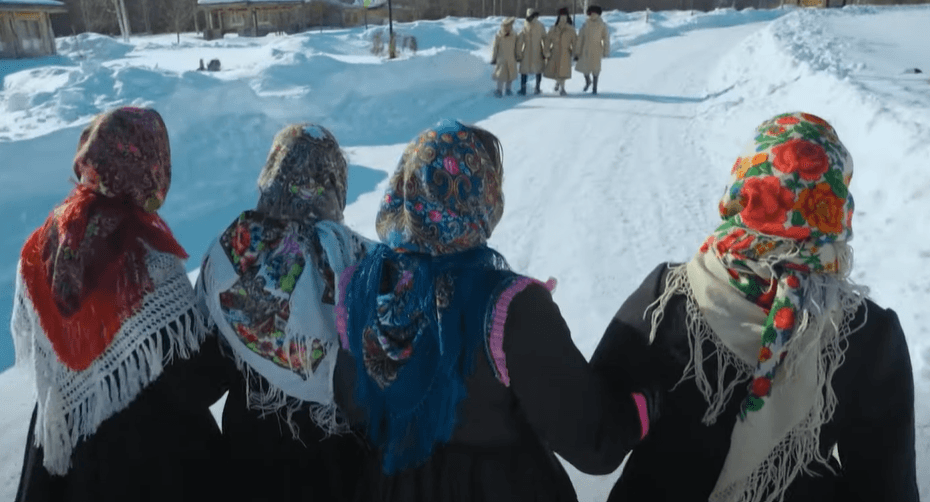
Traditional Chuvash Women’s Clothing (AA)
The total Chuvash population is approximately two million. The territory of the Chuvash Republic covers about 18,300 km² and its capital is called Cheboksary in Russian and Çupaşkar in Chuvash. The official languages are Russian and Chuvash.
The Chuvash Turks hold a unique position among Turkic peoples in historical, linguistic, and cultural terms. Their language is regarded as the sole surviving representative of the Bulgar branch of Turkic languages and is distinguished from other Turkic dialects by its phonetic and morphological features.
Traditionally adhering to elements of the ancient Turkic belief system for a long time, the Chuvash were largely Christianized from the 16th century onward under Russian rule. Today, the majority of the Chuvash population is affiliated with the Russian Orthodox Church, yet archaic belief elements and practices continue to persist within folk culture.
Documentary on the Chuvash Turks (TRT Documentary)
The name “Chuvash” first appears in Russian chronicles in the early 16th century. It is mentioned in the work İstoriya o Kazanskom Tsarstve (Kazan Chronicle) for the year 1502, and again in the records of Kinyaz A. M. Kurbskiy describing his campaign against Kazan in 1551. The absence of the term “Chuvash” in historical sources prior to the 16th century has led to various interpretations regarding its origin.
Some researchers, including N. I. Zolotnitskiy and M. Fasmer, argue that the word “Chuvash” derives from the term yĭvaş, meaning “silent, calm, obedient.”
An alternative view links the name “Chuvash” to the Suvar/Suvas group that inhabited the region before Russian domination and is mentioned in historical sources. According to this perspective, “Chuvash” is not an ethnonym but a socionym that emerged in the 16th century; the correct ethnic designation should be “Suvar.”
A. P. Kovalevskiy attempted to establish a linguistic connection between Suvar and Chuvash by reading the term “suvan” in Ibn Fadlan’s travelogue as “suvaz.” However, this view has been criticized by some scholars (R. F. Fahrutdinov, G. V. Yusupov), who argue that the form “suvaz” cannot be verified in either Old Chuvash or the modern language, and that any similarity rests solely on phonetic resemblance.
G. V. Yusupov interprets the name “Suvar” as a geographical term. According to him, certain Turkic groups settled on the right bank of the Volga River referred to their neighbors on the opposite bank as “suas” (those across the river). This designation may have gradually evolved into an ethnic name. The Mari people themselves referred to the Chuvash as “suasla mari,” meaning “Mari from the opposite bank.”
From the late 20th century onward, especially among Chuvash intellectuals, a movement emerged to revive and adopt the “Suvar” identity as a cultural marker, leading to cultural projects such as the Suvar Ethnopark.
Chuvash Folk Song (Arghun Pride)
The Chuvash Turks are largely associated with the Volga Bulgars and the Suvar/Suvas groups considered their branch. The Volga Bulgars, who formed a powerful political entity in the Middle Volga basin between the 10th and 13th centuries, were the most significant Turkic community in the region economically and culturally. Archaeological, linguistic, and ethnographic evidence demonstrates that modern Chuvash are the direct descendants of this Bulgar-Suvar heritage.
The Mongol invasion of Eastern Europe in the 1220s ended the political independence of the Volga Bulgars. By 1236, the region came entirely under the rule of the Golden Horde. This drastically altered settlement patterns and population movements. The Suvar groups on the left bank of the Volga became, at times, tax-paying subjects and at other times, part of the military system under the strong administration of the Golden Horde.
After the Mongol invasion, some Bulgars established new settlements in the north and on the right bank of the river, while others lived intermixed with Finno-Ugric peoples. During this period, linguistic and cultural interaction intensified; this era is one of the main reasons for the presence of Finno-Ugric elements in contemporary Chuvash culture.
In the late 14th century, with the weakening of the Golden Horde, the political balance in the region shifted. In the 15th century, the Kazan Khanate emerged, and the Chuvash came under its influence. The Kazan Khanate period was marked by intensified relations between the Chuvash and the Tatars as well as other regional groups. However, during this time, the ethnonym “Chuvash” was not yet widespread; the community was primarily known by the identity “Suvar.”
The Kazan Khanate was destroyed in 1551–1552 following the Russian Tsardom’s campaigns, and the region came under Russian rule. From this date onward, the name “Chuvash” became established in Russian administrative records. During the Tsarist period, the Chuvash were incorporated into the system as tax-paying peasants. A central policy of Russian administration was the Christianization of the local population. Intensified missionary activities in the 18th century led to the majority of the Chuvash population becoming affiliated with the Russian Orthodox Church. The process of conversion was neither rapid nor uniform; some Chuvash groups, particularly in rural areas, retained their traditional belief systems for a long time, resulting in religious syncretism within folk culture.
In the 19th century, the centralizing policies of the Russian Empire affected Chuvash territories. As education and administration shifted to Russian, the Chuvash language was largely confined to domestic and local communication. Missionary schools were opened during this period; Chuvash youth educated in Russian entered civil service and church roles. However, the majority of the rural population continued to rely on traditional agriculture and handicrafts for their livelihood.
Following the 1917 Revolution, the administrative structure of the region was reorganized. On June 24, 1920, the Chuvash Autonomous Region was established; in 1925, its status was elevated to the Chuvash Autonomous Soviet Socialist Republic. The Soviet regime promoted Chuvash as a language of education and publication while simultaneously reinforcing the dominance of Russian. Collectivization, industrialization, and forced migration policies caused profound transformations in Chuvash social structure.
Folklore and folk literature were collected and published under Soviet cultural policies; however, ideological filtering led to the loss of some traditional elements. Nevertheless, this period was crucial for the institutionalization of Chuvash literature.
After the dissolution of the USSR in 1991, Chuvashia retained its status as an autonomous republic within the Russian Federation. From the 1990s onward, efforts to redefine Chuvash identity and revitalize culture came to the forefront. Intellectuals emphasizing the Suvar identity began incorporating elements of folk culture into modern identity construction. The Suvar Ethnopark in Cheboksary is one of the symbolic sites of this movement.
Today, with a population of approximately two million, the Chuvash Turks are integrated into the socio-economic life of the Russian Federation while continuing to struggle to preserve their language, religion, and cultural heritage. Although the majority of the population is affiliated with the Russian Orthodox faith, elements of the ancient Turkic belief system still persist in folk traditions.

Example of Tree Statues in Chuvash Folklore (AA)
Chuvash is regarded as the sole surviving representative of the Bulgar branch of Turkic languages and thus holds a unique historical and linguistic position. Compared to other Turkic dialects, it exhibits significant differences in phonetics, morphology, and vocabulary; many of these differences are explained by the legacy of the Volga Bulgars and influences from Finno-Ugric languages.
Chuvash is one of the most divergent Turkic languages typologically. Although vowel harmony is partially preserved, it is broken in some words. The sounds r and l differ from their counterparts in the Oghuz and Kipchak groups (e.g., Turkish “kız” corresponds to Chuvash “hĭr,” “el” to “ul”).
The Old Turkic z sound generally became r in Chuvash, and the ş sound became l (this feature is known as “r-Turkic”).
Throughout history, Chuvash has been written using various scripts. In the 18th century, missionaries developed the first attempts based on the Cyrillic alphabet. During the Soviet period, a Cyrillic-based alphabet was standardized and remains in use today. The modern Chuvash alphabet consists of 37 letters, including special characters such as [ă], [ĕ], and [ç], which are not found in the Russian alphabet.
Chuvash is divided into three main dialect groups:
Chuvash has low mutual intelligibility with other Turkic dialects. This is due to the intensity of its phonetic and morphological differences as well as historical influences from Finno-Ugric and Russian languages. Nevertheless, there are direct connections to Old Turkic in core vocabulary and certain grammatical structures.
Beliefs and Religion
The belief system of the Chuvash Turks has historically formed a syncretic structure incorporating both ancient Turkic religious elements and Christian influences.
Before Russian domination, the Chuvash maintained a local variant of ancient Turkic beliefs. This belief system was centered on the sky god (Turĭ) and included worship of natural forces, ancestors, and spirits.
After the Russian Tsardom conquered the region in the 16th century, the Chuvash faced an intensive campaign of Christianization. Missionary activities became systematic in the 18th century, and the majority of the Chuvash population became affiliated with the Russian Orthodox Church. However, many traditional belief elements were not entirely eradicated; numerous rituals were adapted into Christian frameworks and continued to be practiced.
Chuvash folk beliefs continue to influence important stages of the life cycle today:
Today, the majority of the Chuvash population officially identifies as Orthodox Christian. Nevertheless, especially in rural areas, practices inherited from ancient Turkic beliefs—such as nature worship, reverence for ancestors, and fertility rituals—continue to be observed. This syncretism is considered one of the most distinctive features of Chuvash folk culture.
Hungarian Turkology holds a special position within Western Turkological studies in terms of its historical development and research areas. Hungarian scholars’ interest in Turkic peoples has not been limited to orientalist curiosity but has also been driven by a search to understand their own ethnic origins and cultural connections.
In this context, the Chuvash are highlighted in Hungarian Turkology as a group of particular importance among Turkic tribes. Several key reasons underlie this emphasis:
In Hungarian Turkology, the Chuvash have been a fundamental subject of research in both linguistic history and folk culture. These studies have played a vital role in scientifically documenting the historical and cultural identity of the Chuvash and in establishing their recognition within the international academic community.
Anadolu Ajansı. "Rusya'daki Çuvaş Türklerinin ana yurdu: Çuvaşistan Özerk Cumhuriyeti." Accessed August 12, 2025. https://www.aa.com.tr/tr/yasam/rusyadaki-cuvas-turklerinin-ana-yurdu-cuvasistan-ozerk-cumhuriyeti/3628954
Arghun Pride Youtube Kanalı. "Chuvash Folk Suvar/Bulgar - “Itarmi Chăvash En" Accessed August 12, 2025. https://www.youtube.com/watch?v=Pdhr2xukj_8&list=RDPdhr2xukj_8&start_radio=1
Bayram, Bülent. Çuvaş Türklerinin Kahramanlık Anlatmaları (İnceleme-Metinler). PhD thesis, Ege University Institute of Social Sciences, 2008. Accessed August 12, 2025. https://tez.yok.gov.tr/UlusalTezMerkezi/TezGoster?key=UPP_Zu9isEmWGFXFCBYasQ4YAP29O0QuTgLKaE2KLf4EY8i6yShm4R_CFk4Z6IYs
Bayram, Bülent. “Macar Türkoloji Araştırmalarında Çuvaş Folkloru.” Türkbilig 22 (2011): 87-120. Accessed August 12, 2025. https://dergipark.org.tr/tr/pub/turkbilig1/issue/13393/162041
Bayram, Bülent. “Çuvaşlar Arasında Halk Kültürü Temelinde Yeni Bir Kimlik İnşası ve Suvarlar.” *Tehlikedeki Diller Dergisi / Journal of Endangered Languages*, Winter 2013. Accessed August 12, 2025. https://www.academia.edu/38108868/%C3%87uva%C5%9Flar_Aras%C4%B1nda_Halk_K%C3%BClt%C3%BCr%C3%BC_Temelinde_Yeni_Bir_Kimlik_%C4%B0n%C5%9Fas%C4%B1_ve_Suvarlar
TRT Belgesel YouTube Channel. "Doğu'nun Kayıp Silüetleri | Çuvaş Türkleri | TRT Belgesel." Accessed August 12, 2025. https://www.youtube.com/watch?v=G_YAo1Icot4
Çeltikci, Orhan. "Türk Dünyasının Unsurlarından Çuvaş Türkleri ve Halk İnanışları ile İlgili Tespitler." International Journal of Social and Educational Sciences / Uluslararası Sosyal ve Eğitim Bilimleri Dergisi 1, no. 1 (June 2014): 73-92. Accessed August 12, 2025.

Chuvash Naming in Chuvash | Chuvash, Chupash | ||||||||
|---|---|---|---|---|---|---|---|---|---|
Region Where They Live | The Chuvash Republic, affiliated with the Russian Federation, along with Tatarstan, Bashkortostan, Mari El, Mordva, Udmurtia, Samara, Ulyanovsk, Orenburg, Saratov, Sverdlovsk, and in Siberia the Tyumen, Kemerovo and Krasnoyarsk regions | ||||||||
Capital(s) | Cheboksary (Chuvash: Chupashkar) | ||||||||
Official Languages | Russian, Chuvash | ||||||||
Language Family | Turkic languages, the sole living representative of the Bulgar branch | ||||||||
Dialects | Viryal/Turi (Upper), Anatri (Lower), Anat Yençi (Middle-Lower) | ||||||||
Religion(s) | Predominantly Russian Orthodox Christian etc.) preserved in folk beliefs nature spirits with elements of old Turkic beliefs (Turĭ | ||||||||
Historical Origin | Associated with the Volga Bulgars and the Suvar/Suvas communities | ||||||||
Ethnonym and Origin of the Name
History
Early Periods
Medieval and Mongol Period
Pre-Russian Rule and the Kazan Khanate Period
Russian Tsardom Period
19th Century: Socioeconomic and Cultural Change
Soviet Union Period
Post-1991 and the Present
Language
General Features
Alphabet
Dialects
Position Among Turkic Dialects
Traditional Belief System
Christianization Process
Folk Beliefs and Life Cycle Rituals
Contemporary Belief Structure
The Place of the Chuvash in Hungarian Turkology
Linguistic Connections
Religious and Cultural Research
Folklore Studies
Bibliographic and Institutional Contributions