This article was automatically translated from the original Turkish version.
Type of Geographical İndication | Mahreç Sign | ||||||||
|---|---|---|---|---|---|---|---|---|---|
Application Date | 31.12.2022 | ||||||||
Registration Number | 1532 | ||||||||
Registration Date | 01.02.2024 | ||||||||
Product / Product Group(s) | Other products | ||||||||
Province(s) | Isparta | ||||||||
Applicant/Registrant(s) | Çiçekpınar Municipality | ||||||||
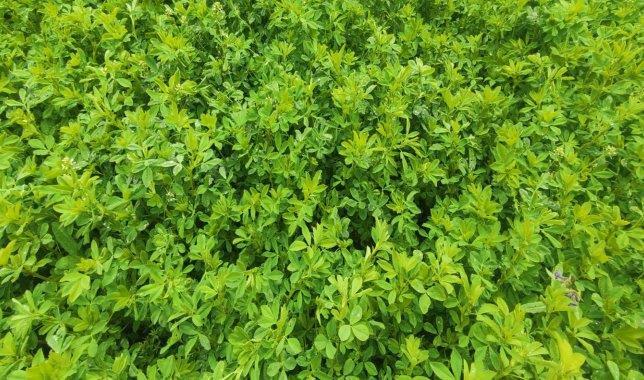
Çiçekpınar alfalfa is a perennial forage crop species with the Latin name Medicago sativa L. This plant is associated with the village of Çiçekpınar in the Şarkikaraağaç district of Isparta Province, Türkiye, and has been registered as a certified mark under Law No. 6769 on Industrial Property, and granted geographical indication protection on 01.02.2024.
Çiçekpınar alfalfa is a plant that can be cultivated under both irrigated and rain-fed conditions, distinguished by its high biomass yield and efficient water use. Thanks to its deep root system, it exhibits resistance to drought and high temperatures. Its importance as a key resource for pollination and nectar production in apiculture, its contribution to increased seed yield, and its role in enriching the soil with organic matter further enhance its value for biodiversity conservation.
The plant consists of six main parts: root, stem, leaves, flowers, fruit, and seeds. On average, each fruit contains four seeds. Flower colors range from purplish tones close to violet. Leaf shapes are oval, elongated oval, or obtuse oval. The plant habit is semi-erect or erect. The optimal stage for harvesting for maximum protein yield is when flowering reaches 10%. The crude protein content is at least 15% and the dry matter content is at least 18%. If harvesting is not delayed, stem lignification is minimized.
The preferred soil types for cultivation are loamy-sandy, loamy, clay-loamy, and well-drained soils with adequate lime content, but not excessively sandy. High groundwater levels and waterlogging can reduce yields, making surface drainage essential. The seedbed must be carefully prepared; the land should be plowed several times and thoroughly broken up using equipment such as disk harrows and harrows.
The plant is typically sown in spring and autumn. It is adapted to dry and semi-arid climates but is sensitive to cold. For spring sowing, frost must have ended and the soil must have reached optimal temperature. Sowing is carried out using broadcasting or row sowing techniques. In irrigated agriculture, row spacing averages 30 cm; in poor conditions, it is 40 cm. Sowing depth is approximately 2 cm in heavy soils and 3 cm in light soils. Use of certified, high-purity seed is recommended.
Irrigation needs vary according to climate, soil structure, and growth stage. Generally, two irrigations are applied: one before and one after each harvest. Sprinkler or flood irrigation systems are preferred.
Control measures against weeds and pests are carried out before and after sowing. Early harvesting is recommended especially to combat parasitic weeds such as dodder. Preventive measures include using clean seed and avoiding the use of manure sourced from contaminated areas.
Animal manure and/or commercial fertilizers are applied based on soil analysis. As a legume, nitrogen fertilizers are not applied except in the establishment year.
Harvesting is carried out at a height of 5–10 cm above ground when flowering reaches 10–15%. The cut alfalfa is collected in bales or bundles. Drying takes approximately two days under sunlight and should ideally be performed in shaded, well-ventilated areas. Modern drying techniques may also be used.
Çiçekpınar alfalfa is marketed either fresh or dried, in bales or bundles. Storage is conducted in dry, cool, odor-free, and clean environments, preferably in semi-enclosed storage facilities.
All production and processing stages are carried out exclusively within the boundaries of Şarkikaraağaç district, Isparta Province. Monitoring is conducted at least once annually under the coordination of Çiçekpınar Municipality, with participation from the Şarkikaraağaç District Directorate of Agriculture and Forestry. Monitoring criteria include production methods, emblem usage, and harvesting and storage conditions. Non-compliance is reported to the relevant individuals and institutions.
Turk Patent and Trademark Office. "Çiçekpınar Yoncası." Turk Patent and Trademark Office. Accessed August 16, 2025. https://ci.turkpatent.gov.tr/cografi-isaretler/detay/8385.
Turk Patent and Trademark Office. "Çiçekpınar Yoncası." Türk Patent ve Marka Kurumu. Accessed August 16, 2025. https://ci.turkpatent.gov.tr/Files/GeographicalSigns/99a21582-4e57-4f09-ac2a-17a245be35d3.pdf.

Type of Geographical İndication | Mahreç Sign | ||||||||
|---|---|---|---|---|---|---|---|---|---|
Application Date | 31.12.2022 | ||||||||
Registration Number | 1532 | ||||||||
Registration Date | 01.02.2024 | ||||||||
Product / Product Group(s) | Other products | ||||||||
Province(s) | Isparta | ||||||||
Applicant/Registrant(s) | Çiçekpınar Municipality | ||||||||
Distinguishing Characteristics
Production Method
Soil and Field Preparation
Climate and Sowing Conditions
Irrigation
Agricultural Control
Fertilization
Harvesting and Drying
Market Supply and Storage
Geographical Boundary and Monitoring