


This article was automatically translated from the original Turkish version.
+1 More
The Enclosure Movement (English: Enclosure or Inclosure) refers historically to the process of converting land previously open for common use or subject to feudal serfdom into private property through fencing or similar boundaries. This process was a form of individualistic agricultural reform aimed at adapting the feudal production system and land use regimes to the demands of a market economy. The movement involved the abolition of obligations that restricted agricultural production during the feudal era such as common grazing (vaine pâture), shared post-harvest land use and communal field cultivation. It also entailed the consolidation and redistribution of fragmented and small plots of land and their reorganization to produce for the market rather than subsistence. This transformation did not merely involve the physical fencing of land but also led to the restructuring of property relations and social structures.
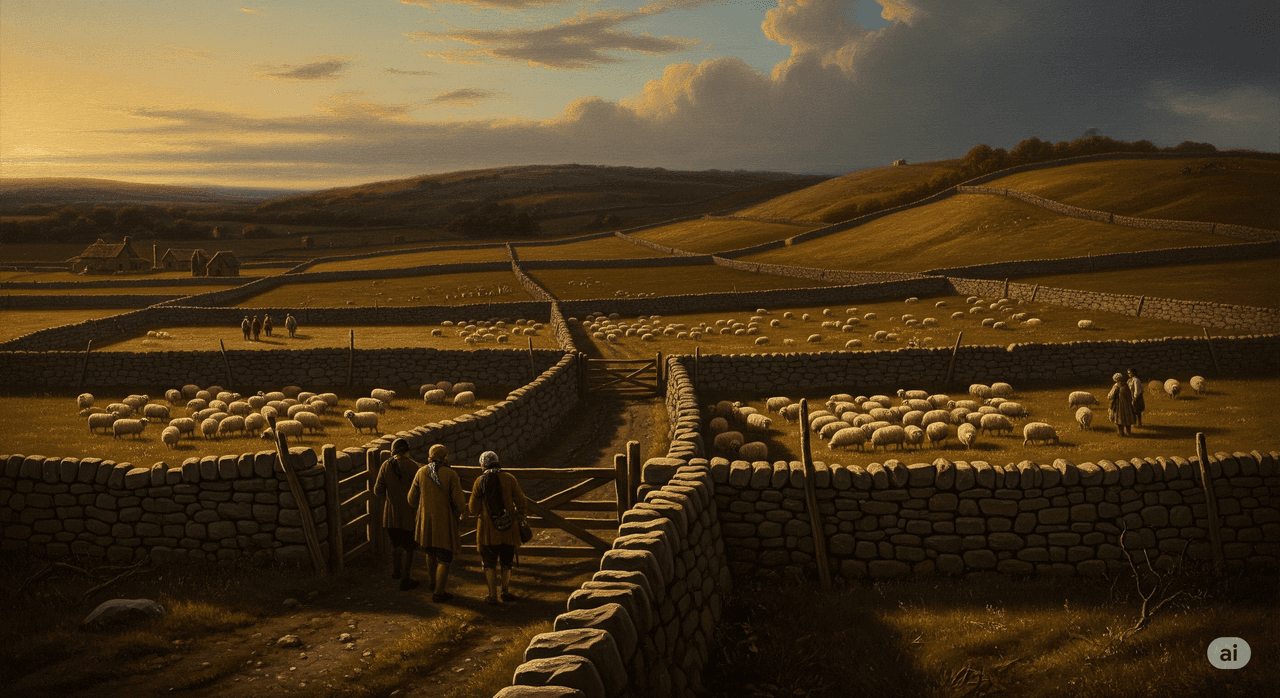
Common Lands Converted to Private Property Through Fencing (Generated by Artificial Intelligence)
The earliest and best-known example of the enclosure movement occurred in England. The process began in the 15th century and continued with varying intensity until the 19th century.
During this period enclosure was largely carried out through individual actions by feudal lords and landowners. Particularly as wool trade became profitable, arable land and common pastures were fenced off and converted into sheep grazing areas. This process forced peasants off lands they had traditionally used under common rights. Enclosures during this period were frequently carried out without legal basis, relying on coercion and suppression.
From the 18th century onward the enclosure movement acquired a legal and systematic character through special “Enclosure Acts” passed by Parliament. These laws legitimized the fencing of common lands and accelerated the process. The aim during this period was not only to create pastures for livestock but also to increase agricultural productivity and commercialize farming. Supported by parliamentary legislation this process led to the widespread elimination of small peasant landownership and common usage rights.
The impacts of the enclosure movement have been analyzed through different theoretical frameworks and have generated opposing interpretations.
According to this view enclosure increased agricultural productivity. It is argued that common lands ended the so-called “tragedy of the commons” characterized by overuse and inefficiency. Private ownership provided landowners with incentives to invest in drainage systems implement crop rotation and adopt new farming techniques. According to this perspective the surplus agricultural production resulting from enclosure supported the industrialization process and met the food needs of a growing population.
Critical approaches define the process as “a revolution of the rich against the poor” and argue that the nobility destroyed ancient legal traditions and customs depriving the poor of their share in common lands. According to this view enclosure stripped peasants of their traditional rights to use pastures hunting grounds and gather firewood. Dispossessed from their land these populations lost their means of subsistence and became a rural proletariat providing “free” labor for industrial facilities in cities. This process disrupted social structures increased poverty and crime rates and was criticized by thinkers such as Thomas More for displacing rural populations and driving them into destitution. This process has also been analyzed within the framework of “primitive accumulation” as dispossession that served as a precondition for capital accumulation.
The enclosure movement was not unique to England but was observed in other regions in different forms and intensities.
The enclosure movement in France was neither as intense nor as widespread as in England. Factors such as insufficient capital the prevalence of small-scale farming and the fact that most landowning nobles were rentiers uninterested in improving their lands slowed the process. In France the movement unfolded as a struggle between large landowners seeking to commercialize their estates and small peasants and landless laborers defending their common usage rights particularly the right of vaine pâture (common grazing). In the second half of the 18th century the government introduced a series of legal measures encouraging enclosure influenced by physiocratic thought. However these measures had limited impact due to local resistance and the complexity of land tenure structures.
It is difficult to speak of an enclosure movement in the Ottoman state similar to the English model. Although the Land Code of 1858 is often regarded as the beginning of the transition to private property a closer examination reveals a different reality. The Code reinforced the legal status of lands classified as mîrî (state-owned) metruk (dedicated to public use) and mevat (unclaimed or abandoned). In particular metruk lands—pastures summer pastures roads marketplaces and similar areas—were allocated for common use by one or several village communities and their sale cultivation or construction was prohibited. Mevat lands could be brought under private use through “ihya” (reclamation) with state permission but this did not involve the appropriation of existing common rights as occurred in England. Thus the Land Code aimed not to transfer common lands to private ownership but to preserve their public and state-owned character.
Events in pastoral Tibet in the late 20th century can be seen as a modern manifestation of the enclosure concept. Beginning in the 1980s the Chinese government implemented a widespread policy of fencing (using wire mesh) citing the need to “prevent pasture degradation” and “modernize animal husbandry.” This policy ended common access to pastures by restricting traditional nomadic lifestyles and the free movement of livestock. At the same time enclosure projects served as an incentive for local officials because they produced tangible outputs that met performance indicators and generated income. In this case enclosure functions as a tool for the state to enhance its control over rural communities and to centrally plan land use.
In recent times the concept of “enclosure” has been extended beyond the physical fencing of land to describe the appropriation of previously common or accessible resources such as knowledge culture and biogenetic materials under private property regimes. This process known as the “Second Enclosure Movement” refers to the expansion of intellectual property rights including copyright patents and trademarks.
Examples of these modern forms of enclosure include:
This second enclosure movement is criticized for creating new property rights over “intangible commons of the mind” the raw material of information and innovation potentially undermining future creativity and scientific progress.
Bauer, Ken. “Development and the Enclosure Movement in Pastoral Tibet since the 1980s.” *Nomadic Peoples* 9, no. 1 (2005): 53–81. Accessed August 16, 2025. https://www.liverpooluniversitypress.co.uk/doi/abs/10.3167/082279405781826119.
Boyle, James. “The Second Enclosure Movement and the Construction of the Public Domain.” In *Copyright Law*, 63–104. Routledge, 2017. Accessed August 16, 2025. https://www.taylorfrancis.com/chapters/edit/10.4324/9781315095400-3/second-enclosure-movement-construction-public-domain-james-boyle.
Rozental, Alek A. “The Enclosure Movement in France.” *The American Journal of Economics and Sociology* 16, no. 1 (1956): 55–71. Accessed August 16, 2025. http://www.jstor.org/stable/3484794.
Çakır Kantarcıoğlu, Meryem. “Ortak Toprakların Özel Mülkiyete Dönüşmesi mi?: İngiliz Çitleme Hareketleri ile 1858 Arazi Kanunnâmesi’ne Dair Bir Karşılaştırma.” *Memleket Siyaset Yönetim* 13, no. 30 (December 2018): 103–40. Accessed August 16, 2025. https://dergipark.org.tr/tr/pub/msydergi/issue/75853/1250974.

Historical Development: The Case of England
Early Period (15th–17th Centuries)
Parliament-Supported Period (18th–19th Centuries)
Theoretical Approaches and Impacts
Efficiency and Modernization Argument
Dispossession and Social Criticism
Applications and Reflections in Different Geographies
France
Ottoman Empire
Pastoral Tibet
The “Second Enclosure Movement”: Modern Interpretations of the Concept