


This article was automatically translated from the original Turkish version.
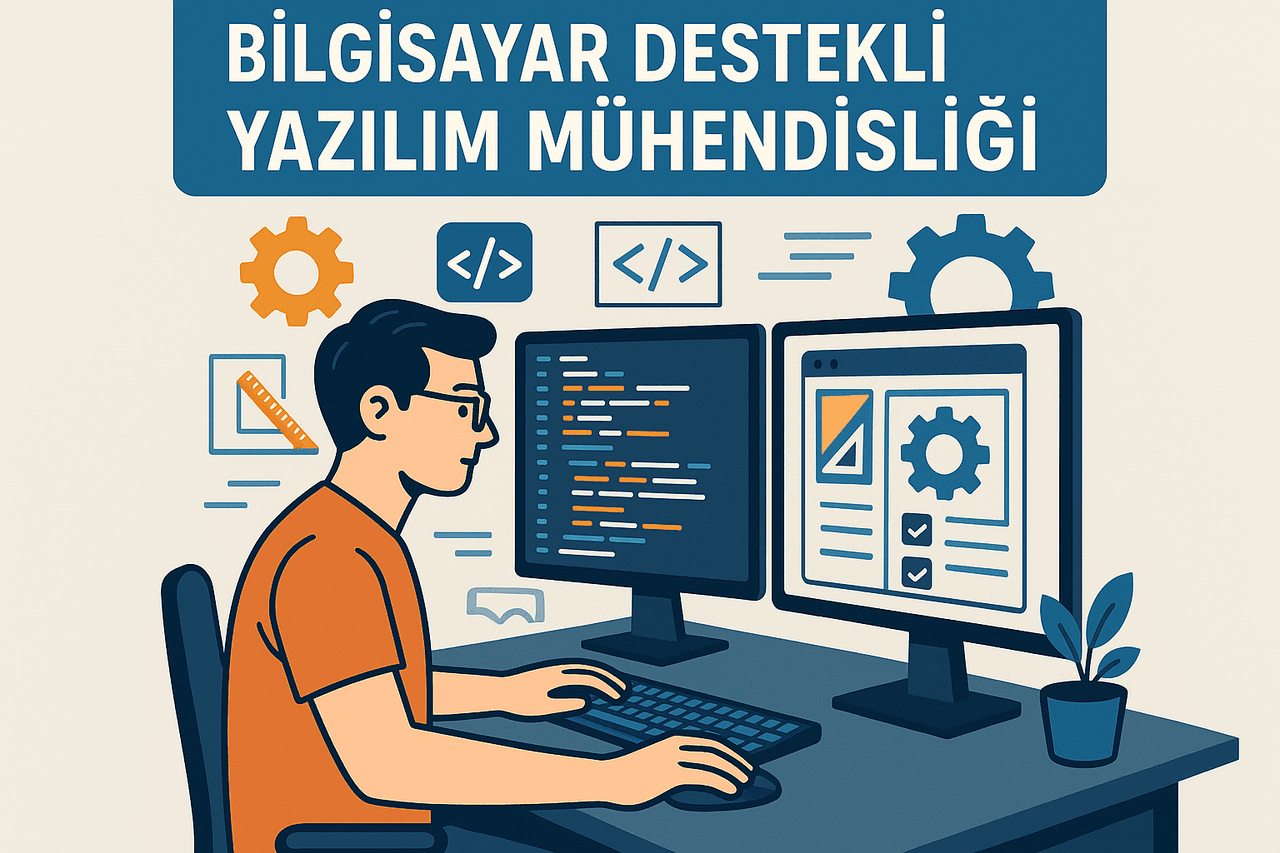
Generated with artificial intelligence.
Computer-Aided Software Engineering (CASE)
Definition(s) | An approach to planning and maintaining all phases of the software development life cycle (SDLC) using computer-aided tools. producing designing | ||||||||
|---|---|---|---|---|---|---|---|---|---|
CASE Vehicle Types | Cloud CASE Project Management Tools Integrated CASE Lower CASE Upper CASE | ||||||||
Basic Components | Shared Repositories & Documentation Project Planning & Traceability Debugging / Unit Testing Automatic Code Generation & Version Control Support for Modeling Languages | ||||||||
Current Trends | Open Source CASE DevOps & CI/CD Low-Code / No-Code Artificial Intelligence & ML Cloud-Based CASE | ||||||||
Computer-Aided Software Engineering (CASE) is a term that has entered the literature to refer collectively to methods and tools that support every phase of the software development life cycle (SDLC). CASE essentially denotes a comprehensive set of computer-aided software tools designed to automate and standardize many stages of the software development process traditionally carried out by humans.
CASE tools have been developed to manage complexity, reduce errors, and enhance cost-efficiency in software design, analogous to how computer-aided design (CAD) tools are used in hardware design.
The Computer-Aided Software Engineering (CASE) concept emerged in the 1970s as a systematic response to the growing complexity of software development activities. During this period, the scale and scope of software projects expanded, and with them, the demands for information sharing and documentation among teams increased proportionally. Traditional paper-based methods—such as planning documents, flowcharts, coding diagrams, and manually prepared reports—produced error-prone, time-consuming, and costly processes.
The primary objective of the first CASE tools was to automate these documents and ensure their consistent maintenance according to established standards. This enabled software engineers to manage complex system designs more easily and established a common language among project stakeholders. The origin of the CASE concept was inspired by computer-aided design (CAD) systems widely used in the hardware domain. Applying the same systematic and automated approach to software development represented a significant step toward controlling quality, speed, and cost parameters in the industry.
The historical development of CASE tools can be analyzed through several key generations, paralleling the evolving needs of software engineering.
First-generation CASE tools focused primarily on automating documentation. Tools developed during this period enabled the rapid and accurate generation of visual representations such as data flow diagrams (DFDs) and entity-relationship diagrams (ERDs).
Second-generation CASE tools offered more holistic approaches to software design and project management. Functions such as code generation, project planning, and defect tracking were introduced, but platform dependency and limited integration capabilities remained significant disadvantages.
Third-generation CASE tools expanded modeling and design capabilities in response to the rise of object-oriented programming. They incorporated advanced features such as version control, team collaboration, and process automation.
Fourth-generation CASE tools have integrated contemporary technologies such as cloud computing, artificial intelligence, and machine learning. This generation is characterized by advanced capabilities including real-time collaboration among geographically dispersed teams, intelligent code suggestions, automated testing, and prototyping. This evolution of the CASE concept aims to ensure software quality while accelerating processes and minimizing costs.
CASE tools are categorized according to their functions within the development life cycle.
Upper CASE tools focus on the early phases of the software development process, such as requirements analysis, system modeling, and high-level design. These tools provide users with the ability to configure and document system requirements using various visual modeling techniques, including Unified Modeling Language (UML).
Lower CASE tools are used in the later stages of the SDLC, including detailed design, coding, testing, and maintenance. They include critical functions such as automatic code generation, version management, unit testing, and debugging. These tools ensure the correctness, integrity, and maintainability of code.
Integrated CASE (I-CASE) tools combine both Upper and Lower CASE functionalities to manage requirements gathering, design, code generation, and testing within a single environment. This structure provides project teams with cross-phase traceability and integrated data management.
In addition, Project Management Tools support managerial functions such as requirements management, resource planning, workflow automation, and document control. Cloud-based CASE tools make these capabilities accessible via the web, facilitating coordinated collaboration among global and distributed teams.
The adoption of CASE tools provides multifaceted contributions to software development processes. First, productivity increases through the automation of repetitive tasks such as code generation, documentation creation, and reporting. This allows developers to focus more effectively on creative and complex tasks.
From a quality perspective, CASE tools monitor adherence to coding standards throughout the project, detect errors at early stages, and encourage the use of reusable components from code libraries. Communication and documentation are standardized through visual modeling and centralized data repositories. All project stakeholders can easily understand the system architecture and requirements, and documents can be kept up to date. Project management functions simplify scheduling, resource allocation, and task distribution. Full traceability is achieved from requirements through design, code, and test results. Cost advantages arise from process automation and early error detection. Additionally, the ease with which CASE tools support compliance with industry-specific regulations and generate audit reports provides a significant advantage in meeting regulatory requirements.
Although CASE tools offer numerous benefits, their implementation presents several challenges.
First, the learning curve is significant. Effective use of tools with complex functionalities requires comprehensive training.
Incorrect tool selection or inadequate customization support can lead to inefficiencies and resistance within processes. Therefore, successful implementation of CASE tools requires an integrated approach encompassing appropriate tool selection, comprehensive user training, integration planning, and executive support.
The applicability of Computer-Aided Software Engineering (CASE) tools extends beyond general software development processes and plays a critical role in fields requiring complex product configuration. In this context, Product Configuration Systems (PCS) emerge as a specialized application of the CASE approach.
PCS refers to software solutions designed to configure flexible and customizable products according to customer requirements. In today’s industries—such as automotive, aerospace, electronics, and mechanical manufacturing—responding rapidly to product variety and customer demands is vital for competitive advantage. A single automobile model, for example, may offer thousands of variations ranging from engine options and color combinations to hardware packages and safety modules. This necessitates accurate representation and continuous updating of configuration data.
At this point, CASE tools bring a model-based engineering perspective to the development and maintenance of PCS. Structured modeling techniques such as Product Variant Master (PVM) and Class Responsibility Collaboration (CRC) cards enable systematic acquisition, validation, and visualization of product information. The PVM approach represents all components of a product—customer-facing, engineering, and manufacturing—in a layered structure. CRC cards clarify role distribution in complex systems by detailing class-based responsibilities and collaborations.
Academic studies have shown that traditional paper-based or manual methods of PCS development lead to information loss, documentation gaps, and inconsistencies. CASE tools mitigate these challenges by offering automation, centralized repository management, reusable model templates, traceability, and version control in PCS projects.
The Computer-Aided Software Engineering (CASE) approach is continuously evolving in response to technological advancements and changing business models. In modern software development practices, the capabilities of CASE tools are no longer limited to traditional functions; they are enriched by emerging trends such as cloud computing, artificial intelligence, low-code platforms, DevOps integration, and open-source ecosystems.
Cloud-based CASE tools are replacing traditional on-premises installations, offering advantages such as scalability, flexibility, and geographical accessibility. These tools enable developer teams to collaborate in real time over the internet. The remote work culture accelerated by the pandemic has further increased the importance of cloud-based platforms.
Artificial intelligence (AI) and machine learning (ML) technologies equip CASE tools with advanced capabilities such as intelligent code suggestions, automated error detection, predictive analytics, and automatic test scenario generation. For instance, an AI-powered CASE tool can analyze a developer’s code to identify potential security vulnerabilities or suggest best-practice templates. This reduces human-induced errors and accelerates quality assurance processes.
Integrating CASE tools with low-code or no-code development platforms enables non-technical users to participate in software development. Simple applications can be rapidly prototyped and deployed using visual flowcharts and drag-and-drop interfaces. This approach supports the rise of citizen developers while balancing the workload of traditional software engineering teams.
Modern CASE tools are integrated with version control systems, automated build, test, and deployment pipelines to align with DevOps culture. This ensures rapid testing of code changes, traceable version transitions, and error-free deployment. For example, a CASE tool connected to a CI/CD pipeline can automatically compile and test code and present error reports to the project manager.
The open-source philosophy is also influencing the CASE landscape. Open-source CASE tools allow users to access source code, customize functionality, and develop new features through community contributions. This approach offers accessibility and sustainability advantages, particularly for organizations with budget constraints.
Awati, Rahul. "What is computer-aided software engineering (CASE)?" 2024. Accessed July 8, 2025. Accessed Adresi.
Bhuyan, Aditya Pratap. "Comprehensive Overview of CASE Tools: Streamlining Software Development". DEV Community. 2023. Accessed July 8, 2025. Accessed Adresi.
Geeksforgeeks. "Benefits of CASE - Software Engineering". 2024. Accessed July 8, 2025. Accessed Adresi.
Geeksforgeeks. "Computer Aided Software Engineering (CASE)." Accessed July 8, 2025. Accessed Adresi.
Ministry of Education Government of India. "Software Engineering Software Case Tools." Accessed July 8, 2025. Accessed Adresi.
Sassi, M. Saifeddine Hadj, Faiza Ghozzi Jedidi, and Lamia Chaari Fourati. "Computer-aided software engineering (CASE) tool for big data and IoT architecture." In *2019 15th International wireless communications & mobile computing conference (IWCMC)*, pp. 1403-1410. IEEE, 2019. Accessed Adresi.
Shafiee, Sara, Yves Wautelet, Steffan Callesen Friis, Lukasz Lis, Ulf Harlou, and Lars Hvam. "Evaluating the benefits of a computer-aided software engineering tool to develop and document product configuration systems." *Computers in Industry* 128 (2021): 103432. Accessed Adresi.

Generated with artificial intelligence.
Computer-Aided Software Engineering (CASE)
Definition(s) | An approach to planning and maintaining all phases of the software development life cycle (SDLC) using computer-aided tools. producing designing | ||||||||
|---|---|---|---|---|---|---|---|---|---|
CASE Vehicle Types | Cloud CASE Project Management Tools Integrated CASE Lower CASE Upper CASE | ||||||||
Basic Components | Shared Repositories & Documentation Project Planning & Traceability Debugging / Unit Testing Automatic Code Generation & Version Control Support for Modeling Languages | ||||||||
Current Trends | Open Source CASE DevOps & CI/CD Low-Code / No-Code Artificial Intelligence & ML Cloud-Based CASE | ||||||||
No Discussion Added Yet
Start discussion for "Computer-Aided Software Engineering (CASE)" article
Origins of the Computer-Aided Software Engineering Concept
Evolution of Computer-Aided Software Engineering Tools
Types of Computer-Aided Software Engineering Tools
Benefits of Computer-Aided Software Engineering
Challenges of Computer-Aided Software Engineering
Integration of Product Configuration Systems (PCS) and Computer-Aided Software Engineering
Current Trends
Cloud-Based CASE Adoption
Integration of Artificial Intelligence and Machine Learning
Integration with Low-Code/No-Code Platforms
DevOps and Continuous Integration/Continuous Deployment (CI/CD)
Open-Source CASE Solutions