


This article was automatically translated from the original Turkish version.
+1 More
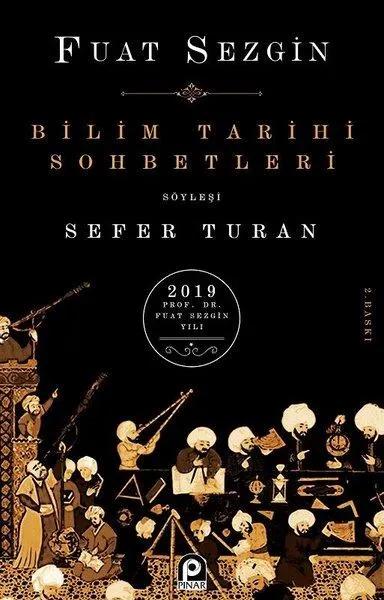
Conversations on the History of Science
Author(s) | Sefer Turan Fuat Sezgin | ||||||||
|---|---|---|---|---|---|---|---|---|---|
Publisher(s) | Pınar Yayınları | ||||||||
Number of Pages | 224 pages | ||||||||
Type(s) | Research - Analysis | ||||||||
Science History Conversations is a work compiled in interview format by Sefer Turan, containing the life, memories, and views on the history of science of Turkish historian of science Prof. Dr. Fuat Sezgin. The first edition was published in 2010 by Timas Publishing under the title “Fuat Sezgin, Historian of the Sciences”; subsequent editions have been presented to readers under the title “Science History Conversations”. The work explores the life story, academic journey, and perspective on the history of science of Fuat Sezgin, who is internationally recognized for his contributions to the history of Islamic science.
The book centers on Fuat Sezgin’s academic journey, which began in the 1940s at the Institute of Oriental Studies, Faculty of Letters, Istanbul University, where he was a student of the German orientalist Hellmut Ritter. Influenced by his teacher’s view that the foundations of science lie in Islamic scholarship, Sezgin turned his focus to this field and produced groundbreaking research on the history of Islamic science. The book details how Sezgin was removed from Istanbul University during the 27 May 1960 military coup as one of the “147s,” and subsequently moved to Germany, where he established the Institute for the History of Arabic-Islamic Science and its museum at J.W. Goethe University in Frankfurt.
The conversations reveal Sezgin’s passion for the history of science, highlighting that during his 60-year career he worked 16 to 17 hours a day, examined nearly 400,000 manuscripts, and learned 27 languages. The book discusses the contributions of Islamic scholars to the global history of science, including claims that the Americas were discovered by Muslims before Christopher Columbus, that the world’s earliest accurate map was drawn by Muslim scholars, and that some works of Ibn Sina were mistakenly attributed to Aristotle. Additionally, it emphasizes the pioneering work of Islamic scholars such as Jabir ibn Hayyan, Ibn al-Haytham, Al-Biruni, and Omar Khayyam in the fields of chemistry, optics, astronomy, and mathematics.
The work reflects Sezgin’s view that the history of science is a shared heritage of humanity and that modern Western science was profoundly shaped by the influence of Islamic civilization. It bridges the scholarly traditions of orientalists such as Hellmut Ritter, Carl Brockelmann, George Sarton, and Franz Rosenthal with the scientific legacy of the Islamic world. The book also examines Sezgin’s initiatives, including his leadership in establishing the Istanbul Museum of Islamic Science and Technology and his curation of models of instruments and devices used by Muslim scholars at the museum in Frankfurt. In this regard, the work is regarded not merely as a biography but as a valuable resource for understanding the role of Islam in the history of science.
Science History Conversations aims to introduce Fuat Sezgin’s scientific legacy to Turkish and global public opinion. The book is recognized as an effort to address the neglect by the West of the 800-year scientific contributions of Islamic scholars. It also includes information on Sezgin’s magnum opus, the 17-volume Geschichte des Arabischen Schrifttums, and his other major works.
Turan, Sefer. Bilim Tarihi Sohbetleri. İstanbul: Pınar Yayınları, 2019.

Conversations on the History of Science
Author(s) | Sefer Turan Fuat Sezgin | ||||||||
|---|---|---|---|---|---|---|---|---|---|
Publisher(s) | Pınar Yayınları | ||||||||
Number of Pages | 224 pages | ||||||||
Type(s) | Research - Analysis | ||||||||
No Discussion Added Yet
Start discussion for "Conversations on the History of Science (Book)" article
Content and Structure
Themes and Contributions
Significance and Impact