


This article was automatically translated from the original Turkish version.

ConvNeXt is an architecture that redesigns classic convolutional neural networks (CNNs) using modern deep learning approaches. Proposed in 2022 by researchers at Facebook AI (Meta AI), this model demonstrates that a purely convolutional structure can achieve highly competitive performance when equipped with contemporary architectural and optimization techniques inspired by the success of Transformer-based models. ConvNeXt delivers performance on par with architectures such as Vision Transformer (ViT) on ImageNet and other visual benchmarks.
ConvNeXt is based on the classic ResNet architecture but incorporates numerous architectural improvements and modernizations. These updates enable accuracy levels comparable to Transformers. The success of ConvNeXt represents a significant milestone in the literature, showing that traditional CNN structures can still remain highly competitive.
The key improvements in the ConvNeXt architecture are as follows:
While models such as ResNet-50 have 50 layers, the ConvNeXt architecture increases this depth to over 100 layers. For training deep models, normalization techniques such as LayerNorm are preferred.
Like Transformer architectures, ConvNeXt processes images by dividing them into fixed-size patch units. This enables the model to work more consistently with large-scale artificial neural networks.
ConvNeXt applies grouped convolutions by splitting the number of channels into groups. This enhances computational efficiency and enables greater feature extraction without increasing model capacity.
Layer Normalization is preferred over Batch Normalization. This method is widely used in Transformer-based architectures and provides more stable learning, particularly with large batch sizes.
The GELU (Gaussian Error Linear Unit) activation function is preferred over ReLU. GELU has become standard in Transformer architectures and has contributed to improved accuracy.
The ConvNeXt architecture was introduced in the work titled “Vision with ConvNets,” demonstrating that CNNs remain highly powerful. It stands out particularly due to faster training times and lower hardware requirements compared to ViT architectures.
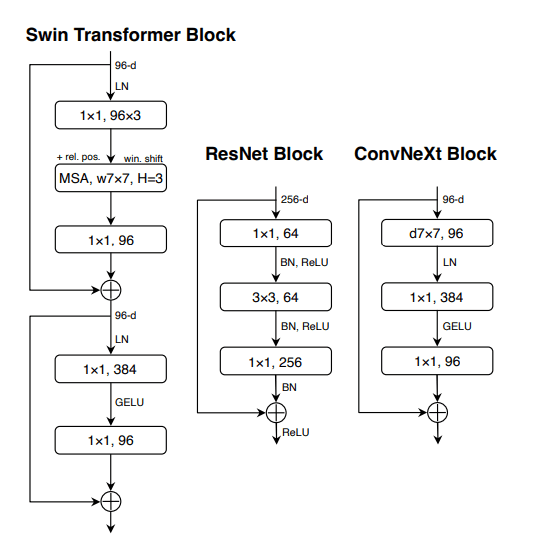
Block designs for ResNet, Swin Transformer, and ConvNeXt (
In ConvNeXt, modern convolutional blocks are restructured with inspiration from Transformers while remaining fully faithful to a convolutional structure.
The ConvNeXt architecture offers models scaled across different capacity levels:
Liu, Zhuang, Hanzi Mao, Chao-Yuan Wu, Christoph Feichtenhofer, Trevor Darrell, and Saining Xie. “A ConvNet for the 2020s.” *arXiv* (Cornell University), January 2022. https://doi.org/10.48550/arxiv.2201.03545.

Modern Convolutional Network Design
Architectural Updates
Increased Depth
Patchified Inputs
Grouped Convolution
Layer Normalization
GELU Activation
The Resurgence of Convolutional Alternatives
ConvNeXt Model Family
Applications