

This article was automatically translated from the original Turkish version.
+1 More
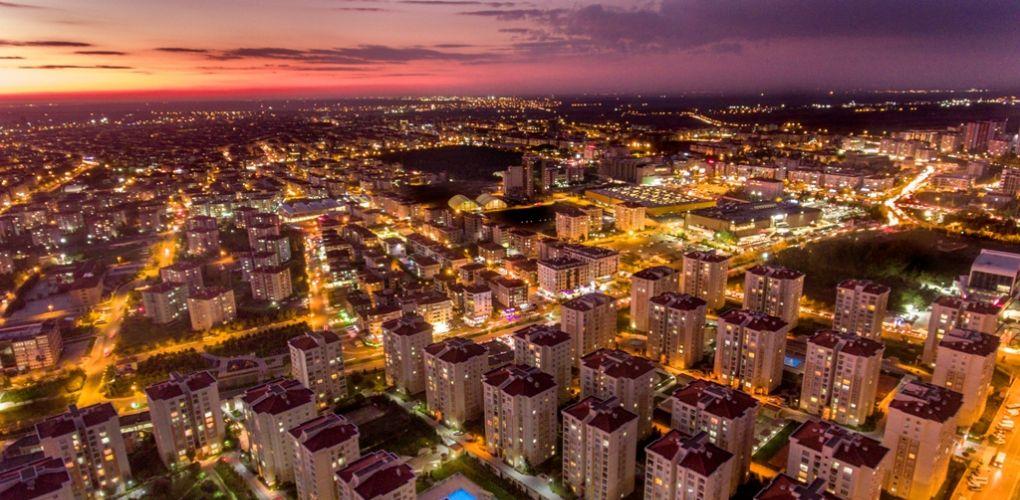
Çorlu, located in the Thrace region of the Marmara Region, is the largest district of Tekirdağ province, comprising 26 neighborhoods. Situated approximately 38 kilometers from the provincial center of Tekirdağ, it lies within the Ergene Basin and at the center of Thrace, on flat plateaus.
Various interpretations regarding the origin of the name Çorlu appear in historical records and literature. In ancient atlases, the settlement was recorded as 'Tzarylus', 'Tzurulum', 'Tzurulus', 'Tzurule', 'Tschurla', 'Tziraltum', 'Thzolous' and 'Trizallum'. During the Byzantine period, due to the widespread production of cheese, it was also known as 'Tribiton', meaning 'Cheese Town', and in some sources as 'Sirello'.
According to folk etymology and certain historical interpretations, the name Çorlu may have derived from the Turkish words 'Çor' or 'Çur', meaning barren or useless, possibly reflecting the difficulties the Turks encountered when taking the city. Alternatively, it may have evolved from the word 'Zor' (difficult), or from the old Turkic term 'Çor'/'Çur', which denoted a rank or title among Turkic tribes. Additionally, the name of the Roman military unit 'Cohors III. Lucensum', composed entirely of Thracian warriors and stationed in the region during Roman times, bears a resemblance to Çorlu. An inscription on a gravestone dated 814 AD found at the Kamaradere site, reading 'Çorlu-Tzoulos administrator Sisinis', indicates that the name was already established in the early Byzantine period.
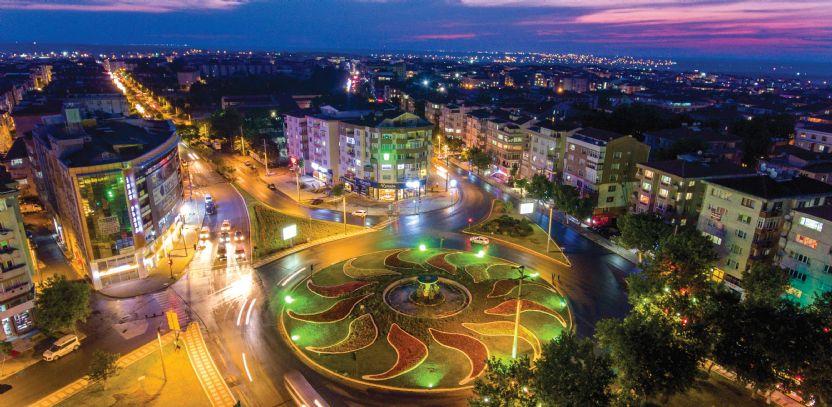
Visual of Çorlu(Çorlu Municipality)
Archaeological evidence reveals human settlement in Çorlu and its surroundings dating back to the Prehistoric and Early Bronze Age. The settlement, established as one of the colony towns by the Thracian-Frigians around 1000 BC, experienced successive invasions by Frigians, Greeks, Scythians, Persians, Macedonians, Romans and Byzantines, and suffered raids by Huns, Avars, Pechenegs and Arabs. During the Middle Ages, its location along the route to Istanbul and its role as the fortified settlement of Tzirallum (Thzolous), built to defend Byzantium, granted the town strategic and military significance.【1】
Çorlu was conquered by I Murat in 1357 and incorporated into Ottoman territory. Although it briefly reverted to Byzantine control following the deaths of Süleyman Paşa and Orhan Gazi, it definitively came under Ottoman rule in 1361. On the orders of I Murat, the city’s defensive walls were demolished to serve as an example to other towns, thereby eliminating Tzirallum’s military function.
During the imperial era, the succession struggle between II Bayezid and his son Şehzade Selim (Yavuz) occurred near Çorlu at Uğraşdere; both II Bayezid (1512) and Yavuz Sultan Selim (1520) died on Çorlu’s territory while traveling toward Edirne. In the 18th century, Çorlu became one of the settlement areas for exiled Hanzades and Girays from Crimea. In 1830, it was designated as a kazas (subdistrict) under the Tekirdağ sanjak of Edirne Vilayet.
Çorlu was temporarily occupied by Russian forces in 1876. During the First Balkan War (1912–1913), it served as the headquarters of the Ottoman Eastern Army but fell to Bulgarian forces on 5–6 December 1912. The city was recaptured by the Turkish army on 15 July 1913 during the Second Balkan War. During the War of Independence, the district was occupied by Greek forces on 25 July 1920 and was definitively liberated on 15 October 1922.
Migration movements during the Republican period reshaped the demographic structure of the district. In 1934, approximately 50,000 Turks from Romania were settled in the Reşadiye neighborhood of Çorlu. Between 1989 and 1990, around 15,000 people forcibly displaced from Bulgaria were resettled in the district.【2】
Çorlu lies between 41°07'30" east longitude and 27°45'00" north latitude. It borders Silivri district of Istanbul and Muratlı and Lüleburgaz to the east; the Sea of Marmara and Marmara Ereğlisi to the south; and the newly established Ergene district to the west. Official records present varying figures for the district’s area, ranging from 409 km² to 991 km² depending on measurement scales and periods. Its elevation above sea level averages between 150 and 193 meters.【3】
The region lies at the transition zone between the cold air masses of the Black Sea and the humid air currents of the Mediterranean and Aegean Seas. Due to its inland position, it is the driest area in Thrace, with an average annual precipitation of 545 mm (kg/m²). The average annual temperature is 12.6 °C, with prevailing northerly and northeasterly winds; winters experience snowfall due to the influence of the Karayel wind.【4】
The district’s water resources are primarily supplied by the Ergene Stream, a major tributary of the Meriç River, and the Çorlu Creek, fed by the Yıldız Mountains. Other streams include Pınarbaşı, Esece and Ahımehmet. The district’s surface is dominated by fertile reddish-brown soils, 30–40 cm thick, composed of fine-grained forest soil mixed with loess.
The majority of Çorlu’s terrain lies on the Ergene Basin, a sedimentary depression formed by deposits transported from the Yıldız Mountains. Stratigraphically, the region contains the Danişmen, Ergene and Thrace formations.
In the Karatepe region to the west of the district, Karatepe Basalts (Olivine Basalt), dating to the Pleistocene and covering approximately 115,000 m², are extracted. These basalts, characterized by high uniaxial compressive strength and low water absorption, are used in civil engineering as concrete aggregate, road fill material and ballast, and possess high industrial value.
Çorlu is also rich in groundwater resources. The majority of the region’s groundwater potential is supplied by the Ergene Basin; 61% (51.72 hm³/year) of the groundwater used by Tekirdağ province originates in Çorlu district. Additionally, the Karatepe quarries are the primary source of sand, gravel, concrete aggregate and asphalt aggregate in the region. Drilling conducted by Türkiye Petroleum Corporation (TPAO) in the Yulaflı (Karacali) area has identified natural gas reserves.
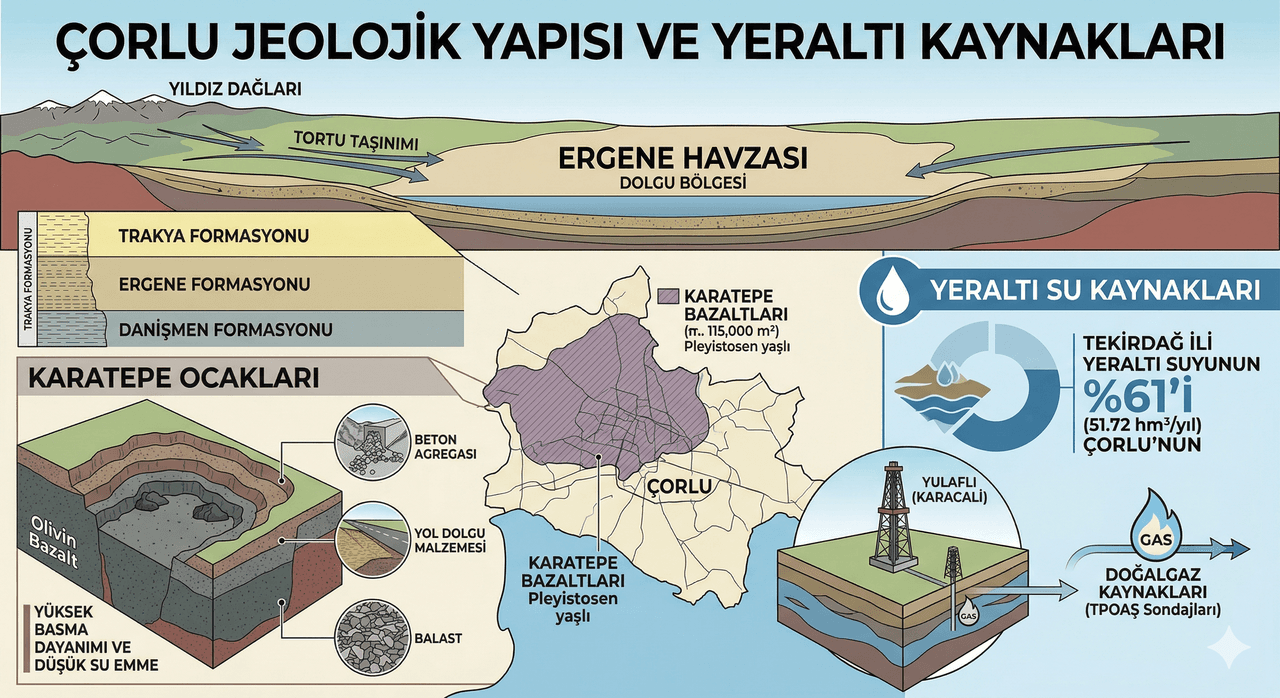
Çorlu Subsurface Resources (Generated by Artificial Intelligence)
Due to rapid population and industrial growth, environmental factors stemming from urban transportation in Çorlu have been studied at an academic level. Public transport vehicles powered by fossil fuel internal combustion engines have been identified as a major source of urban air pollution and greenhouse gas emissions.
Using the Intergovernmental Panel on Climate Change (IPCC) Tier-1 methodology, an analysis of Çorlu’s Route 7, which has 55 stops, revealed that an average of 1,031.7 passengers are transported daily, with vehicles covering an average daily distance of 218.86 km. This results in an average daily emission of 284.74 kilograms of carbon dioxide (CO2). According to these figures, the carbon footprint per passenger in urban transport is recorded at 0.276 kilograms of CO2, underscoring the necessity of transitioning to electric transport under sustainability policies. Additionally, pollution risk in the district is heightened by the infiltration of industrial and urban waste (garbage and chemical waste) into groundwater, facilitated by the region’s permeable sand-gravel geological structure.【5】
Aral, İ. Feda. “Karatepe Bazaltlarının (Çorlu‑Tekirdağ) Yapı Malzemesi Olarak Kullanılabilirliği / The Usability of Karatepe (Çorlu‑Tekirdağ) Basalts as Building Material.” İstanbul Üniversitesi Mühendislik Fakültesi Yerbilimleri Dergisi 17, no. 2 (2004): 69–76. Accessed March 29, 2026. https://dergipark.org.tr/en/download/article-file/173619.
Kılıç, Erdal, and Eray Önler. “Tekirdağ İli Çorlu İlçesinde Toplu Taşıma Kaynaklı Karbon Ayak İzinin Hesaplanması Üzerine Bir Araştırma.” Avrupa Bilim ve Teknoloji Dergisi, no. 41 (November 2022). Accessed March 29, 2026. https://dergipark.org.tr/tr/download/article-file/2400291.
T.C.Çorlu Kaymakamlığı Governorship. "Çorlu Tarihi." Çorlu District Governorship Official Website. Accessed March 29, 2026. https://www.corlu.gov.tr/corlu-tarihi.
Çorlu Belediyesi. "Tarihçe." Çorlu Municipality Official Website. Accessed March 29, 2026. https://www.corlu.bel.tr/idet/41/250/tarihce.
Çorlu Belediyesi. "İlçemiz." Çorlu Municipality Official Website. Accessed March 29, 2026. https://www.corlu.bel.tr/idet/143/259/ilcemiz.
Çorlu Ticaret of Commerce and Industry. "Günümüzde Çorlu." Çorlu Chamber of Commerce and Industry Official Website. Accessed March 29, 2026. https://www.corlutso.org.tr/content-224-gunumuzde_corlu.html.
[1]
T.C. Çorlu Kaymakamlığı, “Çorlu Tarihi,” Çorlu Kaymakamlığı Resmî Web Sitesi, erişim 29 Mart 2026, https://www.corlu.gov.tr/corlu-tarihi.
[2]
Çorlu Belediyesi, “Tarihçe,” Çorlu Belediyesi Resmî Web Sitesi, erişim 29 Mart 2026, https://www.corlu.bel.tr/idet/41/250/tarihce.
[3]
Çorlu Belediyesi, “Tarihçe,” Çorlu Belediyesi Resmî Web Sitesi, erişim 29 Mart 2026, https://www.corlu.bel.tr/idet/41/250/tarihce.
[4]
Çorlu Ticaret ve Sanayi Odası, “Günümüzde Çorlu,” Çorlu Ticaret ve Sanayi Odası Resmî Web Sitesi, erişim 29 Mart 2026, https://www.corlutso.org.tr/content-224-gunumuzde_corlu.html.
[5]
Çorlu Ticaret ve Sanayi Odası, “Günümüzde Çorlu,” Çorlu Ticaret ve Sanayi Odası Resmî Web Sitesi, erişim 29 Mart 2026, https://www.corlutso.org.tr/content-224-gunumuzde_corlu.html.

Origin and Etymology of the Name
Historical Development
Ancient and Byzantine Periods
Balkan Wars, National Struggle and Republican Period
Geographical Location, Climate and Topography
Geological Structure and Subsurface Resources
Environmental Impacts and Public Transport Emissions