


This article was automatically translated from the original Turkish version.
+1 More
Damnatio memoriae is a modern term used to describe a series of measures aimed at erasing the memory of individuals—particularly emperors—who were believed to have committed crimes against the state, following their deaths. The phrase derives from Latin, meaning “the condemnation of memory.”
Although this exact term does not appear in ancient sources, references to the practice are found in expressions such as memoria damnata (condemned memory) or abolitio memoriae (erasure of memory). While these measures targeted the complete destruction of all written and visual traces, they were not a single formal institution with a fixed legal framework but rather a flexible set of actions applied variably depending on the circumstances.
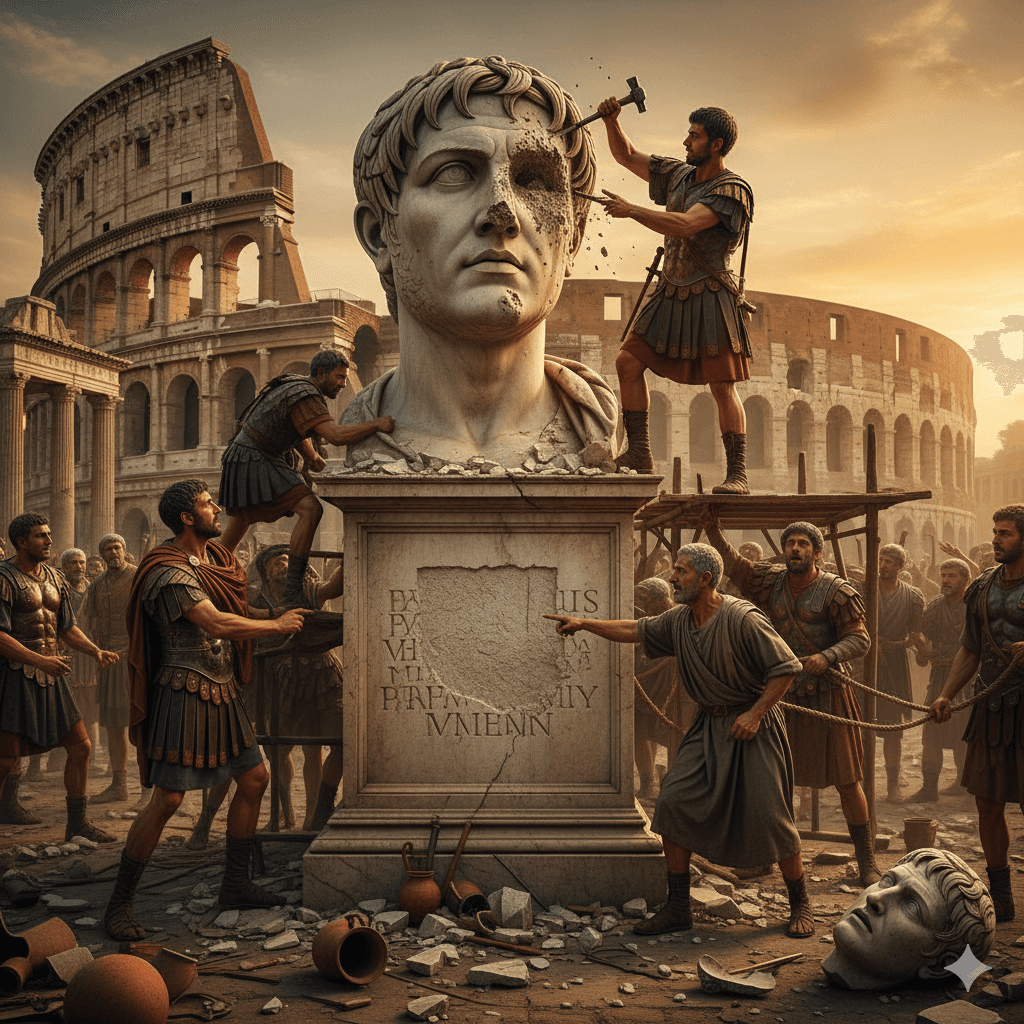
Destruction of a Condemned Memory (Generated by Artificial Intelligence)
The application of damnatio memoriae involved various actions designed to eliminate a person’s presence in public and sometimes private life. These actions generally fell into two main categories: iconographic and epigraphic.
The most common and visibly apparent form of punishment was intervention against the statues and portraits of the condemned individual. These interventions took several forms:
Erasing names from written records was another fundamental aspect of damnatio memoriae. This was carried out in various ways:
Although the origins of damnatio memoriae can be traced back to the Republican period, it acquired a more systematic character as a political tool during the Imperial era.
During the Republic, measures against the memory of individuals accused of treason against the state were already evident, beginning with the Gracchi brothers and Sulla. Decisions taken after the Battle of Actium to erase the memory of Marcus Antonius serve as an example of this practice before the imperial period. Antonius was declared a hostis publicus, his statues were destroyed, and honors bestowed upon him were revoked.
After Caligula was assassinated in C.E. 41, the Senate sought to formally impose a damnatio memoriae upon him. Some senators even proposed erasing the memory of all Caesars and destroying their temples. However, the new emperor Claudius blocked this formal decision to preserve political stability and avoid legitimizing the murder of an emperor. Nevertheless, Claudius took limited measures such as secretly removing Caligula’s statues and invalidating his official acts. Consequently, punishments against Caligula remained localized and ad hoc rather than systematic; the erasure of his name from inscriptions was inconsistent and partial.
Although it is commonly believed that Nero was officially subjected to damnatio memoriae, ancient sources do not confirm any formal Senate decree to that effect. Nero was declared a hostis publicus by the Senate, but this did not automatically entail the erasure of his memory after death. In fact, an elaborate and dignified funeral was held for him after his suicide, indicating that no official damnatio memoriae was enacted. The political instability of C.E. 68–69, marked by the brief reigns of Galba, Otho, and Vitellius, prevented any systematic campaign against Nero’s memory. Indeed, Otho and Vitellius had Nero’s statues recast and his memory honored to bolster their own legitimacy. The number of inscriptions and coins bearing erased names of Nero is limited, and these actions show no systematic coherence.
After Domitianus was murdered in a palace conspiracy in C.E. 96, the Senate, filled with anger and enthusiasm, passed a formal decree of damnatio memoriae against him. According to Suetonius, the Senate resolved to “erase his titles everywhere and abolish all memory of him” (eradendos ubique titulos abolendamque omnem memoriam decerneret). Several political factors enabled this decree to be implemented so effectively: the conspiracy was centered in Rome and controlled by the Senate, Nerva ascended the throne with senatorial support, the populace remained indifferent to Domitianus’s death, and the political stability under Nerva and Trajan ensured the long-term enforcement of the decree.
Domitianus’s damnatio memoriae is regarded as one of the most comprehensive and systematic applications in Roman history. Research has revealed that on average 44 percent of inscriptions from Domitianus’s reign, and up to 60–70 percent in certain senatorial provinces, were defaced. No public dedicatory inscription in Rome escaped this process. Similarly, his statues and portraits were either destroyed or systematically recast as those of Nerva.
Damnatio memoriae was fundamentally a political act, reflecting the power dynamics between the Senate and the emperor. The decision to condemn a ruler’s memory lay within the Senate’s authority and represented its desire to reassert its own legitimacy after the rule of a tyrant. However, the feasibility of such a decision depended on the prevailing political context. Claudius’s nullification of the Senate’s decree against Caligula demonstrates the emperor’s decisive role in this process. Similarly, the political chaos following Nero’s death rendered any potential Senate decree unenforceable. In Domitianus’s case, the accession of Nerva, who enjoyed senatorial backing, ensured the decree’s full implementation.
Legally, these measures were typically justified under charges such as perduellio (treason against the state) or maiestas (crimes against the dignity or sovereignty of the state). However, being declared a hostis publicus during one’s lifetime did not automatically result in damnatio memoriae after death; Nero’s case exemplifies this distinction. Ultimately, damnatio memoriae functioned both as a punishment and as a powerful political instrument through which the new regime rewrote history to consolidate its own legitimacy.

Forms of Application
Iconographic Measures
Epigraphic and Other Measures
Historical Development and Case Studies
Republican Origins
Caligula (C.E. 37–41)
Nero (C.E. 54–68)
Domitianus (C.E. 81–96)
Political and Legal Dimensions