


This article was automatically translated from the original Turkish version.
+2 More
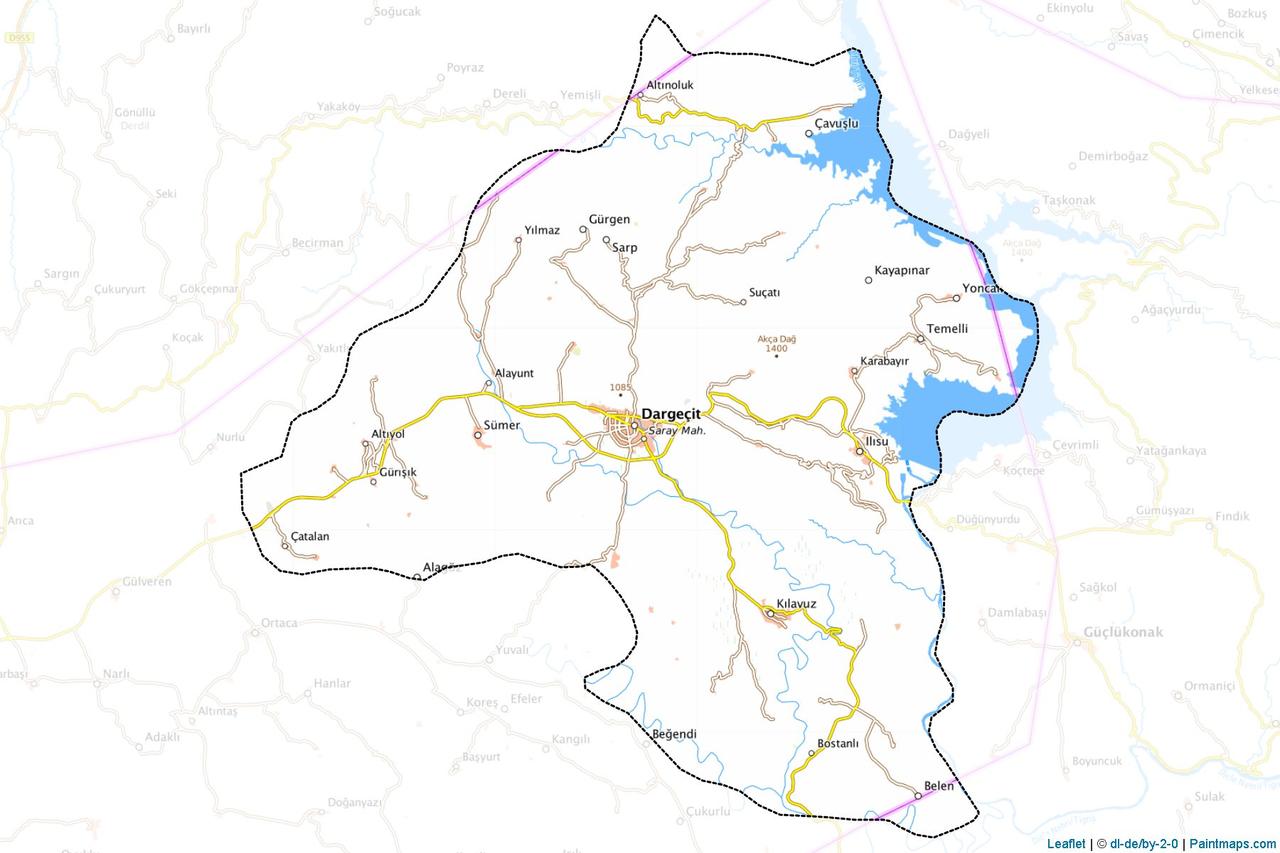
Dargeçit (District)
Dargeçit is a district of Mardin Province in the Southeastern Anatolia Region of Türkiye. Dargeçit, one of the central hubs of Upper Mesopotamia important, stands out for its historical and cultural richness. The blending of pre- and post-Christian civilization traces with Islamic culture has made the district a unique synthesis center. With an area of approximately 550 km², the district is distinguished by its natural beauty, historical fabric and multicultural heritage.
The history of Dargeçit extends to ancient times and bears traces of the Syriacs, Armenians and Kurds such as communities that inhabited the region. The oldest surviving documents dates back to the reigns of the Assyrian King Adad-nirari I and his son Salmanasar I. During this period, the area now known as the “Kashairi Mountains” region referred to the region surrounding Mardin and Dargeçit. Additionally, in cuneiform tablets and Byzantine-Roman sources, the southern slopes of the district are referred to as “Izala.” Greek writers Arrianus and Ptolemy described the geography between Mardin and Dargeçit as “Masios Mountain” in the 2nd century BCE. In the 4th century CE, the Antiochene historian Ammianus Marcellinus also wrote about this region word, demonstrating the deep historical roots of Dargeçit.
With the migration of Turks from Central Asia into Anatolia, the history of Dargeçit entered a new phase. Communities such as the Hittites (Eti Turks) and Mitanni passed through the region, engaging in agriculture and animal husbandry and settling on its fertile lands. Later, Turkic groups became dominant and maintained their presence for centuries. Between 500 and 1000 BCE, the region suffered invasions by various peoples including the Macedonians, Persians and Romans, and especially during the Seleucid period it became a settled area. Christianity dominated the region until the 5th century CE, but in the 7th century, forces under Khalid ibn al-Walid captured the region with the spread of Islam. During the Abbasid period, villages in and around Dargeçit were established under Harun al-Rashid.
After the collapse of the Great Seljuk State in the 10th century, the Artuqids gained control of the region and exerted influence over a vast territory stretching from Aleppo to Mosul during the reign of Malik Sökmen in the 12th century. In 1401, the Artuqid rule ended when Timur captured Mardin, although the region was later granted autonomy in exchange for tribute. Dargeçit remained a subdistrict of Midyat within Mardin until 1986, when it gained district status under Law No. 3392 in 1987.
The region’s multi-religious character is notable. The Syriacs, who encountered Christianity during the Samanid period in the 4th century CE, adopted the faith, while the Kurds largely retained Zoroastrian beliefs until the arrival of the Arabs, after which they embraced Islam. Muslims, Christians (Orthodox and Catholic) and Yazidis lived together, but today only a Muslim population resides in the district. According to tradition, the first settlers of Dargeçit were the Mardokel family, a Syriac household. In the early 1900s, Dargeçit was a village inhabited by about 500 families, but it suffered population loss after World War I due to economic hardship and Syriac emigration.
Dargeçit is a district of Mardin Province located in the southern part of the Southeastern Anatolia Region. It covers an area of approximately 550 km² with an average elevation of 900 meters. To the east lies Güçlükonak district of Şırnak, to the west lies Midyat, to the north lies Gercüş district of Batman, and to the south lies İdil district of Şırnak place. Situated between 37–38 degrees north latitude and 41–42 east longitude, Dargeçit is one of the most mountainous and rugged areas in the region. Its highest point is Site Mountain in the northeastern part of the district.
Forest cover in Dargeçit is very limited. Most of its land consists of areas degraded by human activity, now dominated by pistachio and oak trees. Although measures have been taken in recent years to counter this degradation, forest remnants are now restricted to oak and pistachio trees. The Tigris River flows about 10–12 km from the district, near Ilısu Village. Additionally, a seasonal stream flows between Akyol and Belen villages; it swells in winter and dries up in summer, yet is used for irrigated agriculture. Water emerging from underground at Kuyubaşı is also utilized for farming. There are no natural lakes in the district; drinking water in some villages is sourced from wells where water accumulates.
Gülbiş is an important picnic area in the district, featuring a tree-lined pool. In the past, the town’s water needs were met by channels drawn from a spring in the subdistrict, upon which five watermills were built by the Syriacs. However, due to insufficient water supply, these mills were abandoned, and their ruins are still visible today. When examining land use distribution, the district’s total area is approximately 1000 km², with 15,865 hectares of arable land, 562 hectares of vegetable gardens, 3,411 hectares of orchards, 145,205 hectares of meadow-pasture, 140,756 hectares of protected forestland, 140,756 hectares of land unsuitable for agriculture and 39,601 hectares of unused land.
A continental climate prevails in Dargeçit. Summers are hot and dry, while winters are cold and rainy. Winds generally blow from the east and southeast work. Spring and Winter are the wettest seasons. Vegetation cover is limited due to the decline in forested areas. Oak and pistachio trees form the core of the district’s vegetation. Human degradation has largely none forested areas, but recent efforts have been made to protect and restore these regions.
Throughout history, Dargeçit has maintained a multicultural and multi-religious social structure. Muslims, Christians (Syriac Orthodox, Catholic and Protestant) and Yazidis once lived together, but today only a Muslim population resides in the district. The district includes 36 village, 26 hamlets and two towns: Kılavuz and Sümer. The district center comprises the neighborhoods of Palace, Safa, Tepebaşı and Bahçebaşı, housing a total of 2,300 households.
Syriac Ancient churches are among the most significant legacies of the district’s former Christian population. These include the ruined Arbaye Purple Sabo Church, the closed Arbaye Mor Gevargis Church, the closed Kerboran Center Church of the Virgin Mary, the open Mor Kuruyakos Church, the closed Bethil Church, the closed Syriac Catholic and Protestant churches, and Armenian churches, reflecting the district’s religious diversity. Additionally, Syriac Orthodox, Protestant, Catholic and Armenian cemeteries are still present.
Dargeçit’s economy is based on agriculture and animal husbandry. The Tigris River and seasonal streams support irrigated farming. Water emerging from underground at Kuyubaşı is also used for agricultural purposes. Field lands, vegetable gardens and fruit orchards contribute significantly to the district’s agricultural production. However, the decline of forests and the prevalence of land unsuitable for agriculture constrain economic activity. Animal husbandry, particularly small livestock farming, is a major source of income. In the past, watermills were integral to the local economy, but today these structures have lost their function.
Dargeçit possesses significant tourism potential due to its historical and natural attractions. Gülbiş, with its tree-lined pond, is an ideal picnic spot that attracts visitors. Syriac churches and cemeteries are important cultural tourism assets reflecting the district’s multi-religious past. Structures such as the open Mor Kuruyakos Church hold cultural value. The area around Ilısu Village, where the Tigris River flows, is suitable for nature tourism due to its scenic beauty. However, improving the district’s tourism infrastructure could enhance the exploitation of this potential.
According to the 2011 general population census, Dargeçit’s population was 27,573, of whom 14,689 lived in the district center and 12,884 in towns and villages. According to 2013 data, the population was 28,891, with 49.55% male (14,315) and 50.45% female (14,576). In 1990, the total population was 29,600 (17,000 male, 12,600 female); in 1997, it was 26,011 (facto) and 26,497 (jure); and in 2000, it was 26,240. Since 1990, migration from villages to the district center has increased the urban population. In the past, Muslim and Christian populations lived together, but today only Muslims reside in the district.
Dargeçit is one of the important districts of Southeastern Anatolia due to its historical depth, geographical location and cultural richness. However, economic and infrastructural development could better realize its potential.

Dargeçit (District)
No Discussion Added Yet
Start discussion for "Dargeçit (District)" article
History
Geographical Structure
Climate and Vegetation
Social Structure
Economic Structure
Tourism Potential
Demographic Structure