


This article was automatically translated from the original Turkish version.
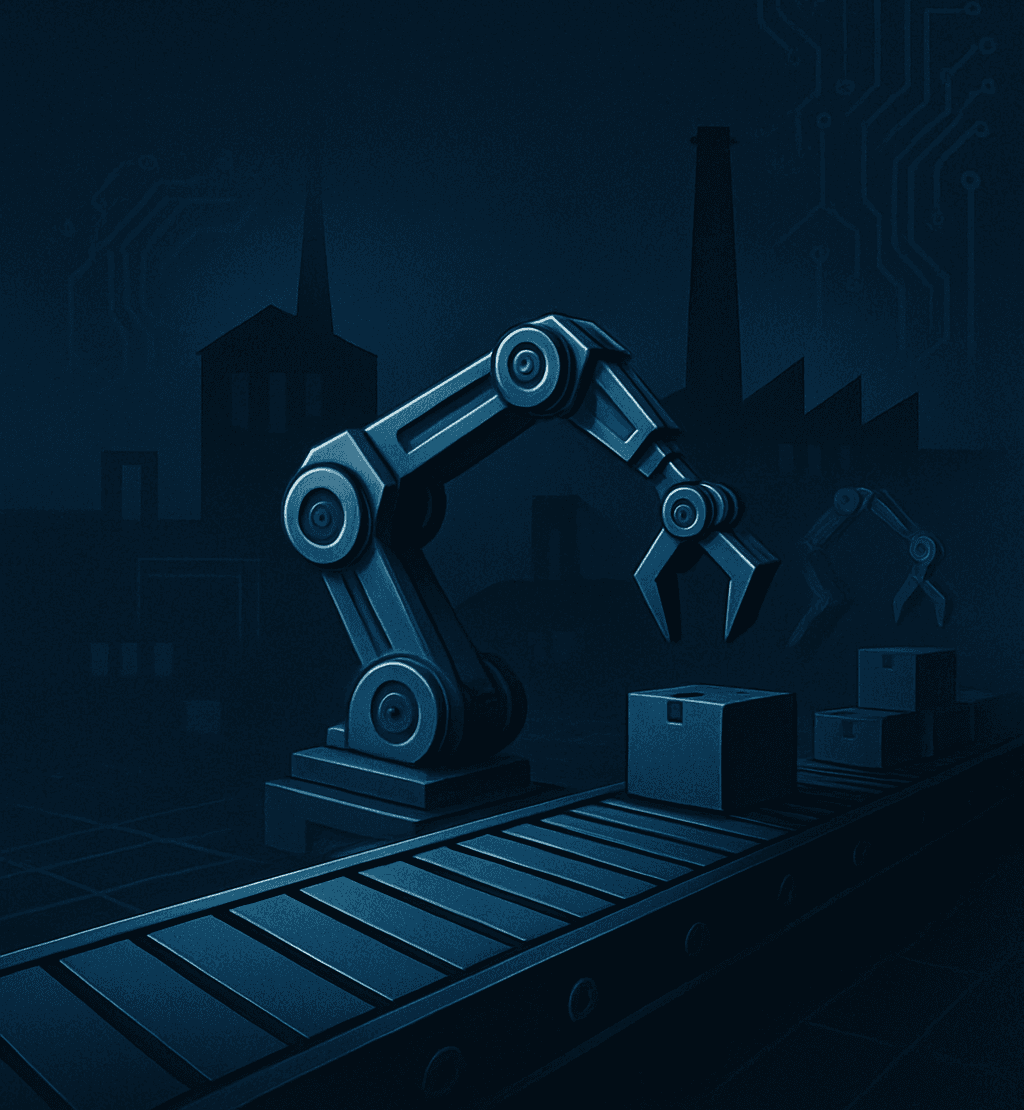
Dark Factory
Target | Efficiency and Automation | ||||||||
|---|---|---|---|---|---|---|---|---|---|
Scope(s) | Industry 4.0 | ||||||||
Human Role | No (Full Automation) | ||||||||
Since the Industrial Revolution, production systems have been in a continuous state of transformation and development. As the final phase of this transformation, the Industry 4.0 paradigm integrates advanced technologies such as the Internet of Things (IoT), Artificial Intelligence (AI), Big Data, and Cyber-Physical Systems into production processes. As a result of these developments, the concept of “dark factories” has emerged. Dark factories are fully automated production facilities that operate 24/7 without human intervention. They derive their name from the fact that, since they require no human labor, they also require no lighting.
Dark factories are production facilities equipped with advanced automation technologies. In these facilities, production lines continuously exchange data through robotic systems, autonomous material handling systems (AGVs), AI-supported decision-making mechanisms, machine learning algorithms, sensors, and IoT devices.
The foundation of these systems is built upon cyber-physical systems, which integrate physical production processes with digital control and analysis infrastructure. Real-time data collection and analysis enable the production process to become self-adapting. For example, at Siemens’ factory in Amberg, Germany, 75% of products are manufactured by robots, and the production line is monitored in real time through its digital twin.
In dark factories, production is optimized not only through automation but also through decision support systems. Thanks to big data analytics, decisions such as demand forecasting, maintenance scheduling, and resource planning are made by algorithms rather than humans. This minimizes human-dependent errors in production processes.
Although dark factories appear to require no human intervention, they encompass numerous fundamental design and management elements from the perspective of industrial engineering. The planning, pre-installation simulations, process analysis, cost and efficiency evaluations of these facilities are all addressed entirely through an industrial engineering lens.
Industrial engineers continue to apply their expertise in areas such as production process streamlining, time-and-motion studies, and ergonomic design within the digital environment of dark factories. Techniques such as simulation-based optimization, workflow modeling (Value Stream Mapping), and return-on-investment analysis for automation investments are widely used in these processes.
Moreover, the integration of systems used in dark factories and continuous improvement (Kaizen) processes are significant areas where industrial engineers contribute. Tasks such as robot layout planning in production systems, volume optimization of automated warehouse systems, or calibration of decision support algorithms using Multi-Criteria Decision Making (MCDM) methods require industrial engineering expertise.
When examining application examples, over 90% of Tesla’s Gigafactory assembly lines are automated, and production planning is supported by AI algorithms.
BMW’s automated press line has achieved labor cost reductions of up to 80%. At Siemens’ Amberg factory, product quality has reached 99.998%. Foxconn’s robotic assembly lines have achieved 25% higher production speed compared to human labor. Bosch’s Stuttgart factory has reduced energy consumption by 30% through AI. General Electric has achieved a 20% increase in efficiency by collecting real-time data from every machine on the production line. Certain sections of BASF’s chemical production facilities have been fully converted to “dark” operations, prioritizing human health. Philips’ robotic toothbrush assembly line can switch between different models in five minutes without encountering human adaptation issues. In Amazon’s dark logistics centers, robots manage inventory with minimal errors, replacing human workers. Industrial engineers play a central role in the deployment and monitoring of such systems.
The greatest advantage of dark factories is the minimization of human-induced errors and the elimination of production interruptions. This significantly reduces time losses and labor costs. Additionally, the continuous monitoring of machines enables predictive maintenance through collected data, minimizing unplanned downtime. Processes are continuously monitored by sensors; anomalies, quality declines, or malfunctions are detected immediately. Planned maintenance and delays caused by breakdowns are largely avoided, allowing uninterrupted production.
Other benefits offered by dark factories include standardization of production quality, more efficient use of resources, and enhanced product traceability. All these factors reduce production costs and enhance competitiveness. Thanks to full automation, labor-related expenses such as shifts, meals, and social benefits are eliminated. The absence of humans in hazardous production environments such as chemical processing drastically reduces workplace accidents to near zero.
Dark factories also bring significant challenges. Their implementation requires substantial capital investment, and the return on investment may take a long time. Moreover, when system failures occur, production may halt partially or completely, as these facilities often lack the flexible human intervention capability. Consequently, timely intervention may be delayed or impossible.
Furthermore, the replacement of human labor by machines can lead to employment losses on a social scale. This situation raises the need for workforce transformation. There is a growing necessity to restructure industrial engineering education to align with this new structure.
Cybersecurity risks are also a critical concern for dark factories. The digital execution of all processes makes production vulnerable to cyberattacks. In this context, new regulations are needed not only from a technical perspective but also from ethical and legal standpoints.
Dark factories are set to play a central role in the future of production systems. These systems provide both cost advantages and quality control through high levels of automation, artificial intelligence, and data analytics. However, this transformation brings not only technological but also structural and professional changes.
The discipline of industrial engineering assumes critical roles throughout all stages of dark factories, from planning to operation. It is anticipated that this role will further expand in the future, and the profession will evolve in line with new production models based on human-machine collaboration. Therefore, both engineering education and industrial organizations must be restructured to adapt to this transformation.
Davies, Ronald. *Industry 4.0: Digitalisation for Productivity and Growth*. European Parliamentary Research Service, 2015. Accessed June 23, 2025. https://www.europarl.europa.eu/thinktank/en/document/EPRS_BRI(2015)568337.
Kagermann, Henning, Wolfgang Wahlster, and Johannes Helbig. *Recommendations for Implementing the Strategic Initiative Industrie 4.0. Final Report of the Industrie 4.0 Working Group*, 2013. Accessed June 23, 2025. https://www.scirp.org/reference/referencespapers?referenceid=2966479.
Kusiak, Andrew. “Smart Manufacturing.” *International Journal of Production Research* 56, no. 1–2 (2018): 508–517. Accessed June 23, 2025. https://www.researchgate.net/publication/318430955_Smart_manufacturing.
Lasi, Heiner, Peter Fettke, Hans-Georg Kemper, Thomas Feld, and Michael Hoffmann. “Industry 4.0.” *Business & Information Systems Engineering* 6, no. 4 (2014): 239–242. Accessed June 23, 2025. https://www.researchgate.net/publication/271950998_Industry_40.
Monostori, László, Botond Kádár, Thomas Bauernhansl, Shinsuke Kondoh, Soundar Kumara, Günther Reinhart, Olaf Sauer, Günther Schuh, Wilfried Sihn, and Kanji Ueda. “Cyber-physical Systems in Manufacturing.” *CIRP Annals – Manufacturing Technology* 65, no. 2 (2016): 621–641. Accessed June 23, 2025. https://publica.fraunhofer.de/entities/publication/482f4edf-2e88-4fe8-a416-33cf62de2ff3.

Dark Factory
Target | Efficiency and Automation | ||||||||
|---|---|---|---|---|---|---|---|---|---|
Scope(s) | Industry 4.0 | ||||||||
Human Role | No (Full Automation) | ||||||||
Technological Infrastructure of Dark Factories
The Role of Industrial Engineering and Its Application Areas
Advantages and Challenges of Dark Factories
Advantages
Challenges and Risks