


This article was automatically translated from the original Turkish version.
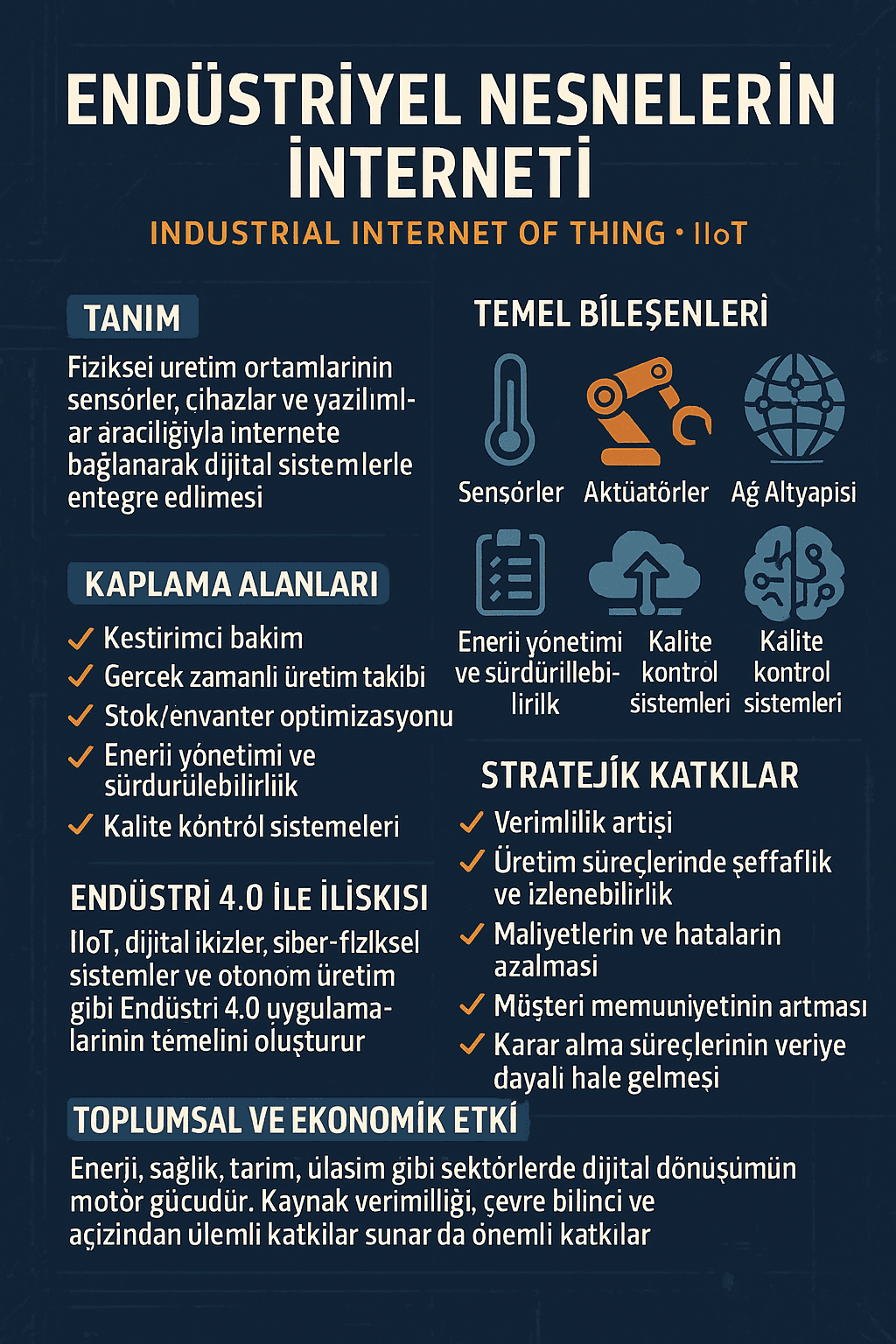
Industrial IoT
Original Name(s) | Industrial Internet of Things | ||||||||
|---|---|---|---|---|---|---|---|---|---|
Type(s) | Technological Concept / Industrial Digitalization | ||||||||
Definition(s) | It is a technological transformation model in which physical production environments are integrated with digital systems. | ||||||||
Basic Components | Integrated Software Artificial Intelligence and Machine Learning Edge and Cloud Computing Network Infrastructure Actuators Sensors | ||||||||
Application Area(s) | Smart logistics and cold chain monitoring Quality control systems Energy management and sustainability Stock/inventory optimization Real-time production monitoring Predictive maintenance | ||||||||
Risks | Digital literacy requirements in the workforce High integration and infrastructure costs Data privacy and compliance issues Cybersecurity vulnerabilities | ||||||||
The Industrial Internet of Things (IIoT) is a technological transformation movement aimed at integrating physical production environments with the digital world. This concept enables production processes to become more efficient, flexible, and intelligent by allowing machines, sensors, and software systems to exchange data over the internet. IIoT is one of the foundational pillars of the Industry 4.0 approach and is transforming not only industrial manufacturing but also sectors such as energy, healthcare, agriculture, and logistics.
Traditional production systems primarily consisted of manual controls and isolated machines. However, with IIoT, this structure has evolved: machines now communicate with each other, collect data, and make decisions based on that data. This shift has led to production being redefined not merely as a physical process but as an information-based one. Today, any machine on a production line can measure real-time temperature data, analyze energy consumption, and automatically send signals to other machines to adjust the production flow as needed.
In these systems, decentralized architectures are emphasized. Data is typically processed not on centralized servers but on edge devices located directly on the production floor. This reduces latency and enables production to respond more rapidly. This capability offers significant advantages, particularly in industrial fields requiring high precision.
One of the most important contributions of IIoT is making the invisible visible on production floors. Thanks to real-time data collection capabilities, machine efficiency, potential failures, and bottlenecks in the production process can be identified in advance, allowing interventions to be planned more effectively. This reduces costs and improves production quality.
Moreover, the data provided by IIoT systems influences not only production processes but also the overall strategic decisions of the enterprise. Senior management can analyze production trends using this data, guide new investments more accurately, and enhance competitiveness in the market.
The effectiveness of Industrial IoT systems depends on the integrated operation of their technological components. Each component performs specific tasks, forming the backbone of digital factories and making production processes more flexible, scalable, and intelligent.
Sensors form the first link in this structure. Smart sensors provide data to the system by continuously measuring numerous physical variables in the production environment, such as temperature, pressure, vibration, humidity, and energy consumption. This data is critical for monitoring machine operating conditions and detecting potential failures in advance.
Data from sensors is converted into physical actions through actuators. For example, when a machine’s temperature reaches a critical level, the system detects this and activates a cooling mechanism. In this way, IIoT does not merely monitor data—it can directly intervene in the production line.
Advanced network infrastructures are required to ensure seamless data transmission and communication between systems. Next-generation connectivity technologies such as 5G, Wi-Fi 6, and LoRaWAN enable low-latency, high-bandwidth data transmission. These communication channels allow the system to make real-time decisions and operate effectively within decentralized architectures.
It is not enough for data to be collected—it must also be processed. This is where cloud computing and edge computing come into play. While cloud environments store data for long-term analysis, edge computing solutions analyze data rapidly near the production site to provide real-time feedback. This enables systems to operate autonomously.
Artificial intelligence (AI) and machine learning (ML) algorithms are needed to extract meaning from collected data. These algorithms identify patterns in the data, analyze production performance, and make predictive forecasts. These capabilities make a significant difference in processes such as predictive maintenance, quality control, and production planning.
A unified software infrastructure is also required to ensure all these components work in harmony. These software systems function like the central nervous system of the network, coordinating between different modules, regulating data flow, and providing users with visual interfaces for reporting.
IIoT is establishing itself at every stage—from the production line to the supply chain—transforming industrial activities. Through IIoT applications, enterprises can achieve higher output with fewer resources while standardizing quality and increasing customer satisfaction.
One of the most prominent applications of IIoT is predictive maintenance. This application enables the early detection of failures by analyzing data such as vibration, temperature, and usage duration from machines. As a result, maintenance can be scheduled without interrupting production, downtime is reduced, and efficiency increases. This method not only lowers maintenance costs but also extends equipment lifespan.
Real-time tracking systems allow every step of the production line to be monitored instantaneously. Operators can see in real time which stage a product is at, how long it takes to complete, and which machines are operating more efficiently. This transparency facilitates the rapid identification and resolution of disruptions in the production process.
Inventory and stock management have also been transformed by IIoT. Thanks to smart shelving systems and sensors, the quantity of each product available can be continuously tracked. Increases or decreases in demand are detected immediately by the system, triggering automated ordering mechanisms. This eliminates situations of excess inventory or stock shortages.
Energy efficiency is one of the fundamental goals of sustainable production, and IIoT contributes significantly in this area. Smart metering devices enable real-time monitoring and analysis of energy consumption. Devices that waste energy are identified, and the system can automatically suggest optimization measures. This reduces both environmental impact and energy costs.
Quality control applications are systems that operate at every stage of production, not just at the final stage. Image processing systems and sensors verify whether products meet established standards. These technologies help detect defective products at the earliest possible stage, reducing waste and customer complaints.
The future of IIoT is not limited to the improvement of existing technologies; it is evolving toward integration with broader industrial and societal systems. Today, these systems are predominantly used in production facilities, but they are expected to become indispensable across many sectors in the near future—from agriculture to healthcare, and from energy to urban management.
The Industry 4.0 vision aims not only for the digitization of production but also for meaningful communication between these digital structures. IIoT sits at the heart of this vision, forming the foundation for applications such as digital twins, cyber-physical systems, and autonomous production. Digital twin technologies create virtual replicas of physical machines or systems, enabling remote monitoring and optimization. This structure makes maintenance processes faster and more cost-effective.
In addition, AI-supported decision systems are enabling greater autonomy in production. IIoT systems process sensor data in real time to trigger decision mechanisms. In the future, these systems are expected to become even more independent with enhanced AI support.
In the energy sector, increased use of IIoT is anticipated through smart grid applications. Real-time monitoring of energy consumption, more efficient utilization of renewable energy sources, and reduction of carbon emissions are all made possible by these systems. This directly contributes to achieving sustainability goals.
Furthermore, it is predicted that IIoT technologies will find greater application in logistics and supply chain management. Vehicles and warehouses equipped with smart sensors will be able to track the location and condition of products in real time, enabling the creation of more efficient logistics networks. This is especially critical for sensitive products such as fresh food and pharmaceuticals.
Another aspect of IIoT’s future structure relates to advancements in cybersecurity. The growing number of connected systems brings with it increased security vulnerabilities. Therefore, future IIoT solutions are expected to be not only more efficient but also more secure in terms of protection mechanisms.
Gilchrist, Alasdair. *Industry 4.0: The Industrial Internet of Things.* Berkeley, CA: Apress, 2016. Accessed May 23, 2025. https://link.springer.com/book/10.1007/978-1-4842-2047-4.
Lee, Jay, Behrad Bagheri, and Hung-An Kao. “A Cyber-Physical Systems Architecture for Industry 4.0-Based Manufacturing Systems.” *Manufacturing Letters* 3, no. 1 (2015): 18–23. Accessed May 23, 2025. https://www.sciencedirect.com/science/article/pii/S221384631400025X.
Muralikrishnan, Adithya Vijayan, and Sabari Kannan Sahadevan. *Integrating Industry 4.0: Enhancing Operational Efficiency through Data Digitalization: A Case Study on Hitachi Energy.* Master's thesis, Master’s Programme in Industrial Management and Innovation, May 2024. Accessed May 23, 2025. https://www.diva-portal.org/smash/get/diva2:1875287/FULLTEXT01.pdf.
Wang, Shiyong, Jiafu Wan, and Chunhua Zhang. “Implementing Smart Factory of Industrie 4.0: An Outlook.” *International Journal of Distributed Sensor Networks* 12, no. 1 (2016): 1–10. Accessed May 23, 2025. https://journals.sagepub.com/doi/full/10.1155/2016/3159805.
Xu, Xun. “From Cloud Computing to Cloud Manufacturing.” *Robotics and Computer-Integrated Manufacturing* 28, no. 1 (2012): 75–86. Accessed May 23, 2025. https://www.sciencedirect.com/science/article/pii/S0736584511000949.

Industrial IoT
Original Name(s) | Industrial Internet of Things | ||||||||
|---|---|---|---|---|---|---|---|---|---|
Type(s) | Technological Concept / Industrial Digitalization | ||||||||
Definition(s) | It is a technological transformation model in which physical production environments are integrated with digital systems. | ||||||||
Basic Components | Integrated Software Artificial Intelligence and Machine Learning Edge and Cloud Computing Network Infrastructure Actuators Sensors | ||||||||
Application Area(s) | Smart logistics and cold chain monitoring Quality control systems Energy management and sustainability Stock/inventory optimization Real-time production monitoring Predictive maintenance | ||||||||
Risks | Digital literacy requirements in the workforce High integration and infrastructure costs Data privacy and compliance issues Cybersecurity vulnerabilities | ||||||||
Industrial IoT Components
Industrial IoT Application Areas
Industry 4.0 and IIoT