


This article was automatically translated from the original Turkish version.
+2 More
Deliryum Sürecindeki Hasta
(Yapay Zeka ile Oluşturulmuştur)
Delirium (Delirium); an acute and transient brain dysfunction or organic brain syndrome developing due to a medical condition, substance use, toxic exposure, or withdrawal.
Delirium is derived from the Latin verb delirare meaning to go off course and the Greek word leros meaning to talk nonsense. 【1】
The description of this condition dates back to antiquity. In the 5th century BCE, Hippocrates interpreted the acute confusional state caused by alcohol withdrawal as inflammation of the mind and brain and named it phrenitis. 【2】
The term delirium in its modern sense was first used by the Roman medical writer Aulus Cornelius Celsus in the 1st century BCE. In medical history, Sutton in 1813 named the clinical picture observed in alcohol-dependent individuals delirium tremens; later, Greiner and Bonhoeffer described this condition using the concept of "clouding of consciousness." Engel and Romano demonstrated through electroencephalography (EEG) findings that the disorder reflects a general reduction in brain metabolism.
The prevalence of delirium varies widely between 4% and 80% depending on the population studied and the clinical setting. 【3】 Delirium is observed in approximately 10% to 30% of hospitalized patients in general medical services, rising to 30% to 50% in patients over 65 years of age.【4】
In elderly patients over 75 years of age receiving care in nursing homes and in patients with terminal cancer or AIDS, delirium prevalence ranges from 25% to 85%. The highest risk groups are patients in intensive care units, where delirium occurs in 40% to 80% of cases, and postoperative patients undergoing major surgeries, especially orthopedic and cardiac procedures. In clinical practice, delirium signs are frequently overlooked; studies show that undiagnosed delirium rates in elderly patients range from 32% to 70%.【5】
The etiology of delirium is multifactorial, resulting from the interaction of predisposing and triggering factors. Advanced age, dementia, visual and hearing impairments, immobilization, chronic systemic diseases, and a history of alcohol use are key predisposing risk factors. An organic etiological factor can be identified in approximately 95% of elderly patients. 【6】
Common triggering medical causes include infections such as urinary tract infections, pneumonia, sepsis, and meningitis; metabolic disturbances such as hypoxia, fluid-electrolyte imbalances, dehydration, hypoglycemia, and organ failure; and cardiovascular diseases, head trauma, and surgical procedures.
Additionally, polypharmacy and certain classes of psychoactive medications play a direct role in delirium development; anticholinergics, benzodiazepines, narcotic analgesics, H2 blockers, antidepressants, and some antibiotics can induce this condition. Sleep deprivation and environmental stressors such as the intensive care unit setting are also initiating factors.
The pathophysiology of delirium is considered a widespread functional disturbance and metabolic dysfunction of the brain. The underlying mechanisms involve reduced cerebral oxidative metabolism and imbalances in neurotransmitter systems.
The most widely accepted hypothesis is decreased acetylcholine activity and increased dopamine levels in the brain. However, disturbances in serotonin, norepinephrine, glutamate, and gamma-aminobutyric acid functions also contribute to the process. At the neuroanatomical level, disruption of functional integrity between the ascending reticular activating system in the brainstem and the prefrontal, posterior parietal cortex, and thalamus explains the impairments in consciousness and attention seen in delirium.
Additionally, neuroinflammation triggered by infection or tissue injury, increased blood-brain barrier permeability due to endothelial dysfunction, and disrupted cerebral perfusion are other mechanisms involved in pathogenesis.
Delirium follows a clinical course that begins acutely over hours or days and fluctuates throughout the day; symptom severity is typically more pronounced during nighttime darkness or early morning hours. The most characteristic feature is reduced ability to focus, sustain, and shift attention. Fluctuations in level of consciousness ranging from lethargy to hyperalertness, short-term memory disturbances, disorganized thought processes, and incoherent speech are observed. Orientation to time and place is frequently lost. Sensory perception errors, visual or tactile hallucinations, persecutory delusions, reversal of the sleep-wake cycle, and emotional lability occur.
Delirium is subdivided into three subtypes: hyperactive, hypoactive, and mixed. In the hyperactive subtype, agitation and restlessness predominate; in the hypoactive subtype, drowsiness and reduced awareness are observed. In the mixed subtype, features of both types alternate during the day. Normoactive types, with no marked change in motor activity, also exist.
The diagnosis of delirium is established by integrating a detailed medical history, physical and neurological examination, and cognitive function tests. According to current diagnostic criteria, diagnosis requires the presence of attention disturbance, additional cognitive or perceptual abnormalities, rapid onset and fluctuating course of symptoms, and evidence that these findings are attributable to an underlying medical condition or substance use.
Scales such as the Confusion Assessment Method, Delirium Rating Scale, NEECHAM Confusion Scale, and Mini-Mental State Examination are used for diagnosis and monitoring.
To identify the underlying cause, initial investigations include complete blood count, renal and liver function tests, electrolyte levels, urinalysis, chest X-ray, and electrocardiography. In cases where the etiology remains unclear, toxicology screening, brain imaging, EEG, or lumbar puncture may be performed. Differential diagnosis must exclude dementia, depression, and primary psychotic disorders.

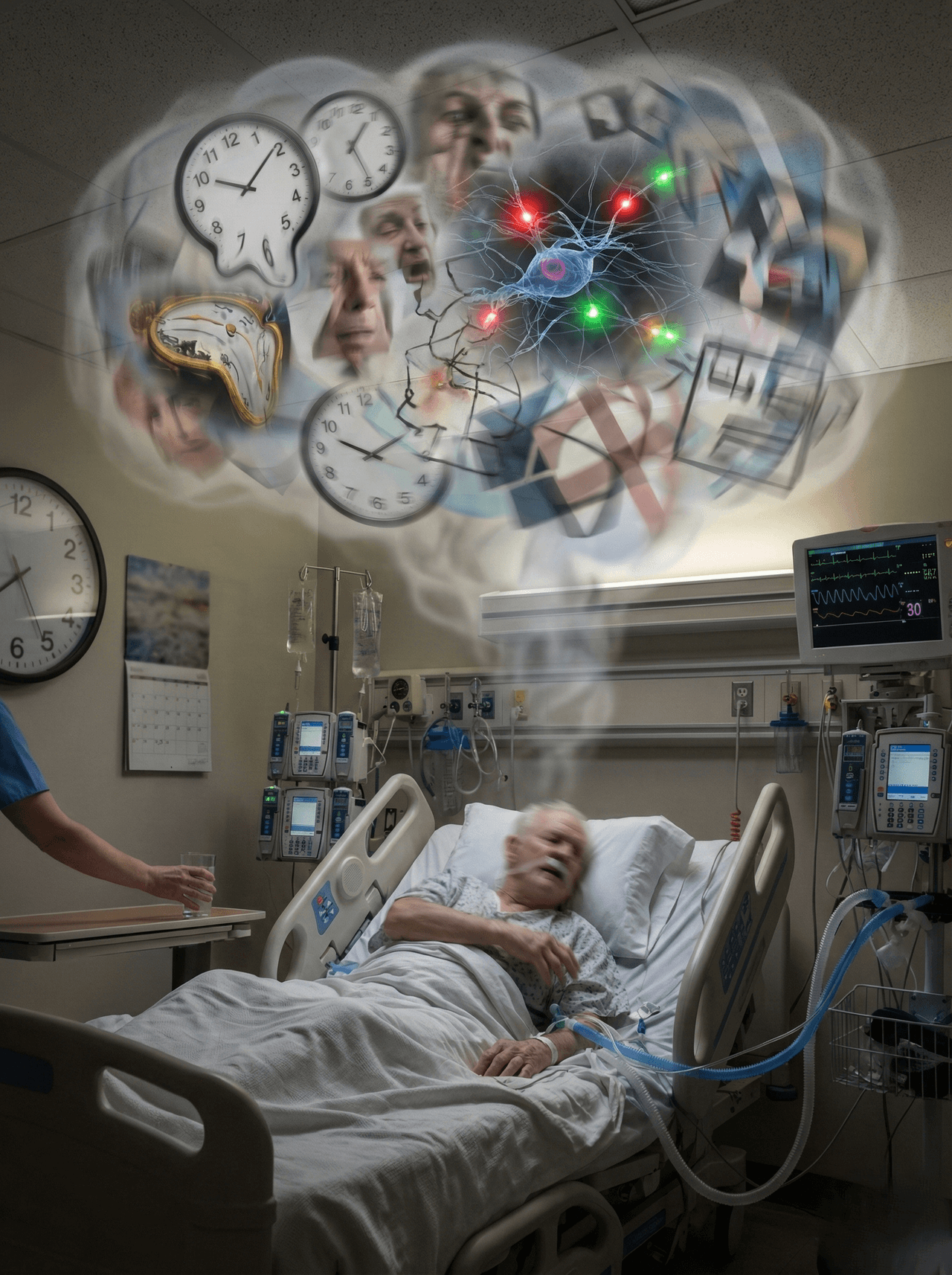
Patient During Delirium Treatment
(Generated by Artificial Intelligence)
Management of delirium is based on rapid identification and removal of the underlying organic trigger.
Treatment proceeds through two approaches: non-pharmacological interventions and pharmacological treatment. Non-pharmacological measures include maintaining a quiet and optimally lit environment, providing visual and auditory assistive devices, supporting orientation with calendars and clocks, correcting fluid-electrolyte imbalances, and preserving the sleep-wake cycle. Physical restraints should be avoided.
Pharmacological treatment is not routinely used; it is reserved only when agitation impedes medical care or poses a safety risk. In drug therapy, typical antipsychotics such as haloperidol, as well as atypical antipsychotics such as risperidone, olanzapine, and quetiapine, are used. Benzodiazepines are generally contraindicated as they may worsen the condition; however, they are the primary treatment for delirium tremens caused by alcohol or substance withdrawal.
Delirium is generally reversible if the underlying cause is promptly treated. However, it is a serious condition associated with high mortality and morbidity risk.
Patients with delirium experience prolonged hospital stays, reduced functional capacity, and a two- to fourfold increased risk of death. Mortality rates within the first month after diagnosis range from 25% to 33%; in high-risk groups, this rate may reach as high as 76%. Effects may persist after discharge; cognitive recovery can take up to a year, and independence in daily living may be impaired.【7】
In inadequately treated cases, permanent neuronal damage may occur, leading to irreversible dementia or death. Physical complications such as falls, fractures, and accidental removal of medical devices may arise due to impaired perception and motor control. Immobility increases the frequency of pressure ulcers, pneumonia, incontinence, and secondary infections. In cases of delirium tremens due to alcohol withdrawal, life-threatening conditions such as autonomic hyperactivity, cardiovascular collapse, and epileptic seizures may occur. Long-term socioeconomic consequences include decline in self-care abilities and increased need for long-term institutional care.
Warning: The content in this article is provided solely for general encyclopedic information purposes. The information here should not be used for diagnosis, treatment, or referral. Before making any decisions regarding health matters, you must consult a physician or qualified healthcare professional. The author and KÜRE Encyclopedia assume no responsibility for any consequences arising from the use of this information for diagnosis or treatment purposes.
Doğu, Özlem, and Hatice Kaya. "Yoğun Bakımda Deliryum ve Hemşirelik Bakımı." *Journal of Human Rhythm* 3, no. 2 (2017): 81–84. Accessed February 19, 2026. https://dergipark.org.tr/en/download/article-file/317094
Dönmez, M. Cem, Duru Gündoğar, and Serpil Demirci. "Deliryum: Nedenleri ve Klinik Yaklaşım." Türkiye Klinikleri Tıp Bilimleri Dergisi 27, no. 5 (2007): 718-724. Accessed February 19, 2026. https://www.researchgate.net/profile/Serpil-Demirci-3/publication/286481113_Delirium_Causes_and_clinical_approach_Review/links/5677991908aebcdda0ea2865/Delirium-Causes-and-clinical-approach-Review.pdf
Halil, Meltem. "Deliryum ve Dahiliye Kliniklerinde Önemi." *İç Hastalıkları Dergisi* 14, no. 1 (2007): 39–44. Accessed February 19, 2026. https://www.ichastaliklaridergisi.org/managete/fu_folder/2007-01/2007-14-1-039-044.pdf
Kaya, Ender, Sinan Sönmez, and Fatma Barlas. "Deliryum." *Okmeydanı Tıp Dergisi* 29, no. 2 (2013): 70–74. Accessed February 19, 2026. https://pdf.journalagent.com/eamr/pdfs/OTD_29_SUP_2_70_74.pdf
Kuşçu, Mehmet Kemal, Volkan Topçuoğlu, Özlem Altunel, and Yasin Bez. "Deliryum Tanısıyla Takip Edilen Hastaların İzlem Sonuçları." *Anadolu Psikiyatri Dergisi* 5 (2004): 16-21. Accessed February 19, 2026. https://storage.imrpress.com/journal/AP/5/1/pii/132373/12861512c161175cf1a69fd05b6aad38.pdf
Onur, Elif, Can Cimilli, and Halis Ulaş. "Psikiyatri Konsültasyonlarında Deliryum." *Demans Dergisi* 3 (2003): 127-130. Accessed February 19, 2026. https://www.halisulas.com/wp-content/uploads/2018/10/Psikiyatri-konsu%CC%88ltasyonlar%C4%B1nda-deliryum.pdf
Çevik, Banu, Elif Akyüz, Ziyafet Uğurlu, Asuman Ersayın, and Nevin Doğan. "Yoğun Bakımda Çalışan Hemşirelerin Deliryum Yönetimi Konusunda Farkındalıklarının Belirlenmesi." Başkent Üniversitesi Sağlık Bilimleri Fakültesi Dergisi 1, no. 1 (2016): 32-46. Accessed February 19, 2026. https://dergipark.org.tr/tr/download/article-file/3649627
Ökdem, F. Ş., trans. "Deliryum." *Kriz Dergisi* 13, no. 1 (2005): 33–45. Accessed February 19, 2026. https://dergipark.org.tr/en/download/article-file/595530
Özer, Kayra Baybora, Zehra Göksu Ulusoy, İlker Kanlı, and Lut Tamam. "Deliryum." *Çukurova Tıp Öğrenci Dergisi* 1, no. 2 (2021): 61–68. Accessed February 19, 2026. https://dergipark.org.tr/en/download/article-file/2194093
[1]
Kayra Baybora Özer vd., "Deliryum," Çukurova Tıp Öğrenci Dergisi 1, no. 2 (2021), access date 19 February 2026, https://dergipark.org.tr/en/download/article-file/2194093
[2]
M. Cem Dönmez, Duru Gündoğar and Serpil Demirci, "Deliryum: Nedenleri ve Klinik Yaklaşım," Türkiye Klinikleri Tıp Bilimleri Dergisi 27, no. 5 (2007), access date 19 February 2026, https://www.researchgate.net/profile/Serpil-Demirci-3/publication/286481113_Delirium_Causes_and_clinical_approach_Review/links/5677991908aebcdda0ea2865/Delirium-Causes-and-clinical-approach-Review.pdf
[3]
Kayra Baybora Özer vd., "Deliryum," Çukurova Tıp Öğrenci Dergisi 1, no. 2 (2021), access date 19 February 2026, https://dergipark.org.tr/en/download/article-file/2194093
[4]
Ender Kaya, Sinan Sönmez and Fatma Barlas, "Deliryum," Okmeydanı Tıp Dergisi 29, no. 2 (2013), access date 19 February 2026, https://pdf.journalagent.com/eamr/pdfs/OTD_29_SUP_2_70_74.pdf
[5]
Meltem Halil, "Deliryum ve Dahiliye Kliniklerinde Önemi," İç Hastalıkları Dergisi 14, no. 1 (2007), access date 19 February 2026, https://www.ichastaliklaridergisi.org/managete/fu_folder/2007-01/2007-14-1-039-044.pdf
[6]
Kayra Baybora Özer vd., "Deliryum," Çukurova Tıp Öğrenci Dergisi 1, no. 2 (2021), access date 19 February 2026, https://dergipark.org.tr/en/download/article-file/2194093
[7]
Ender Kaya, Sinan Sönmez and Fatma Barlas, "Deliryum," Okmeydanı Tıp Dergisi 29, no. 2 (2013), access date 19 February 2026, https://pdf.journalagent.com/eamr/pdfs/OTD_29_SUP_2_70_74.pdf


Deliryum Sürecindeki Hasta
(Yapay Zeka ile Oluşturulmuştur)
No Discussion Added Yet
Start discussion for "Delirium (Delirium)" article
History
Epidemiology
Etiology
Pathophysiology
Clinical Features
Diagnosis
Treatment
Prognosis
Complications