

This article is not approved yet.
Limited delivery alternatives make grocery and other company and office stock management systems inefficient. Security officers handle high volumes and recipients go far to retrieve items left at security stations. Inefficiencies slow workflows and reduce productivity. Manual interdepartmental deliveries delay and divert staff. Data-driven autonomous delivery robots with HMC solve the challenge with strong information processing. LiDAR and GNSS let these outdoor robots navigate and recognize impediments in real time (Ahmad, et al., 2023; Hossain, 2023; Madani & Ndiaye, 2022). Emergency interventions and route optimization are possible using HMC prediction models and decision-making systems.
Designing an autonomous delivery robot
An autonomous stock management delivery robot with enhanced HMC features is the goal of this project. Project uses data-driven technologies and AI-based decision-making to improve logistics, sustainability, and user productivity.
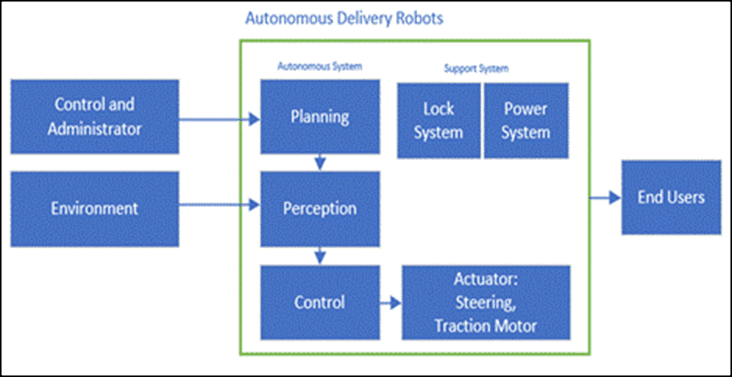
A reliable prototype under varied external conditions is the goal. Modern logistics systems like the Smart System-based Delivery Robot distribute things securely, efficiently, and sustainably throughout campuses and offices. Smart System 4-Layer was used to build this robot:
Control system commands activate steering, acceleration, and braking actuators.
Users will send and receive via robot. A mobile app will notify of delivery status and robot location. It addresses logistical issues and shows smart technology and automation in daily life.

No Discussion Added Yet
Start discussion for "Delivery Mobile Robot" article
Autonomous Delivery
Administration and System Control
Support Systems
Actuators
End-user interfaces