
This article was automatically translated from the original Turkish version.
Producer(s) | United Launch Alliance (ULA) | ||||||||
|---|---|---|---|---|---|---|---|---|---|
First Flight(s) | 21 December 2004 | ||||||||
Last Planned Flight | 2025 (projected) | ||||||||
Total Height | Approximately 72 meters | ||||||||
Launch Weight | ≈ 733,000 kg | ||||||||
Fuel Type | Liquid Hydrogen (LH2) and Liquid Oxygen (LOX) | ||||||||
Payload Capacity (LEO) | ≈ 28,790 kg | ||||||||
Payload Capacity (GTO) | ≈ 14,220 kg | ||||||||
Delta IV Heavy is a heavy-lift launch system developed and operated by United Launch Alliance (ULA), a company based in the United States. The rocket was primarily designed to carry out high-orbit missions for institutions such as the United States Department of Defense, the National Reconnaissance Office (NRO), and NASA. As the most powerful member of the Delta IV family, this system is optimized specifically for transporting heavy payloads to geosynchronous orbit and beyond.
The Delta IV program was initiated in the late 1990s by Boeing under the United States Air Force’s Evolved Expendable Launch Vehicle (EELV) program. In 2006, Boeing’s Delta program merged with Lockheed Martin’s Atlas program to form ULA. The first successful launch of the Delta IV Heavy configuration occurred in 2004.
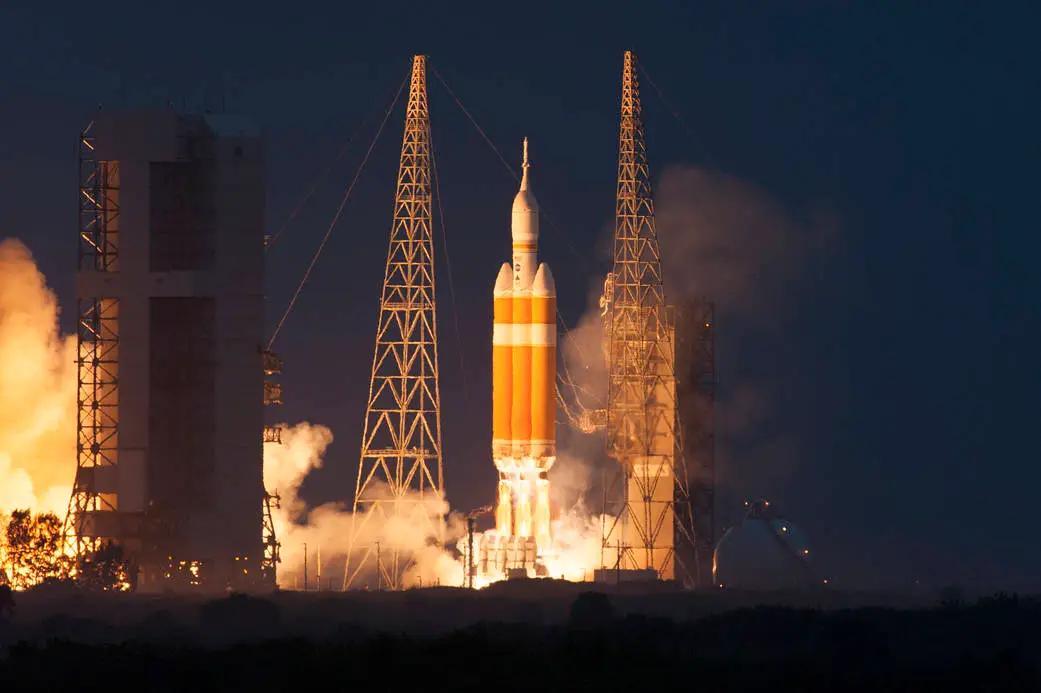
NASA’s Orion Spacecraft Being Launched on an Uncrewed Test Flight Into Earth Orbit (NASA)
Delta IV Heavy consists of three Liquid Rocket Booster (LRB) modules, known as Common Booster Cores (CBCs). One CBC is positioned at the center while the other two are attached laterally to provide additional thrust. This configuration enables high lift capacity through the synchronized operation of three engines of similar diameter.
The payload capacity of Delta IV Heavy is as follows:
Delta IV Heavy has been preferred for missions requiring high precision and heavy lift capability. These include intelligence satellites (such as NROL missions), space telescopes, and deep space missions. The rocket has typically launched from Cape Canaveral Space Force Station (LC-37B) and Vandenberg Space Force Base (SLC-6).
Some notable missions include:
Despite its high payload capacity, Delta IV Heavy faces operational limitations due to its non-reusability and relatively high cost. Although the RS-68A engines generate substantial thrust, they are considered less efficient compared to competing systems such as SpaceX’s Merlin or Raptor engines. Furthermore, with the introduction of ULA’s next-generation Vulcan Centaur rocket, the Delta IV Heavy is being phased out gradually.

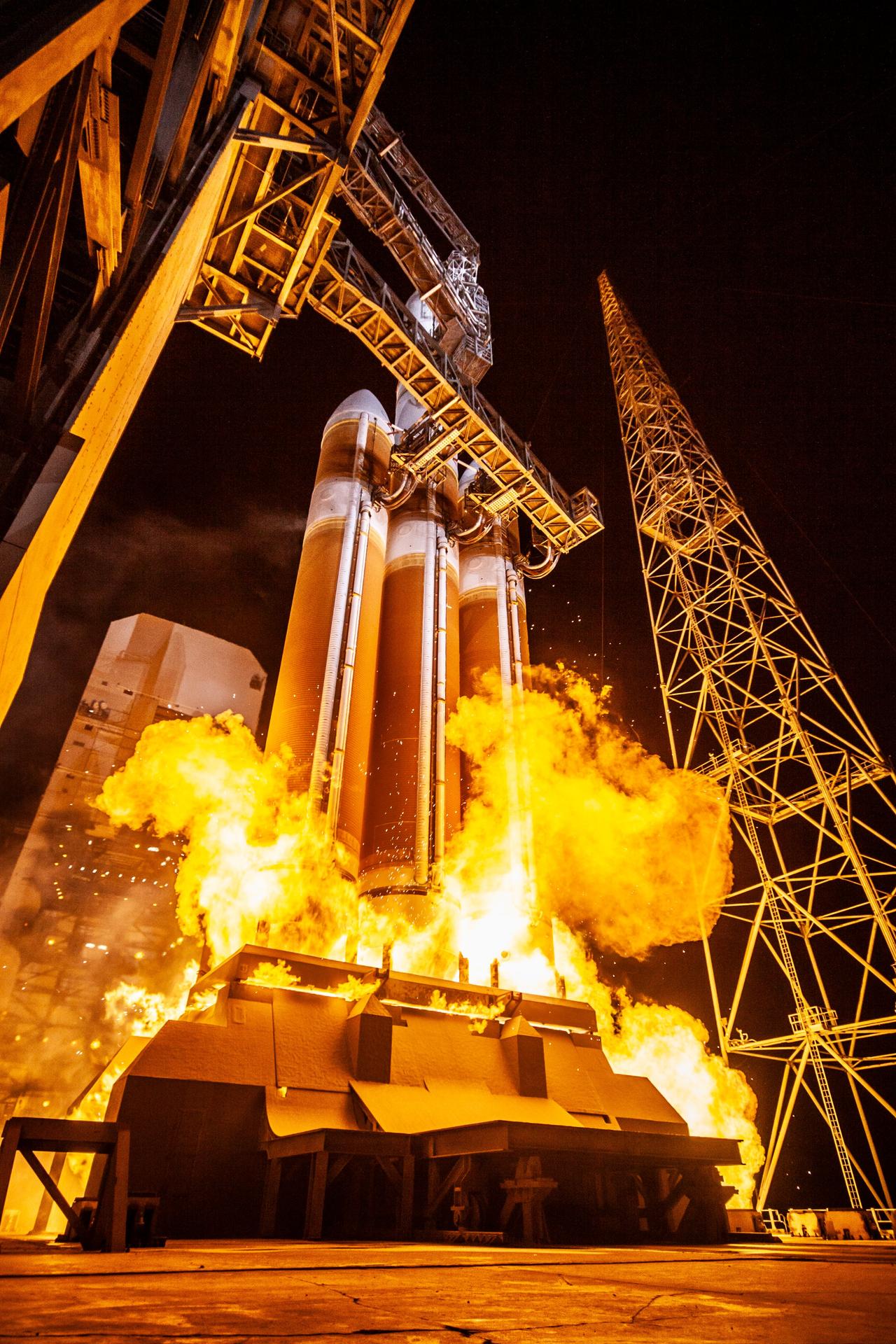
On 10 August 2018, shortly after the Mobile Service Tower was retracted from Launch Complex 37 at Cape Canaveral Space Force Station (NASA)
The cost of a single Delta IV Heavy launch is estimated to range between $350 million and $400 million USD, depending on mission specifics. This high cost has diminished its competitiveness in the market, particularly as reusable rocket technologies have advanced. While agencies such as NASA and the NRO have continued to use it due to its reliability, it has never been a commercially competitive option in the launch market.
ULA has announced that Delta IV Heavy will be fully retired by the mid-2020s and replaced by the Vulcan Centaur system. The Vulcan rocket aims to deliver higher performance at a lower cost. After its final launches, Delta IV Heavy can be regarded as having played a temporary but strategically significant role in the history of space launch vehicles.
Delta IV Heavy is a heavy-lift launch system specifically developed for certain mission profiles requiring high security and payload capacity. As rocket technology advances, it is gradually being superseded by more modern and competitive systems.
NASA. “Orion Launches Atop Delta IV Heavy for EFT-1 Mission.” *NASA*. https://www.nasa.gov/image-article/orion-launches-atop-delta-iv-heavy-eft-1-mission/. Accessed June 21, 2025.
NASA. “ULA Delta IV Heavy Rocket with Parker Solar Probe.” *NASA*. https://www.nasa.gov/image-article/ula-delta-iv-heavy-rocket-with-parker-solar-probe/. Accessed June 21, 2025.
United Launch Alliance. “Delta IV.” ULA. https://www.ulalaunch.com/rockets/delta-iv. Accessed June 21, 2025.
Wall, Mike. “Photos: ULA’s Mighty Delta IV Heavy Rocket Launches NROL-68 Spy Satellite.” *Space.com*. https://www.space.com/ula-delta-heavy-nrol-68-photos. Accessed June 21, 2025.

Producer(s) | United Launch Alliance (ULA) | ||||||||
|---|---|---|---|---|---|---|---|---|---|
First Flight(s) | 21 December 2004 | ||||||||
Last Planned Flight | 2025 (projected) | ||||||||
Total Height | Approximately 72 meters | ||||||||
Launch Weight | ≈ 733,000 kg | ||||||||
Fuel Type | Liquid Hydrogen (LH2) and Liquid Oxygen (LOX) | ||||||||
Payload Capacity (LEO) | ≈ 28,790 kg | ||||||||
Payload Capacity (GTO) | ≈ 14,220 kg | ||||||||
Historical Development
Technical Specifications
Structural Configuration
Propulsion Systems
Payload Capacity
Dimensions and Mass
Mission Profiles and Applications
Operational Limitations of Delta IV Heavy
Cost and Economic Factors
Delta IV Heavy and Its Future