
 Recently Added:
This article was automatically translated from the original Turkish version.
The Democratic Republic of the Congo–Republic of Rwanda Peace Agreement, signed on 27 June 2025 in Washington D.C., the capital of the United States of America, is a comprehensive peace and cooperation document aimed at ending long-standing conflicts between the two countries. The agreement encompasses regional security, border protection, neutralization of armed groups, the voluntary return of refugees and displaced persons, and economic integration processes.

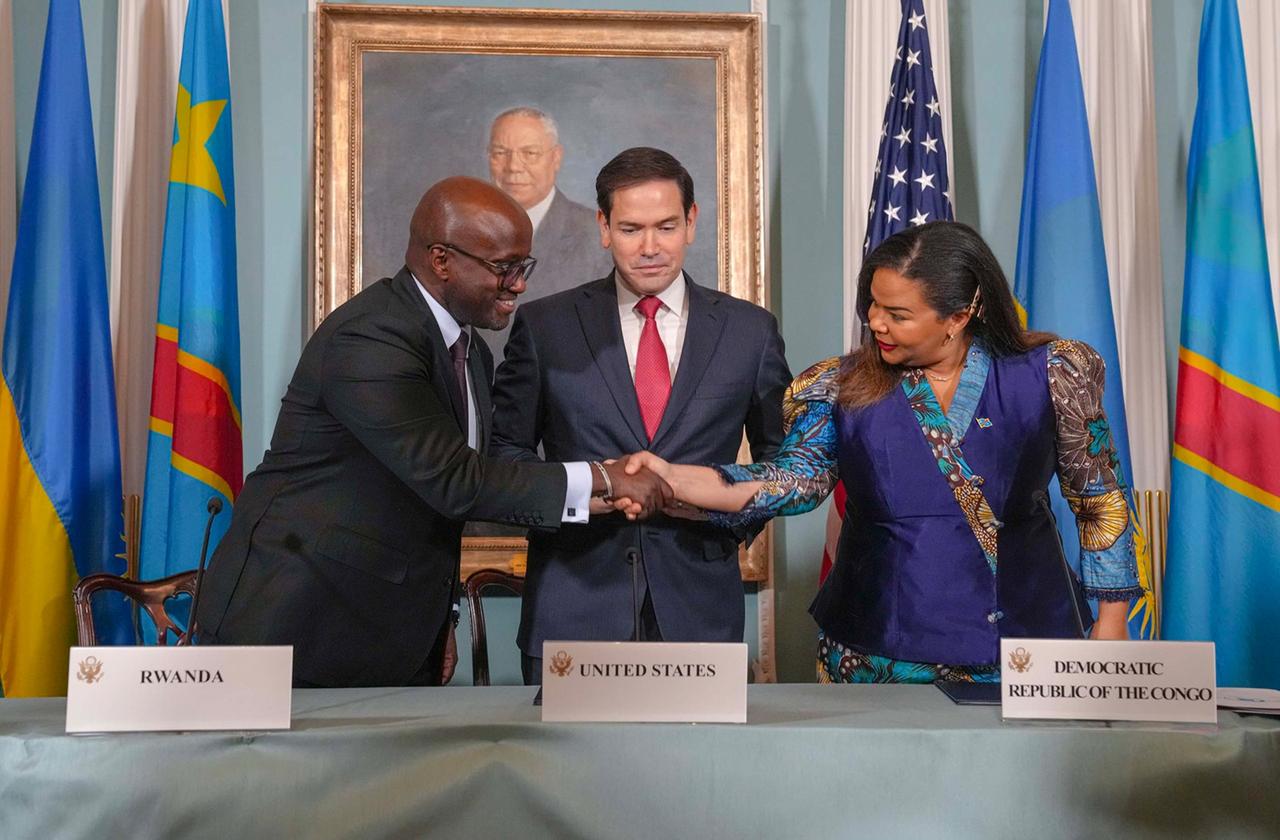
Signing of the peace agreement between the Democratic Republic of the Congo and the Republic of Rwanda, 27 June 2025 – (U.S. Embassy in Rwanda)
Since the 1990s, various armed groups have operated in eastern Democratic Republic of the Congo. These groups have carried out attacks against civilians, seized settlements, and caused widespread human rights violations. The Kinshasa government has accused Rwanda of supporting the M23 rebel group. The Kigali government has denied these allegations. In early 2025, M23 launched offensives in the North and South Kivu provinces, capturing numerous cities including Goma and Bukavu as well as strategic locations. Thousands of civilians were killed and hundreds of thousands displaced during this period.
Throughout 2025, the M23 group gained control over Goma and Bukavu, the two major cities in eastern Democratic Republic of the Congo. It also seized key mining sites and airports in the region. The Congolese government requested security assistance from the United States administration. Parallel negotiations were also conducted between the Congolese government and M23 representatives in Doha.
The agreement was negotiated under the mediation of the United States of America and Qatar. The U.S. Secretary of State Marco Rubio and various Qatari diplomats played active roles in the process. Negotiations advanced through official meetings in Washington and parallel talks in Doha. The parties continued negotiations based on the “CONOPS Plan” developed during the fifth ministerial meeting held in Luanda, Angola in 2024 and the sixth ministerial meeting in November 2024.
The agreement was signed on 27 June 2025 in the Treaty Room of the U.S. Department of State in Washington by the Democratic Republic of the Congo’s Minister of Foreign Affairs Therese Kayikwamba Wagner and Rwanda’s Minister of Foreign Affairs Olivier Nduhungirehe. U.S. Secretary of State Marco Rubio was present at the ceremony. Subsequently, the parties were received at the White House by U.S. President Donald Trump. Trump welcomed both ministers in the Oval Office and presented letters inviting Democratic Republic of the Congo President Félix Tshisekedi and Rwanda President Paul Kagame to Washington. Trump’s Senior Advisor for Africa Massad Boulos also played an active role in the process.
The facilitators of the agreement include the United States, Qatar, and the African Union. Qatar assumed a mediating role in organizing previous talks held in Doha between the parties. The African Union supported diplomatic efforts throughout the process, particularly through the initiative of Angolan President João Lourenço. The East African Community (EAC) and the Southern African Development Community (SADC) also assumed mediation and facilitation roles. United Nations Security Council Resolution 2773 served as one of the key international reference documents defining the framework of the agreement.
Signing of the peace agreement between the Democratic Republic of the Congo and the Republic of Rwanda, 27 June 2025 – (U.S. Department of State)
The agreement emphasizes the obligation of the parties to respect each other’s sovereignty, territorial integrity, and national unity. The parties commit to adhering to the principles outlined in the United Nations Charter, the African Union Constitutive Act, and UN Security Council Resolution 2773. Rwanda is expected to lift its defense measures, while the Democratic Republic of the Congo is required to neutralize the FDLR (Democratic Forces for the Liberation of Rwanda) armed group. The parties agree to refrain from hostile actions against each other, direct or indirect military intervention, and any form of support to armed groups.
The agreement includes provisions on the disarmament, demobilization, and conditional integration of non-state armed groups. The parties affirm their support for the Doha-based negotiations between the DRC and AFC/M23. Under this framework, the neutralization of FDLR, the lifting of defense measures, and the cessation of hostilities by all armed groups are targeted. Where feasible, former combatants may be conditionally integrated into the Armed Forces of the Democratic Republic of the Congo or the Congolese National Police following individual assessments.
The parties commit to establishing the Joint Security Coordination Mechanism (JSCM) within 30 days of the agreement entering into force. The JSCM will consist of military, intelligence, and foreign affairs representatives from both parties. Its responsibilities include identifying the locations of FDLR and affiliated groups, monitoring their activities, and coordinating necessary operations. Meetings will be held alternately in Kinshasa and Kigali. The United States and Qatar will participate as observers.
The agreement includes provisions to ensure the voluntary, safe, and dignified return of refugees and displaced persons. This process will be conducted under the coordination of local authorities and relevant international organizations. The agreement also anticipates the creation of conditions to facilitate access for humanitarian organizations, guarantee the safety of humanitarian personnel, and ensure the delivery of emergency relief supplies.
Commitments regarding the United Nations Peacekeeping Mission in the Democratic Republic of the Congo, MONUSCO, are specifically addressed in the agreement text. The parties pledge to support MONUSCO’s activities aimed at protecting civilians and implementing the peace process. MONUSCO’s freedom of movement and personnel security will be guaranteed. Furthermore, implementation of United Nations Security Council Resolution 2773 and other relevant resolutions will continue.
The agreement foresees the establishment of a “Regional Economic Integration Framework” to be implemented within three months. This framework will take into account existing regional economic structures such as the African Continental Free Trade Area (AfCFTA), the International Conference on the Great Lakes Region (ICGLR), the East African Community (EAC), and the Southern African Development Community (SADC). The parties will develop joint economic projects aimed at increasing foreign trade and investment opportunities derived from critical mineral supply chains in the region. Cooperation from the U.S. government and American investors is anticipated during this process.
According to the agreement, disputes arising between the parties will first be resolved through friendly means. The Joint Oversight Committee (JOC) will be activated to resolve disputes. The committee will examine complaints between the parties, identify violations, and propose solutions. The first meeting of the committee is scheduled to take place within 45 days of the agreement entering into force. The committee’s working procedures will be shaped according to mandates defined at its inaugural meeting.
The agreement also addresses the strategic interests of the United States of America in the region. U.S. President Donald Trump stated during the signing process that significant mining rights had been secured from the Democratic Republic of the Congo. The agreement text stipulates that the parties will cooperate with the U.S. government and American investors on regional economic integration projects. Furthermore, the Washington administration announced the preparation of new trade and investment protocols with the Democratic Republic of the Congo and Rwanda regarding the extraction and supply chain management of critical minerals.
The parties commit to enhancing transparency in regional critical mineral supply chains and preventing illicit trade. In this context, joint value chains linking the economies of both countries are envisaged. The Economic Framework Agreement is expected to establish regulations concerning the trade of strategic minerals including tantalum, gold, cobalt, copper, and lithium. Additionally, cooperation is planned in joint infrastructure projects, energy production, and cross-border trade.
The parties agree to ensure transparency and implement economic oversight mechanisms throughout the entire process, from mineral extraction to refined metal production. Independent audit and monitoring systems will be established to eliminate corruption from investment projects in the region. The agreement anticipates the development of various mechanisms to enable U.S. investment and infrastructure development in projects undertaken in the region.
United Nations Secretary-General António Guterres welcomed the agreement, stating that it represents a significant step toward peace and stability in eastern Democratic Republic of the Congo and the Great Lakes Region. He emphasized the importance of implementing United Nations Security Council Resolution 2773. MONUSCO Mission Head Bintou Keita also affirmed the mission’s support for the peace process.
The Ministry of Foreign Affairs of the Republic of Türkiye, in a statement issued on 30 June 2025, welcomed the peace agreement between the Democratic Republic of the Congo and Rwanda. The statement underscored Türkiye’s continued commitment to contributing to peace, stability, and prosperity in Africa.
Qatar, one of the agreement’s mediators, highlighted its support for the process and emphasized the importance of the talks held in Doha. The African Union, the East African Community (EAC), and the Southern African Development Community (SADC) also stand among the actors supporting the agreement.
Al Jazeera. “DR Congo, Rwanda sign peace deal in ‘turning point’ after years of conflict.” Accessed June 30, 2025. https://www.aljazeera.com/news/2025/6/27/dr-congo-and-rwanda-sign-peace-deal-in-turning-point-after-years-of-war
Anadolu Ajansı. "Türkiye, Kongo Demokratik Cumhuriyeti ve Ruanda Arasındaki Barış Anlaşmasını Memnuniyetle Karşıladı." Accessed June 30, 2025. https://www.aa.com.tr/tr/gundem/turkiye-kongo-demokratik-cumhuriyeti-ve-ruanda-arasindaki-baris-anlasmasini-memnuniyetle-karsiladi/3616443
Associated Press. “Congo and Rwanda sign a US-mediated peace deal aimed at ending decades of bloody conflict.” AP News. Accessed June 30, 2025. https://apnews.com/article/congo-rwanda-drc-peace-deal-m23-trump-5e5b52100729ad6587a6f267c6c79ae0
BBC News. “DR Congo and Rwanda Sign Peace Deal in Washington.” Accessed June 30, 2025. https://www.bbc.com/news/articles/c1e0ggw7d43o
Reuters. “Rwanda, Congo sign peace deal in US to end fighting, attract investment.” Accessed June 30, 2025. https://www.reuters.com/world/africa/rwanda-democratic-republic-congo-set-sign-peace-agreement-washington-2025-06-27/
U.S. Department of State. “Peace Agreement Between the Democratic Republic of the Congo and the Republic of Rwanda.” Accessed June 30, 2025. https://www.state.gov/peace-agreement-between-the-democratic-republic-of-the-congo-and-the-republic-of-rwanda/
United Nations News. “Guterres welcomes peace deal between DR Congo and Rwanda.” Accessed June 30, 2025. https://news.un.org/en/story/2025/06/1165071

The Democratic Republic of the Congo and the Republic of Rwanda signed a comprehensive peace agreement in Washington on 27 June 2025. The agreement covered issues including border security, disbandment of armed groups, refugee return and economic cooperation. The United States and Qatar acted as mediators in the negotiation process. The parties committed to completing military withdrawals within three months and initiating a regional economic integration process.
No Discussion Added Yet
Start discussion for "Democratic Republic of the Congo–Rwanda Peace Agreement (2025)" article
June 30, 2025
Historical Background
June 30, 2025
Signing Process of the Agreement
June 30, 2025
Main Provisions of the Agreement
June 30, 2025
Economic Dimension and Critical Minerals
June 30, 2025
International and Regional Reactions