


This article was automatically translated from the original Turkish version.
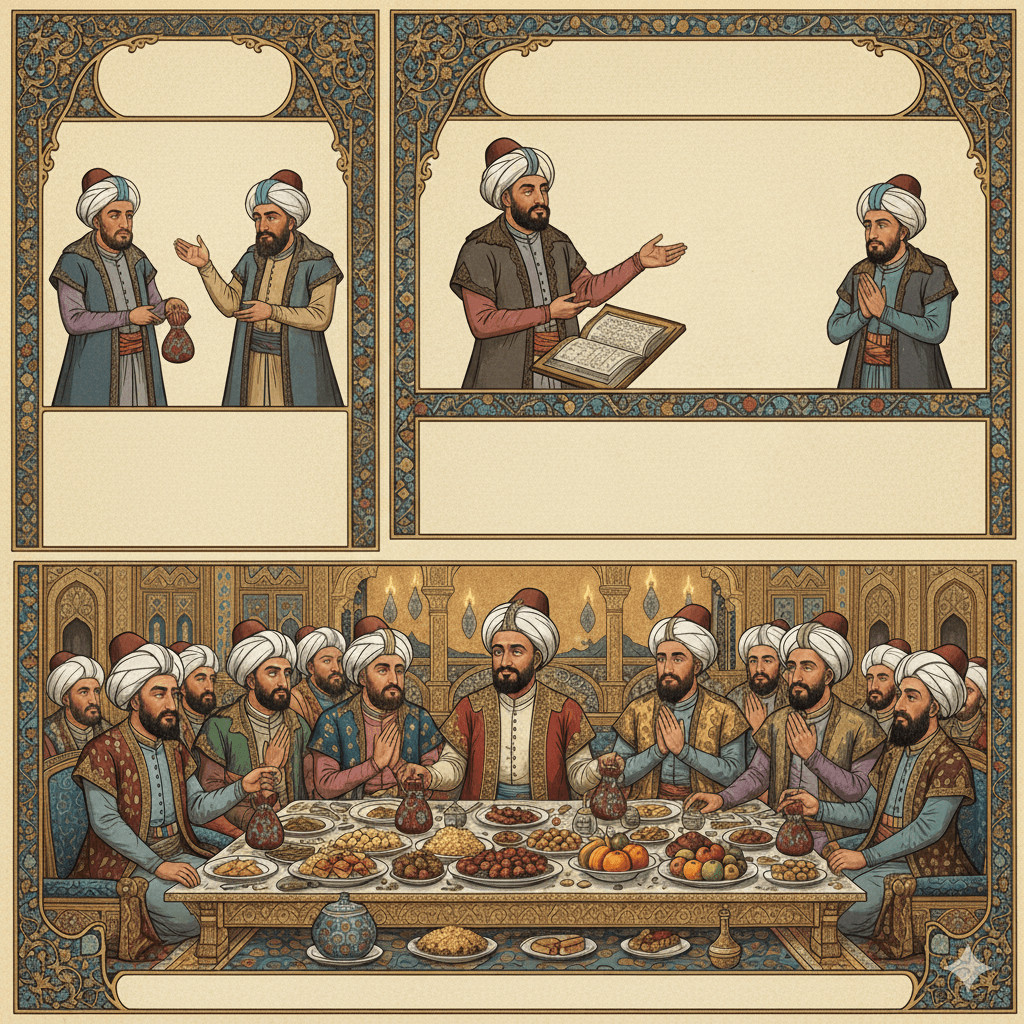
Diş Kirası (Yapay Zeka ile Oluşturulmuştur.)
Diş Kirası is a longstanding tradition in Ottoman society and Turkish culture, referring to cash or in-kind gifts given by the wealthy, state officials, or heads of households to guests invited for iftar, particularly during the month of Ramadan. At the core of this concept is the idea that the guest, by accepting the host’s meal and dedicating their time to the table, has “worn out their teeth” for the host’s sake and thereby earns them spiritual merit. The gift offered in return is thus called the “rent of the teeth.”
The term Diş Kirası and the practice of mutual aid it represents have deep roots in Turkish cultural and state traditions. The earliest written records of this custom appear in the 11th-century work Kutadgu Bilig, composed by Yusuf Has Hajib and regarded as one of the foundational texts of Turkic-Islamic statecraft. The passage advising, “Give gifts to guests; if possible, give the rent of the teeth (tiş teri),” demonstrates that this practice was integrated into Turkish social structures and state protocol soon after the adoption of Islam. The emphasis on “tiş teri” (teeth’s labor or effort) signifies a symbolic compensation offered in return for the guest’s exertion in accepting the host’s hospitality.
The Persian cultural equivalent of this tradition is known as “dandan-muzd” (teeth payment or reward). The 11th-century (1082) political treatise and mirror for princes, Kâbusnâme, provides detailed accounts of similar practices in 10th-century Baghdad and Basra. According to one anecdote in the text, Ibn Muqla, a vizier of the Abbasid Caliphate in the 10th century, forgave the debt of a wealthy tax collector named Naşr, who had been hosted as a “guest-prisoner” in his palace for a month, by granting him “diş kirası” in recognition of the meals he consumed during Ramadan.
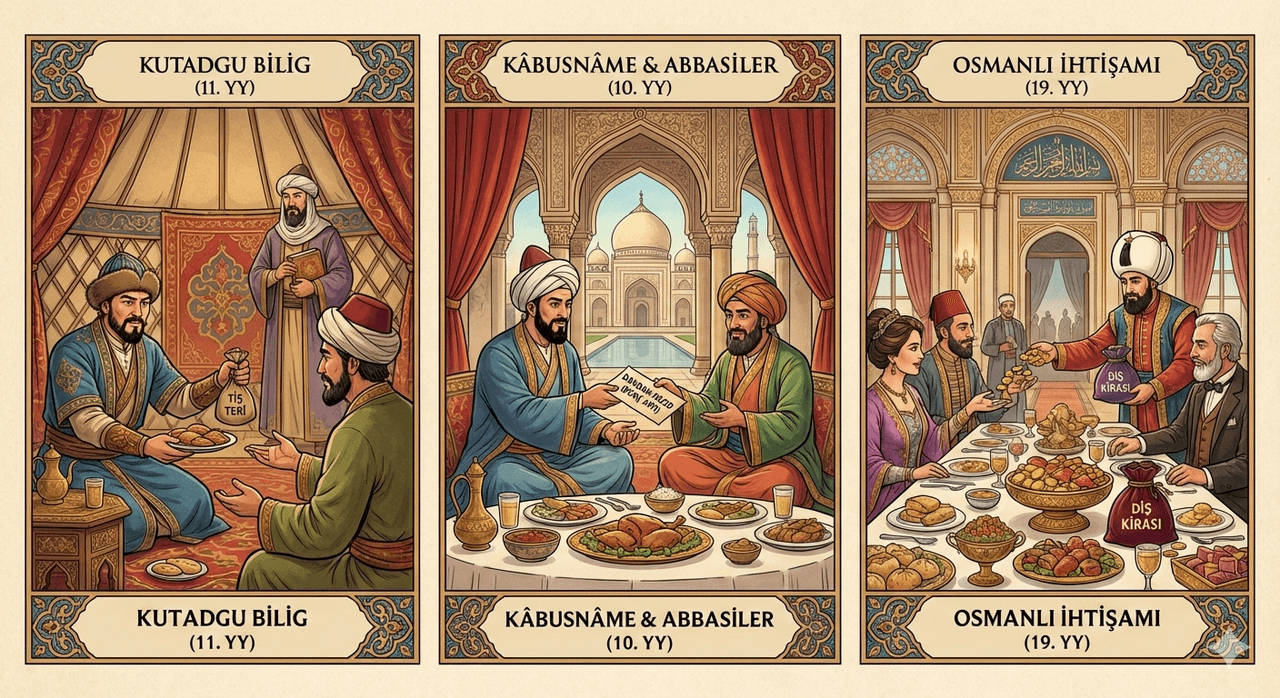
A Visual Representing the Historical Background of the Diş Kirası Tradition (Generated by Artificial Intelligence)
The six different Anatolian Turkish translations of Kâbusnâme produced in the 14th and 15th centuries illuminate the process by which the term entered Ottoman culture. Early 14th-century translators were unable to fully render the term “dandan-muzd” and instead used general expressions of hospitality such as “salt and bread right.” However, the final translation presented to Sultan Murad II in 1432 marks the first clear articulation of the concept, indicating that the tradition began to institutionalize in Ottoman society from the 15th century onward. While this custom lost prominence in 17th-century Iran, it gained momentum in Ottoman society, reaching its peak in the 19th century.
Etymologically, the term derives from the Persian phrase “dandân-muzd” (teeth payment). The presence of similar practices in 11th-century Persian literature, particularly in major works like Kâbusnâme that reflect the social life and etiquette of the era, demonstrates that the tradition was nourished by a shared cultural zone extending from Central Asia to Anatolia.
In the Ottoman context, this tradition gradually acquired an institutional character. One concrete historical example is the custom, observed in the banquets of Mahmud Pasha, Grand Vizier of Fatih Sultan Mehmed, of hiding gold coins within the pilaf. This practice illustrates how Diş Kirası became an integral part of Ottoman palace and noble household life, functioning both as a symbol of generosity and as a mechanism of social assistance.
During Ramadan in Ottoman society, the month served as a period of heightened social solidarity, during which class barriers became more permeable. In Istanbul’s grand mansions and the imperial palace, iftar tables were effectively opened to the public. As an expression of the concept of “the guest of God,” every guest—whether known or unknown to the host, rich or poor—was considered a natural participant in this tradition. Although scholars, dervishes, and medrese students were often given special precedence at these feasts, over time these gatherings became arenas for competition among hosts to demonstrate status and generosity.
The nature of the Diş Kirası gift varied according to the guest’s social status and the host’s means. Typically, gold, silver akçe, or mecidiye coins were presented in embroidered velvet or silk pouches, forming the core of the tradition. However, gifts were not limited to money; depending on the guest’s rank, items such as prayer beads, textiles, amber mouthpieces, silver plates, or jewelry of high material value were also bestowed.
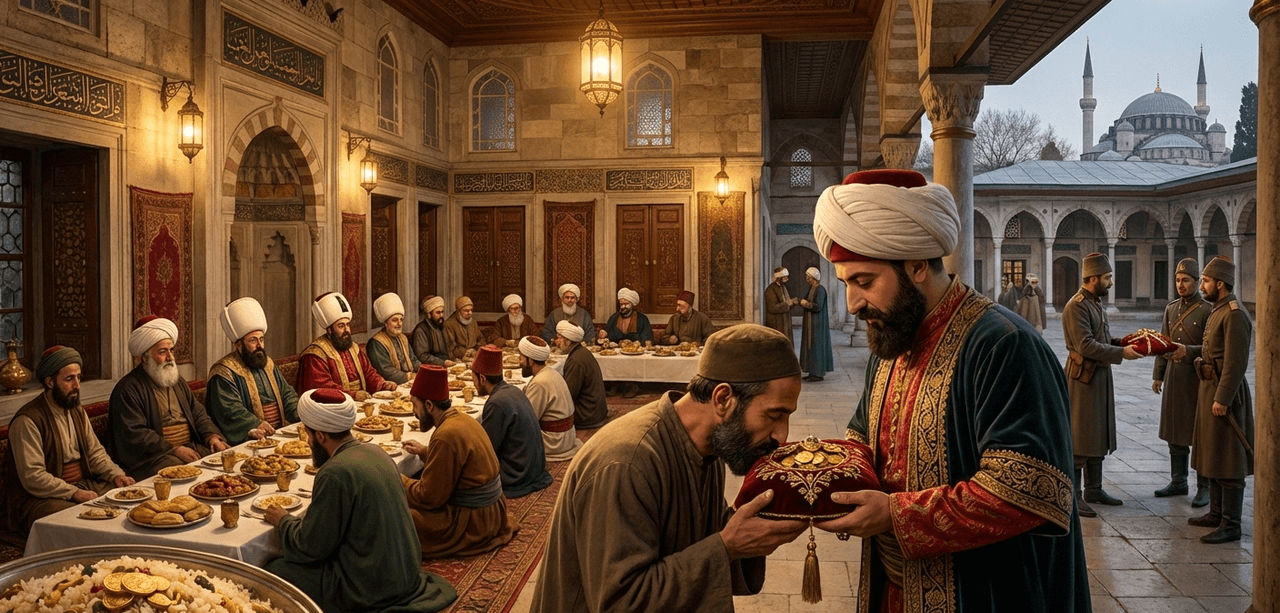
The Implementation of the Diş Kirası Tradition (Generated by Artificial Intelligence)
One of the most famous examples of this tradition is Grand Vizier Mahmud Pasha, Fatih Sultan Mehmed’s chief minister. It is recounted that during his banquets, he had gold coins the size of chickpeas hidden within the pilaf.【1】 Guests who found these coins on their spoons became their immediate owners. This practice not only served as one of the methods by which viziers and state officials shared their wealth with the public but also transformed the banquet into a social event.
The presentation of Diş Kirası was a high ritual expression of the Ottoman philosophy of “not offending while giving.” The gift-giving process followed a strict protocol of courtesy. Especially in the imperial palace, after iftar, guests would convey their respects to the sultan through the harem officials. The harem official bringing the gift would first kiss the pouch or item and place it upon his own head as a sign of reverence, then extend it to the guest. The guest would reciprocate by kissing the gift and placing it upon his own head before accepting it. This mutual ritual of respect symbolized that the gift was not a mere charity, but a refined expression of gratitude offered in return for the guest’s honor bestowed upon the host’s table.
Within Ottoman social structure, Diş Kirası went far beyond a simple act of gift-giving; it elevated mutual aid to an ethical plane. Its most fundamental social function was to dissolve the distance between social classes by bringing the needy and the affluent together at the same table under the shared framework of hospitality. Reflecting Turkic-Islamic aesthetics, the emphasis was not on directly giving alms to the poor in a demeaning manner, but on honoring them as esteemed guests. The host’s acknowledgment that the guest had “worn out their teeth for my food” served as a protective veil, preserving the dignity of the recipient.
However, from the late 19th century onward, the Ottoman Empire’s economic crisis and the state’s diminishing financial capacity began to directly affect this tradition. The economic hardships that replaced earlier periods of abundance transformed Diş Kirası from a voluntary gesture of generosity into a financial burden for householders. Although measures were eventually adopted to restrict participation in iftar feasts to exclude non-invited individuals—particularly those outside the ranks of medrese students and religious officials—these restrictions yielded little practical effect due to the deeply entrenched nature of the custom. With the advent of the Second Constitutional Era, the erosion of the old palace protocol and the gradual decline of noble household life further weakened the institutional support for the tradition.
The complete disappearance of the tradition occurred during and after the National Struggle, amid broader social transformations. The widespread poverty and wartime economy, in which the nation sacrificed all its resources for the defense of the homeland, rendered such large-scale and costly feasts unsustainable. With the proclamation of the Republic, the changing social structure, modernized lifestyles, and the replacement of mansion culture by apartment living caused Diş Kirası to lose its status as a social obligation or widespread custom. Today, this tradition is remembered in collective memory as one of the symbols of mutual aid and survives only as a cultural heritage.
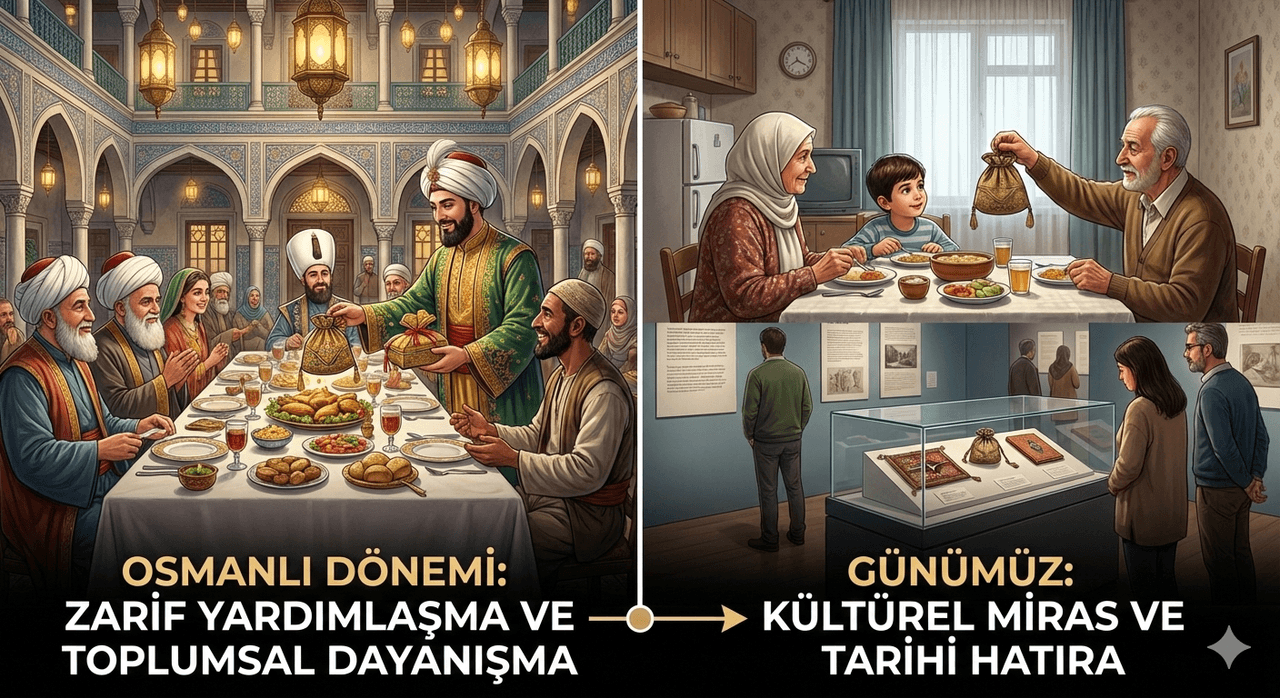
A Visual Representing the Social Function of the Diş Kirası Tradition (Generated by Artificial Intelligence)
Although in Ottoman social life the term Diş Kirası primarily symbolized the elegance and culture of mutual aid during Ramadan, throughout history it also came to denote a very different practice. This alternative usage was particularly associated with the elite military units of viziers and high-ranking state officials known as “deliler” (madmen or wild soldiers).
The deliler, who formed part of the personal retinue of viziers and were known for their bravery, normally received salaries or provisions from their patron. However, when a vizier was dismissed, demoted, or faced financial difficulties, these soldiers’ stipends were often cut off. Left without means of subsistence, they frequently turned into uncontrollable forces. During this period, the deliler began to forcibly demand money, food, and livestock from the local population.
The payments extorted by the deliler and their retinues from the populace were also called “Diş Kirası.” In this context, the original meaning of “a gift given in return for the guest’s exertion at the table” was replaced by “demands made by those who consumed the people’s food.” The soldiers, while securing provisions for themselves and their horses, prompted the local population to adopt the name of the Ramadan tradition as a way of describing or mitigating this coercive burden.
[1]
DİA, "Diş Kirası" TDV İslam Ansiklopedisi, Access 14 February 2026, https://islamansiklopedisi.org.tr/dis-kirasi


Diş Kirası (Yapay Zeka ile Oluşturulmuştur.)
Historical Background and Etymology
Implementation and Rituals
Social Function and Decline
Usage in a Different Sense