


This article was automatically translated from the original Turkish version.
+1 More
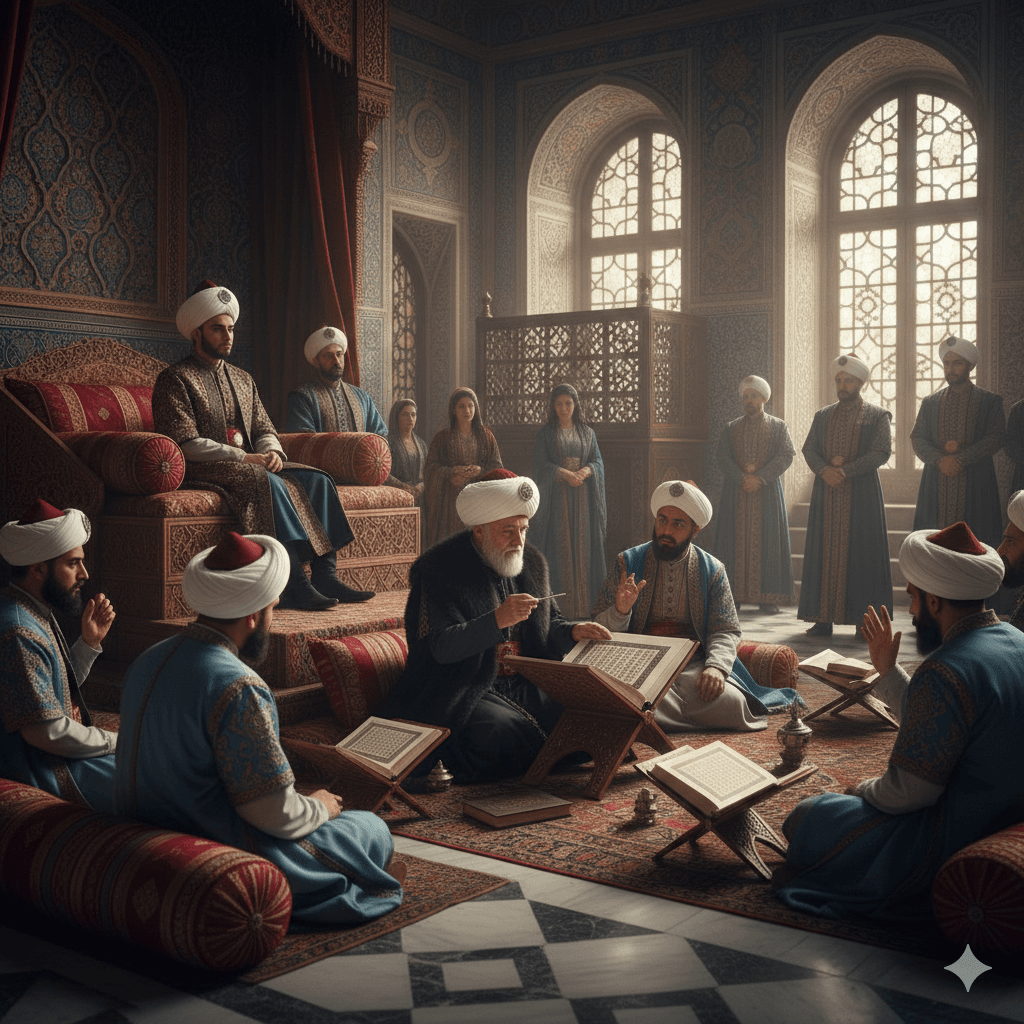
Huzur Dersleri (Yapay Zeka ile Oluşturulmuştur.)
Huzur lessons (full name: Huzûr-ı Hümâyun dersleri) were systematic exegetical discussions conducted in the presence of the Ottoman sultan by Islamic scholars during the month of Ramadan. These lessons constituted one of the highest intellectual platforms where scholarship and politics converged, continuing the Islamic tradition of “muhâdara.” In these assemblies, attended personally by the sultan, verses of the Qur’an were examined from linguistic, jurisprudential and theological perspectives, while simultaneously emphasizing the state’s commitment to learning and the legitimacy of the dynasty.
The origins of Huzur lessons, one of the most enduring traditions in the Ottoman state uniting religious and political authority, lie in the Arab “muhâdara” and classical Islamic “müzakere-münazara” culture. From the founding years, Ottoman sultans placed great importance on gathering scholars around them to ground their legitimacy in intellectual authority and cultivate a scholarly environment. The intensification of scholarly debates during the reign of Fatih Sultan Mehmed, with the sultan’s direct participation, is regarded as the first concrete steps of this tradition. The lessons on the Bayzâvî tafsir commissioned by IV. Mehmed in 1669 from Şeyhülislâm Minkārîzâde Yahyâ Efendi and the renowned preacher Vanî Mehmed Efendi marked a pivotal turning point in the nature of these sessions.【1】 However, practices during this period were not yet structured, regular, or institutionalized for Ramadan; they remained isolated events dependent on the sultan’s personal interest.
The first systematic prototype of Huzur lessons in the modern sense was initiated in 1136 by Grand Vizier Nevşehirli Damad İbrahim Paşa in his own palace.【2】 İbrahim Paşa gathered the scholars of the era during Ramadan to deliver tafsir sessions, and in 1728 Sultan III. Ahmed attended one of these lessons, thereby paving the way for their inclusion in the palace protocol.【3】 III. Mustafa’s participation in these lessons during his princely years under his father’s reign significantly influenced his later decision to institutionalize the tradition. Indeed, Huzûr-ı Hümâyun dersleri were officially institutionalized by the order of III. Mustafa in Ramadan 1172 and incorporated into the state’s protocol regulations.【4】 According to the records of the “III. Mustafa Rûznâmesi,” the first official lesson, presided over by Fetva Emini Ebûbekir Efendi as the “mukarrir” (presenting scholar), addressed verse 135 of Surah Nisa concerning the commandment of justice.【5】
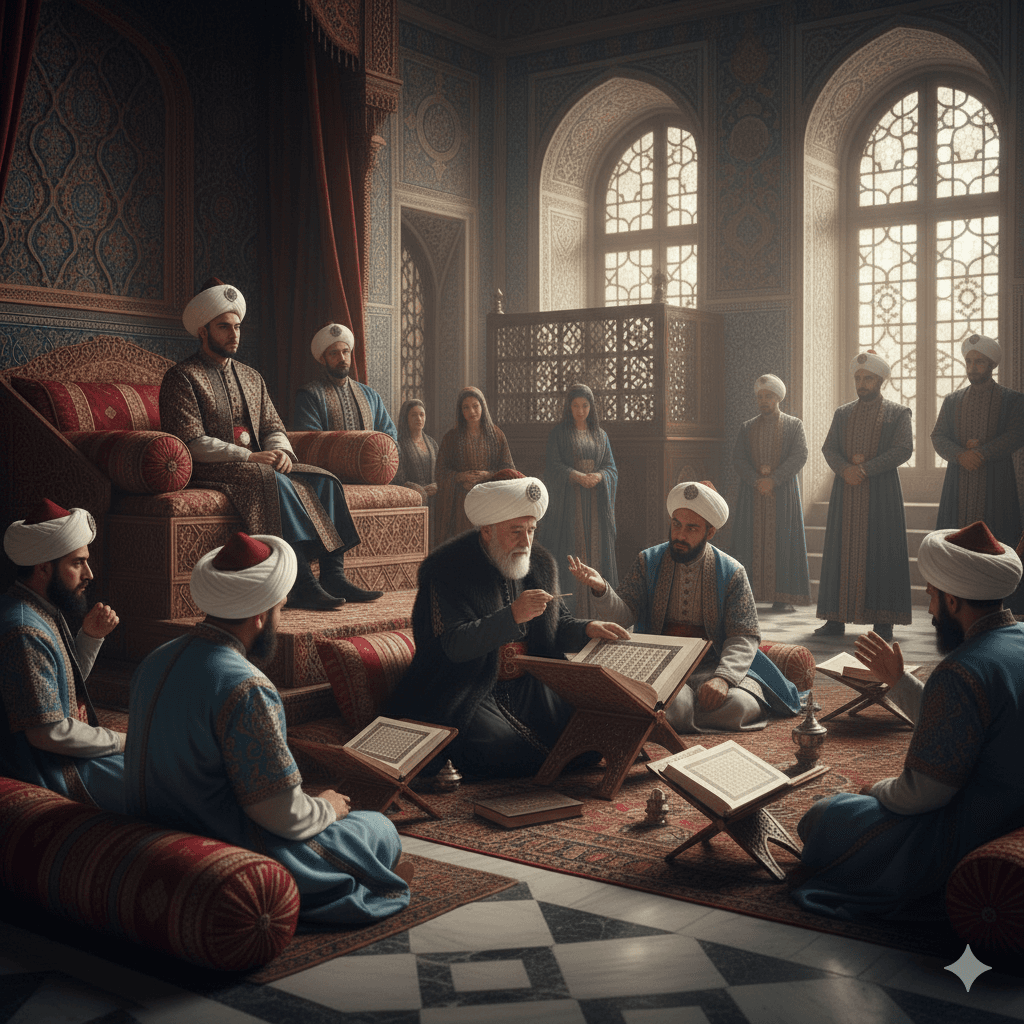
A Visual Depicting the Implementation of Huzur Lessons (Generated by Artificial Intelligence)
From the second half of the eighteenth century onward, Huzûr-ı Hümâyun dersleri became firmly established as a state tradition and were reinforced in the nineteenth century under II. Mahmud with new principles. During this period, the lessons were maintained at a balanced level—not merely as scholarly debates but also as sessions that would not overly tax the sultan’s mind while preserving their intellectual depth; topics such as gazâ and cihad were encouraged.【6】 Under Sultans Abdülaziz and II. Abdülhamid, these assemblies became part of the court ceremonial, conducted in the salons of Dolmabahçe and Yıldız Palaces according to a strict hierarchy and principle of confidentiality.【7】 The structure, which achieved its institutional identity under III. Mustafa in 1759, endured even through the harsh conditions of the First World War and the Armistice years, with its final session held in the presence of Caliph Abdülmecid Efendi in 1923.【8】 With the abolition of the caliphate on 3 March 1924, this 165-year-old official tradition of Ottoman scholarly life faded into history.【9】
Huzûr-ı Hümâyun dersleri constituted a complete ritual system, meticulously defined within the intricate details of Ottoman court protocol and woven with religious and political symbolism. The commencement of the lessons was announced by a formal procession known as the “biniş merasimi,” attended by the sultan and state officials.【10】 The assemblies were held between the noon and afternoon prayers during the first ten days of Ramadan (in some periods, eight sessions).【11】 The venue was entirely at the sultan’s discretion and ranged from historic halls in Topkapı Palace such as the Sepetçiler Kasrı, Sarık Odası, or Sofa Köşkü, to later venues like the Muayede Salonu of Dolmabahçe Palace and the Çit Kasrı of Yıldız Palace.【12】 The arrangement of the hall was designed to reflect both the authority of scholarship and the majesty of the sultanate. The sultan occupied a raised cushion or couch directly opposite the assembly, while the scholars sat on cushions arranged in a semicircle (crescent shape) around the mukarrir, who was positioned to the sultan’s right, each with their own rahle (scripture stand).【13】
A defining feature of the proceedings was the strict adherence to scholarly hierarchy and confidentiality. Beginning on the fifteenth of Şaban, scholars were notified of their selection for participation, but they were strictly forbidden from engaging in any private discussions among themselves until the day of the lesson.【14】 The primary purpose of this rule was to ensure that the scholarly debate before the sultan unfolded with complete sincerity, naturalness, and intellectual effort. This prohibition against pre-planned arguments compelled the scholars to demonstrate their immediate scholarly knowledge and intellect. The lesson began with the mukarrir reciting a designated verse from the Qur’an and analyzing it based on Kādî Beyzâvî’s tafsir, “Envârü’t-tenzîl.”【15】 During this exposition, the muhataps raised objections or posed questions from the perspectives of etymology, logic, and jurisprudence. The discussions were conducted at a detailed and academic level; debates over the origins of words or the grammatical function of conjunctions such as “vav” could extend the exegesis of a single surah to five or six years. For example, the tafsir of Surah Isrâ lasted three years (1775–1778), while the discussion of the first thirty verses of Surah Bakara spanned five years.【16】
As part of protocol, dress codes were also observed: typically, the mukarrir wore a black cübbe while the muhataps wore blue ones.【17】 In addition to the sultan, princes, viziers, and high-ranking state officials attended as listeners, while palace women observed the discussions from behind a curtain.【18】 Upon conclusion of the lessons, the sultan withdrew to the Harem, after which scholars received “atıye”—monetary gifts, valuable cübbes, shawls, and special presents—according to their scholarly rank.【19】 Although during the reign of II. Mahmud there were occasional requests to conduct the lessons in a simpler “avam üslubu” (popular style), the general practice remained grounded in a rigorous and profound scholarly discourse.【20】
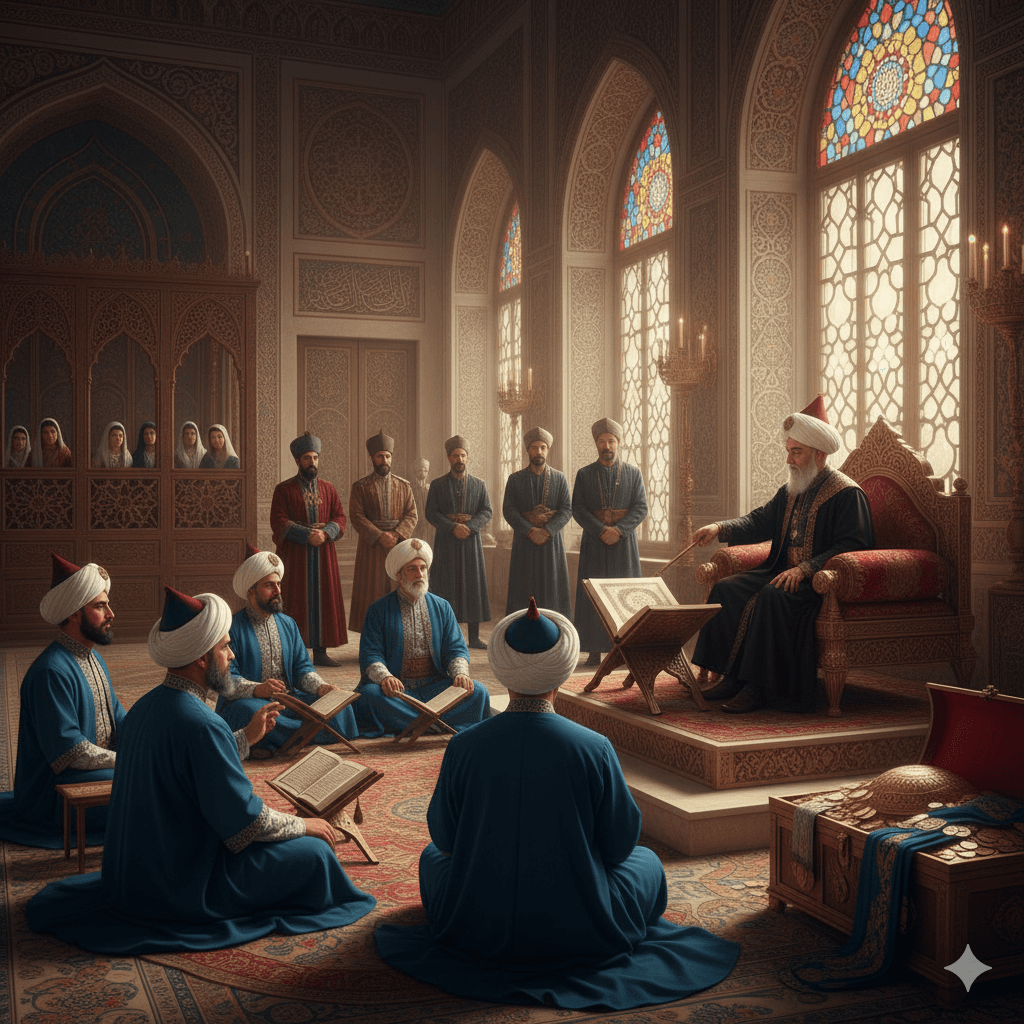
A Visual Depicting the Procedure of Huzur Lessons (Generated by Artificial Intelligence)
The disciplinary framework of the lessons extended beyond the assembly itself to encompass the social lives of participants. Scholars selected to attend the Huzur lessons were regarded as “on duty” throughout Ramadan; thus, leaving Istanbul, undertaking the Hajj, or visiting relatives required written permission from the Şeyhülislâm and the sultan’s approval.【21】 Continuity of attendance was essential; if a mukarrir could not attend due to a valid excuse such as illness, the chief muhatap could not automatically replace him—only a new decree from the sultan could resolve the situation.【22】 According to customs established in the nineteenth century, when a vacancy occurred in the mukarrir position, the muhataps were promoted according to seniority, demonstrating that the institution operated a merit-based promotion system within its own ranks.【23】
Huzur lessons, a synthesis of Ottoman scholarship and politics, consisted of three fundamental elements built upon a hierarchical protocol. At the center of this structure stood the sultan, serving as patron, organizer, and highest-ranking listener. The sultan’s role in the assembly extended beyond passive attendance; he was also the guarantor of scholarly freedom and the authority who conferred honors upon the scholars at the conclusion of the session. The sultan’s presence elevated the seriousness of the subject under discussion and symbolized the state’s highest echelon’s commitment to a foundational scholarly discipline such as Qur’anic exegesis. The sultan’s position within the assembly was deliberately arranged as a balancing element, representing the spiritual authority of scholarship over politics and the respect of politics for scholarship.
The most critical figure in the proceedings was the mukarrir, the designated lecturer chosen from among the senior and most qualified scholars of the day. The mukarrir’s primary function was to present a pre-selected verse interpreted through the lens of Kādî Beyzâvî’s “Envârü’t-tenzîl” tafsir.【24】 However, the role of the mukarrir was not merely to recite and explain the text; while analyzing the verse linguistically (sarf-nahiv), etymologically, and jurisprudentially, the mukarrir was also required to defend his interpretation against rigorous challenges and objections from the muhataps. The mukarrir’s competence was measured by both his mastery of the tafsir text and his composure and persuasiveness during debate. The mukarrir occupied a position to the right of the sultan, close to him, representing academic authority.
The third element of the structure consisted of the muhataps, who acted as interlocutors (known as “tâlipler” in the early period). Their role was to subject the mukarrir’s interpretations to scholarly scrutiny, pose questions, and deepen the discussion. The muhataps sometimes challenged the mukarrir with such forceful objections that they pushed him into intellectual dilemmas, ensuring a comprehensive understanding of the interpreted verse.
The selection of scholars for Huzur lessons was based on a rigorous hierarchy and merit principle, reflecting the state’s high regard for scholarship. Participants were chosen from among müderris (professors) who had received their scholarly credentials in Istanbul, held high scholarly rank, resided in Istanbul, and held no official administrative post.【25】 The selection process was finalized by the sultan’s decree following a meticulous review and recommendation by the Şeyhülislâm’s office (Meşihat).【26】 During this process, not only the scholars’ intellectual depth but also their social prestige and moral conduct were decisive criteria. When a vacancy occurred in the mukarrir position, the chief muhatap of the current assembly was promoted by seniority. However, if a mukarrir could not attend due to a valid excuse, the chief muhatap could not automatically replace him; a new nomination by the Şeyhülislâm and the sultan’s approval were required.
The distinguishing feature of the lessons was their conduct within an environment of absolute scholarly freedom. While the mukarrir interpreted the verse, the muhataps could raise severe scholarly criticisms and pose challenging questions without restraint. However, this freedom of expression required strict adherence to the scholars’ “adab-ı münazara” (rules of scholarly debate). Those who violated scholarly boundaries by using disrespectful language toward the mukarrir or the assembly were punished by the state. For instance, in 1763, Tatar Ali Efendi was exiled to Bozcaada for exceeding the bounds of courtesy during debate; in 1801, III. Selim immediately dismissed three muhataps whose unnecessary objections disrupted the dignity of the session.【27】 During the reign of II. Mahmud, scholarly disputes among the ulema were subjected to legal and jurisprudential review to preserve the seriousness of the assembly.【28】
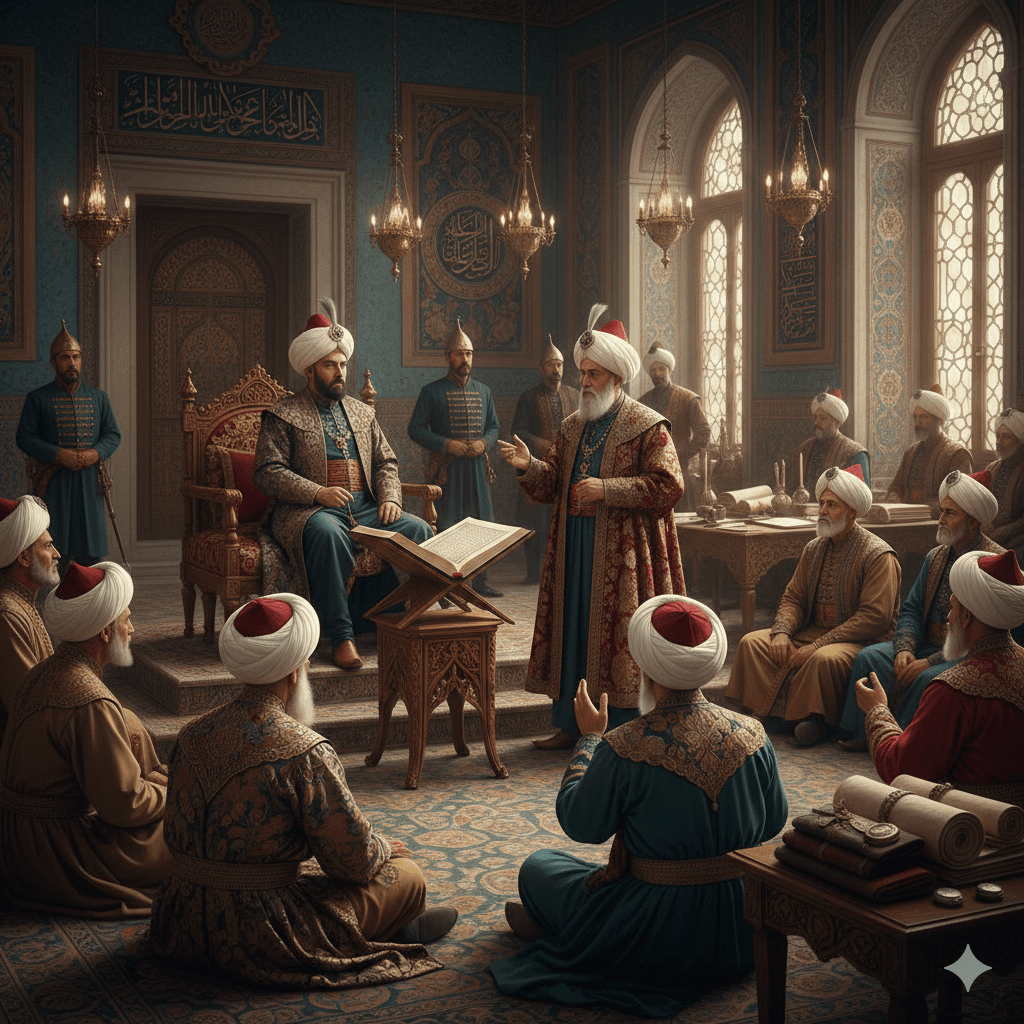
A Visual Depicting the Selection of Participants (Generated by Artificial Intelligence)
The disciplinary system encompassed not only physical penalties but also professional dismissal and loss of reputation. The Şeyhülislâm’s office closely monitored scholars for arriving unprepared, violating confidentiality rules, or engaging in conduct that undermined the dignity of the assembly. During II. Mahmud’s reign, scholars who contradicted each other or unnecessarily swore oaths to create tension were criticized by the sultan as “tatsız” (unpleasant).【29】
The award ceremony following the Huzur lessons was part of the tradition of honoring scholars. At the conclusion of the sessions, the sultan granted each scholar a monetary gift known as “atıye-i seniyye,” proportional to their scholarly rank. Initiated at 100 gold coins per person under III. Mustafa, these gifts later continued in kuruş denominations; even Valide Mihrişah Sultan added supplementary amounts from her personal budget during the reign of III. Selim.【30】 In addition to monetary gifts, it became customary to bestow valuable cübbes, shawls, and occasionally special timepieces upon the scholars. Furthermore, promotion of successful muhataps to the mukarrir position or their appointment to important müderris posts formed part of the system’s career rewards.
The curriculum of Huzur lessons was based on the classical Islamic exegetical work “Envârü’t-tenzîl ve esrârü’t-teʾvîl” by Kādî Beyzâvî.【31】 The selection of surahs and verses for discussion was not arbitrary; it was meticulously determined months in advance by the Şeyhülislâm’s office and submitted to the sultan for approval. These selections reflected the political and social orientation of the state at the time. For instance, the choice of verse 135 of Surah Nisa—“O you who believe! Be upright witnesses for Allah, even if it be against yourselves, your parents, or your kin”—for the first official lesson under III. Mustafa in 1759 represented an intellectual endorsement of the foundational Ottoman state principle of “daire-i adliye” (circle of justice).【32】
The method of delivery reflected academic rigor, resulting in a slow-paced exegesis process. When a verse was examined, its general meaning was not sufficient; its etymology, sentence structure, recitation variants, and rhetorical subtleties were analyzed in minute detail. Due to these analyses, the exegesis of a single surah sometimes spanned decades. Archive records indicate that the tafsir of Surah Bakara began in 1201 (1787) and, after five years of intensive work, only the first thirty verses were completed by 1205 (1791). Similarly, the tafsir of Surah Isrâ lasted three years (1775–1778), and the discussion of Surah Fetih spanned five years (1779–1784).【33】
The thematic focus of the discussions evolved according to changing state needs. Initially, verses concerning faith, moral principles, and worship were preferred; however, during the turbulent nineteenth century, particularly under II. Mahmud’s directive, a transformation occurred in the content of the lessons.【34】 A palace decree dated 1250 (1834–35) directed that the lessons should focus on themes such as gazâ, cihad, patience, and perseverance—topics that would sustain the state and army and elevate societal moral values—rather than abstract and exhausting debates.【35】 During this period, contemporary issues such as military organization and soldiers’ devotion to Allah were also incorporated into the discussions. Nevertheless, the scholars consistently remained faithful to Beyzâvî’s text and refrained from compromising on linguistic and jurisprudential analysis.
One of the controversial aspects of Huzur lessons within scholarly circles was the practice of swearing oaths during discussions or while defending a position. This tradition became particularly prominent during the reign of II. Mahmud (around 1831).
Through the framework of Islamic legal classifications of oaths, the nature of these oaths during the lessons was carefully examined:
Scholars argued that oaths made during Huzur lessons, intended to affirm scholarly conviction, generally fell under the category of “yemin-i lağv,” or were sometimes used as a rhetorical tool to silence an opponent. However, II. Mahmud questioned the compatibility of such oaths with scholarly dignity and preferred that the assemblies be conducted in a simpler, more instructive manner rather than being overwhelmed by such “abstract and profound” debates.【39】
[1]
Mehmet İpşirli, "Huzur Dersleri" TDV İslam Ansiklopedisi, Erişim 14 Şubat 2026, https://islamansiklopedisi.org.tr/huzur-dersleri.
[2]
Ömer Kara, “Osmanlı’da Huzur Dersleri Geleneği ve Literatürü” Türkiye Araştırmaları Literatür Dergisi, sy 18: 520, Erişim 14 Şubat 2026, https://izlik.org/JA52RY52SS.
[3]
Mehmet İpşirli, "Huzur Dersleri" TDV İslam Ansiklopedisi, Erişim 14 Şubat 2026, https://islamansiklopedisi.org.tr/huzur-dersleri.
[4]
Ömer Kara, “Osmanlı’da Huzur Dersleri Geleneği ve Literatürü” Türkiye Araştırmaları Literatür Dergisi, sy 18: 521, Erişim 14 Şubat 2026, https://izlik.org/JA52RY52SS.
[5]
Ömer Kara, “Osmanlı’da Huzur Dersleri Geleneği ve Literatürü” Türkiye Araştırmaları Literatür Dergisi, sy 18: 527, Erişim 14 Şubat 2026, https://izlik.org/JA52RY52SS.
[6]
Mehmet İpşirli, "Huzur Dersleri" TDV İslam Ansiklopedisi, Erişim 14 Şubat 2026, https://islamansiklopedisi.org.tr/huzur-dersleri.
[7]
Mehmet İpşirli, "Huzur Dersleri" TDV İslam Ansiklopedisi, Erişim 14 Şubat 2026, https://islamansiklopedisi.org.tr/huzur-dersleri.
[8]
Rıdvan Kara, “Osmanlı’da Huzur Dersleri Kronolojisi” Sakarya Üniversitesi İlahiyat Fakültesi Dergisi 26 (49): 280, Erişim 14 Şubat 2026, https://doi.org/10.17335/sakaifd.1439210.
[9]
Mehmet İpşirli, "Huzur Dersleri" TDV İslam Ansiklopedisi, Erişim 14 Şubat 2026, https://islamansiklopedisi.org.tr/huzur-dersleri.
[10]
Ömer Kara, “Osmanlı’da Huzur Dersleri Geleneği ve Literatürü” Türkiye Araştırmaları Literatür Dergisi, sy 18: 522, Erişim 14 Şubat 2026, https://izlik.org/JA52RY52SS.
[11]
Mehmet İpşirli, "Huzur Dersleri" TDV İslam Ansiklopedisi, Erişim 14 Şubat 2026, https://islamansiklopedisi.org.tr/huzur-dersleri.
[12]
Mehmet İpşirli, "Huzur Dersleri" TDV İslam Ansiklopedisi, Erişim 14 Şubat 2026, https://islamansiklopedisi.org.tr/huzur-dersleri.
[13]
Mehmet İpşirli, "Huzur Dersleri" TDV İslam Ansiklopedisi, Erişim 14 Şubat 2026, https://islamansiklopedisi.org.tr/huzur-dersleri.
[14]
Ömer Kara, “Osmanlı’da Huzur Dersleri Geleneği ve Literatürü” Türkiye Araştırmaları Literatür Dergisi, sy 18: 526, Erişim 14 Şubat 2026, https://izlik.org/JA52RY52SS.
[15]
Mehmet İpşirli, "Huzur Dersleri" TDV İslam Ansiklopedisi, Erişim 14 Şubat 2026, https://islamansiklopedisi.org.tr/huzur-dersleri.
[16]
Mehmet İpşirli, "Huzur Dersleri" TDV İslam Ansiklopedisi, Erişim 14 Şubat 2026, https://islamansiklopedisi.org.tr/huzur-dersleri.
[17]
Mehmet İpşirli, "Huzur Dersleri" TDV İslam Ansiklopedisi, Erişim 14 Şubat 2026, https://islamansiklopedisi.org.tr/huzur-dersleri.
[18]
Mehmet İpşirli, "Huzur Dersleri" TDV İslam Ansiklopedisi, Erişim 14 Şubat 2026, https://islamansiklopedisi.org.tr/huzur-dersleri.
[19]
Mehmet İpşirli, "Huzur Dersleri" TDV İslam Ansiklopedisi, Erişim 14 Şubat 2026, https://islamansiklopedisi.org.tr/huzur-dersleri.
[20]
Mehmet İpşirli, "Huzur Dersleri" TDV İslam Ansiklopedisi, Erişim 14 Şubat 2026, https://islamansiklopedisi.org.tr/huzur-dersleri.
[21]
Mehmet İpşirli, "Huzur Dersleri" TDV İslam Ansiklopedisi, Erişim 14 Şubat 2026, https://islamansiklopedisi.org.tr/huzur-dersleri.
[22]
Mehmet İpşirli, "Huzur Dersleri" TDV İslam Ansiklopedisi, Erişim 14 Şubat 2026, https://islamansiklopedisi.org.tr/huzur-dersleri.
[23]
Ömer Kara, “Osmanlı’da Huzur Dersleri Geleneği ve Literatürü” Türkiye Araştırmaları Literatür Dergisi, sy 18: 530, Erişim 14 Şubat 2026, https://izlik.org/JA52RY52SS.
[24]
Ömer Kara, “Osmanlı’da Huzur Dersleri Geleneği ve Literatürü” Türkiye Araştırmaları Literatür Dergisi, sy 18: 538, Erişim 14 Şubat 2026, https://izlik.org/JA52RY52SS.
[25]
Mehmet İpşirli, "Huzur Dersleri" TDV İslam Ansiklopedisi, Erişim 14 Şubat 2026, https://islamansiklopedisi.org.tr/huzur-dersleri.
[26]
Ömer Kara, “Osmanlı’da Huzur Dersleri Geleneği ve Literatürü” Türkiye Araştırmaları Literatür Dergisi, sy 18: 526, Erişim 14 Şubat 2026, https://izlik.org/JA52RY52SS.
[27]
Mehmet İpşirli, "Huzur Dersleri" TDV İslam Ansiklopedisi, Erişim 14 Şubat 2026, https://islamansiklopedisi.org.tr/huzur-dersleri.
[28]
Mehmet İpşirli, "Huzur Dersleri" TDV İslam Ansiklopedisi, Erişim 14 Şubat 2026, https://islamansiklopedisi.org.tr/huzur-dersleri.
[29]
Mehmet İpşirli, "Huzur Dersleri" TDV İslam Ansiklopedisi, Erişim 14 Şubat 2026, https://islamansiklopedisi.org.tr/huzur-dersleri.
[30]
Mehmet İpşirli, "Huzur Dersleri" TDV İslam Ansiklopedisi, Erişim 14 Şubat 2026, https://islamansiklopedisi.org.tr/huzur-dersleri.
[31]
Mehmet İpşirli, "Huzur Dersleri" TDV İslam Ansiklopedisi, Erişim 14 Şubat 2026, https://islamansiklopedisi.org.tr/huzur-dersleri.
[32]
Mehmet İpşirli, "Huzur Dersleri" TDV İslam Ansiklopedisi, Erişim 14 Şubat 2026, https://islamansiklopedisi.org.tr/huzur-dersleri.
[33]
Mehmet İpşirli, "Huzur Dersleri" TDV İslam Ansiklopedisi, Erişim 14 Şubat 2026, https://islamansiklopedisi.org.tr/huzur-dersleri.
[34]
Mehmet İpşirli, "Huzur Dersleri" TDV İslam Ansiklopedisi, Erişim 14 Şubat 2026, https://islamansiklopedisi.org.tr/huzur-dersleri.
[35]
Mehmet İpşirli, "Huzur Dersleri" TDV İslam Ansiklopedisi, Erişim 14 Şubat 2026, https://islamansiklopedisi.org.tr/huzur-dersleri.
[36]
Fatih Akyüz, “İlim ve Siyasetin Bir Randevusu: Huzur Dersleri.” Milli Saraylar Kültür- Sanat- Tarih Dergisi, Sayı: 6 sayfa 108, Erişim 14 Şubat 2026, https://isamveri.org/pdfsbv/D01111/2010_6/2010_6_AKYUZF.pdf#page=4.56
[37]
Fatih Akyüz, “İlim ve Siyasetin Bir Randevusu: Huzur Dersleri.” Milli Saraylar Kültür- Sanat- Tarih Dergisi, Sayı: 6 sayfa 108, Erişim 14 Şubat 2026, https://isamveri.org/pdfsbv/D01111/2010_6/2010_6_AKYUZF.pdf#page=4.56
[38]
Fatih Akyüz, “İlim ve Siyasetin Bir Randevusu: Huzur Dersleri.” Milli Saraylar Kültür- Sanat- Tarih Dergisi, Sayı: 6 sayfa 108, Erişim 14 Şubat 2026, https://isamveri.org/pdfsbv/D01111/2010_6/2010_6_AKYUZF.pdf#page=4.56
[39]
Mehmet İpşirli, "Huzur Dersleri" TDV İslam Ansiklopedisi, Erişim 14 Şubat 2026, https://islamansiklopedisi.org.tr/huzur-dersleri.


Huzur Dersleri (Yapay Zeka ile Oluşturulmuştur.)
Historical Development and Institutionalization
Procedure and Court Protocol
Elements and Functions
Selection of Participants and Scholarly Freedom
Verses and Surahs Discussed
The Oath and Jurisprudential Dimension