


This article was automatically translated from the original Turkish version.
Dibek coffee is a traditional type of coffee prepared by pounding coffee beans in a stone mortar or basin called a “dibek,” using a pestle, rather than grinding them in conventional coffee mills. The term “dibek” originates from Arabic and means “pounding,” deriving the coffee’s name from this grinding technique. This method results in coffee with coarser particles, a smoother mouthfeel, and a creamy texture.
Dibek coffee is generally lighter in color compared to Turkish coffee and may also be enriched with cocoa, date syrup, menengiç, or various spices according to taste preferences. Although prepared similarly to classic Turkish coffee, the coffee grounds settle more slowly in the cup and remain warmer for longer due to their dense consistency. These characteristics have enabled dibek coffee to maintain its significance as a preferred beverage in various regions of Türkiye, especially during guest hospitality, special occasions, and traditional ceremonies.
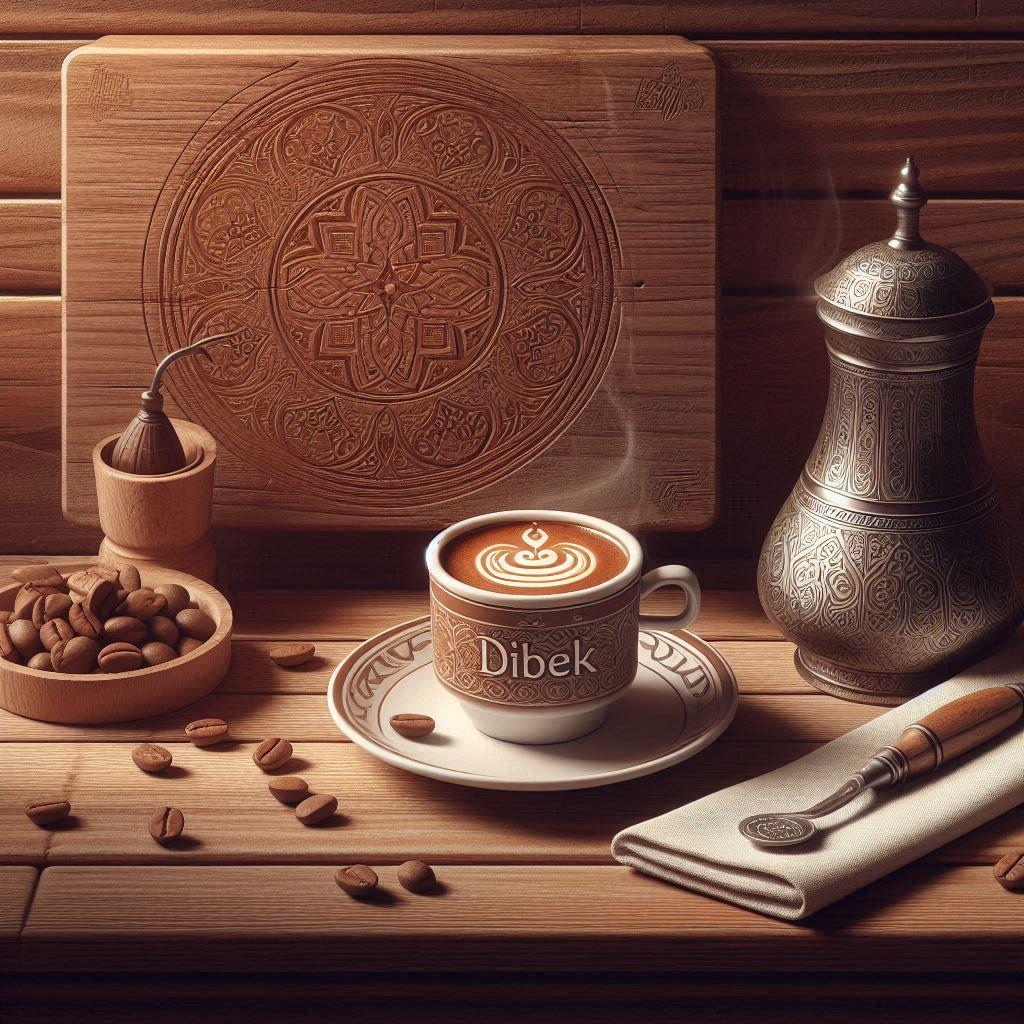
Dibek Coffee Presentation (Generated by Artificial Intelligence.)
The most distinctive feature of dibek coffee is that the coffee beans are ground by hand pounding rather than using conventional mills. This process is typically carried out in large stone basins (dibeks), preserving the oil content of the beans and imparting a more intense aroma to the coffee. Although modern commercial production attempts to replicate similar results using machines, dibek coffee prepared by traditional methods is still regarded as superior. Dibek coffee is not always made from pure coffee beans; it can also be prepared using blends enriched with natural aromatics such as menengiç, date syrup, salep, mastic, and cardamom. This blend contributes to the perception of dibek coffee as both an aromatic and health-beneficial beverage.
Dibek coffee distinguishes itself from other coffees through its creamy texture, smooth mouthfeel, and gentle effect on the stomach. Due to its density and aromatic profile, it is commonly consumed with sweets. Particularly in Southeastern and Central Anatolia, it is traditionally served on special occasions such as weddings, holidays, and guest receptions. In many regions of Türkiye, it is consumed in coffeehouses and homes according to tradition and is also presented in tourist areas as a cultural symbol.
Dibek coffee is recognized as part of the “Turkish Coffee Culture and Tradition,” inscribed by UNESCO on the Representative List of the Intangible Cultural Heritage. This coffee is not merely a beverage; it is also a symbol of social connection, hospitality, and sharing culture. Its preparation through traditional methods plays a vital role in establishing links with the past and ensuring the sustainability of local cultures.

Dibek Coffee in the Ottoman Era (Generated by Artificial Intelligence.)
Today, dibek coffee is available in pre-packaged forms with various flavors and is easily accessible in supermarkets. In cafes, it is presented to consumers in elaborate displays (with traditional serving tools, decorative elements, and small desserts) as a cultural experience. In this way, it preserves its traditional values while adapting to contemporary coffee consumption habits.
Albay, Tolga. "Bu Kahveye Tadını Taş Veriyor." Anadolu Ajansı, October 28, 2011. Accessed April 16, 2025. https://www.aa.com.tr/tr/yasam/bu-kahveye-tadini-tas-veriyor/404990.
Anadolu Ajansı. 2019. "Giritli Ailenin 150 Yıllık Taşından Çıkan Lezzet: Dibek Kahvesi." Anadolu Ajansı. Accessed April 16, 2025. https://www.aa.com.tr/tr/pg/foto-galeri/giritli-ailenin-150-yillik-tasindan-cikan-lezzet-dibek-kahvesi/0.
Ministry of Culture and Tourism of the Republic of Türkiye, General Directorate of Living Heritage and Cultural Activities. "Turkey on UNESCO's Lists of Intangible Cultural Heritage." Accessed April 16, 2025. https://yakegm.ktb.gov.tr/TR-345095/unesco-somut-olmayan-kulturel-miras-listelerinde-turkiye.html.
Nevşehir Hacı Bektaş Veli Üniversitesi. "Kültürel Miras Açısından Türk Kahvesi." Nevşehir Hacı Bektaş Veli Üniversitesi Açık Accessed Sistemi, 2021. https://acikerisim.nevsehir.edu.tr/xmlui/bitstream/handle/20.500.11787/3144/K%c3%bclt%c3%bcrel%20Miras%20A%c3%a7%c4%b1s%c4%b1ndan%20T%c3%bcrk%20Kahvesi.pdf?sequence=1&isAllowed=y.
Ogan, Yener, and Ferhan Odabaşı. “Türk Kahvesi ve Dibek Kahvesi’nin Gelenekselden Modern Sunuma Dönüşümü.” In *Gastronomi Alanında Tematik Araştırmalar I*, edited by Hülya Demirdelen Alrawadieh and Selda Arslan, pp. 38–47. Ankara: Detay Yayıncılık, 2022. https://www.researchgate.net/profile/Yener-Ogan/publication/363893655_Gastronomi_Alaninda_Tematik_Arastirmalar_I/links/63343b4c76e39959d680c8b8/Gastronomi-Alaninda-Tematik-Arastirmalar-I.pdf#page=38.

Preparation Method
Gastronomic Characteristics and Consumption Culture
Cultural Heritage Status
Commercialization and Modern Presentations