This article was automatically translated from the original Turkish version.
+2 More
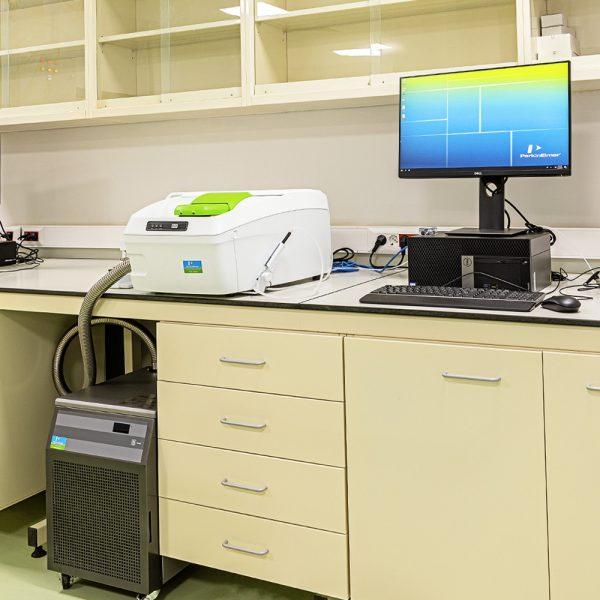
https://detuam.sbu.edu.tr/hizmet/diferansiyel-taramali-kalorimetre-dsc/
DSC
Application Area(s) | Polymer characterization (glass transition materials science and metallurgy studies fat analyses in the food industry drug stability melting) crystallinity | ||||||||
|---|---|---|---|---|---|---|---|---|---|
Hardware Components | Sample and reference chamber, heating furnace, temperature sensors, gas control system, data collection and analysis software | ||||||||
Differential Scanning Calorimetry (DSC) is a thermal analysis method that examines the physical and chemical transformations of a material by measuring the difference in heat flow between a sample and a reference. It is widely used to determine parameters such as phase transitions (e.g., melting crystallization glass transition), chemical reactions, and specific heat capacity. DSC instruments were developed in the 1960s and commercially introduced within the same decade. Today DSC is extensively used in industries including pharmaceuticals food ceramics and metallurgy with polymer characterization being the primary application; it accounts for over 80% of polymer analysis procedures.
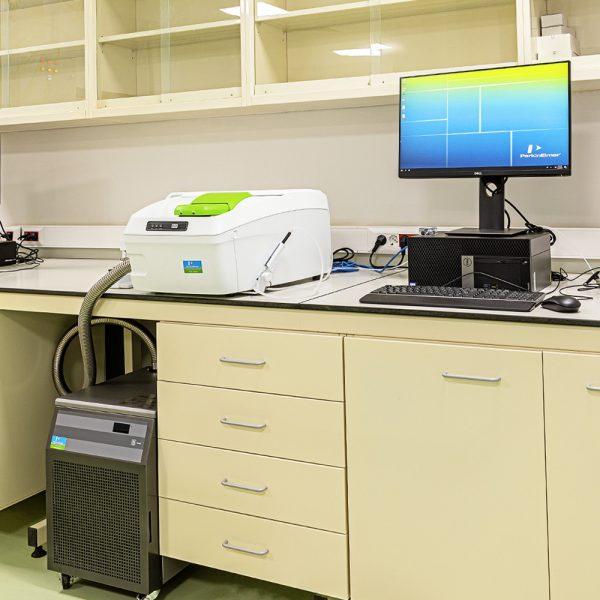
DSC (1)
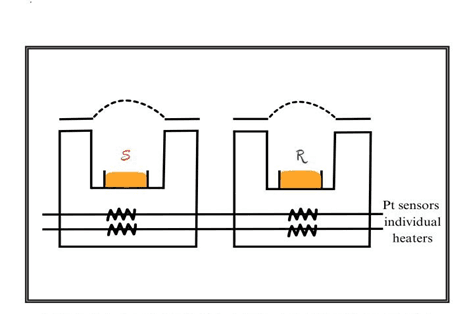
In DSC the sample and reference are subjected to the same temperature program while the difference in heat flow applied to both is measured. These heat differences are converted into electrical signals via thermocouple sensors and recorded. The measured heat flow difference varies depending on the physical or chemical events experienced by the sample.
Modern DSC instruments have a heat flow sensitivity of approximately ±0.1 µW. Heating rates can be programmed between 0.1 °C/min and 100 °C/min. The measurement temperature range can be extended down to -180 °C using liquid nitrogen; in some systems the upper limit can reach +700 °C.
DSC instruments generally consist of the following components:
Next-generation instruments employ modulated DSC (MDSC) technology which enables temporal separation of signals. This allows for clearer interpretation of low-enthalpy events.
DSC is actively used in central research laboratories at institutions in Türkiye such as ODTÜ YTÜ and GTÜ for various testing services across multiple industries.
Polymers: Glass transition temperature (Tg) melting point crystallization.
Pharmaceuticals: Polymorph analysis purity determination (up to 99% accuracy).
Food: Cocoa butter crystallization behavior starch gelatinization.
Metallurgy: Alloy phase transition temperatures thermal stability.
Composites: Curing profiles reaction kinetics.
Enables rapid and precise analysis with small sample amounts (approximately 5–10 mg).
Wide temperature range and atmosphere control are possible.
Both physical and chemical events can be examined simultaneously.
High reproducibility and compatibility with automation are available.
Signal noise may increase for low-enthalpy events.
It is difficult to resolve overlapping events in complex samples.
Solutions: Signals can be separated using modulated DSC systems; high-sensitivity thermocouple systems are recommended.
DSC instruments typically consist of a differential sensor furnace temperature control unit gas flow system and data acquisition unit. Measurement temperature ranges vary by instrument model but generally span from -150 °C to 700 °C. Some advanced models can operate under high pressure or at very low temperatures.
Craig, Duncan Q. M. “The Use of Thermal Analysis in the Development of Solid Dosage Forms.” *Thermochimica Acta* 248 (1995): 159–169. https://www.ncbi.nlm.nih.gov/pmc/articles/PMC2977967/.
Gabbott, Paul. *Principles and Applications of Thermal Analysis.* Chichester: Wiley-Blackwell, 2008. https://onlinelibrary.wiley.com/doi/book/10.1002/9780470697702.
Health Sciences University DETUAM. "Diferansiyel Taramalı Kalorimetre (DSC)." Accessed July 3, 2025. https://detuam.sbu.edu.tr/hizmet/diferansiyel-taramali-kalorimetre-dsc/.
Osmangazi Üniversitesi Research and Application Center. "Simultane Termal Analizör (STA)." Accessed July 1, 2025. https://arum.ogu.edu.tr/Sayfa/Index/64/simultane-termal-analizor-sta.
Shetty, Rekha. “Differential Scanning Calorimetry (DSC).” *Thermal Methods of Analysis*, Sophia College for Women. Accessed July 3, 2025. https://chem.libretexts.org/Courses/Sophia_College_for_Women/Thermal_Methods_of_Analysis_(Shetty)/04%3A_Differential_Scanning_Calorimetry_(DSC).
Topçu, Yusuf. *Isısal Analiz Yöntemleri.* Samsun: Ondokuz Mayıs Üniversitesi Yayını, 2020. https://avys.omu.edu.tr/storage/app/public/ytopcu/135592/isisal_analiz_yontemleri_web.pdf.
Yıldız Teknik Üniversitesi Merkezi Araştırma Laboratuvarı. "Termal Analiz Laboratuvarı." Accessed July 1, 2025. https://merkezlab.yildiz.edu.tr/termal-analiz-laboratuvari.

https://detuam.sbu.edu.tr/hizmet/diferansiyel-taramali-kalorimetre-dsc/
DSC
Application Area(s) | Polymer characterization (glass transition materials science and metallurgy studies fat analyses in the food industry drug stability melting) crystallinity | ||||||||
|---|---|---|---|---|---|---|---|---|---|
Hardware Components | Sample and reference chamber, heating furnace, temperature sensors, gas control system, data collection and analysis software | ||||||||
No Discussion Added Yet
Start discussion for "Differential Scanning Calorimetry (DSC)" article
Working Principle
Instrument Components
Applications
Application Examples by Sector
Advantages of the Method
Limitations
Instrument Features and Hardware