


This article was automatically translated from the original Turkish version.
+2 More
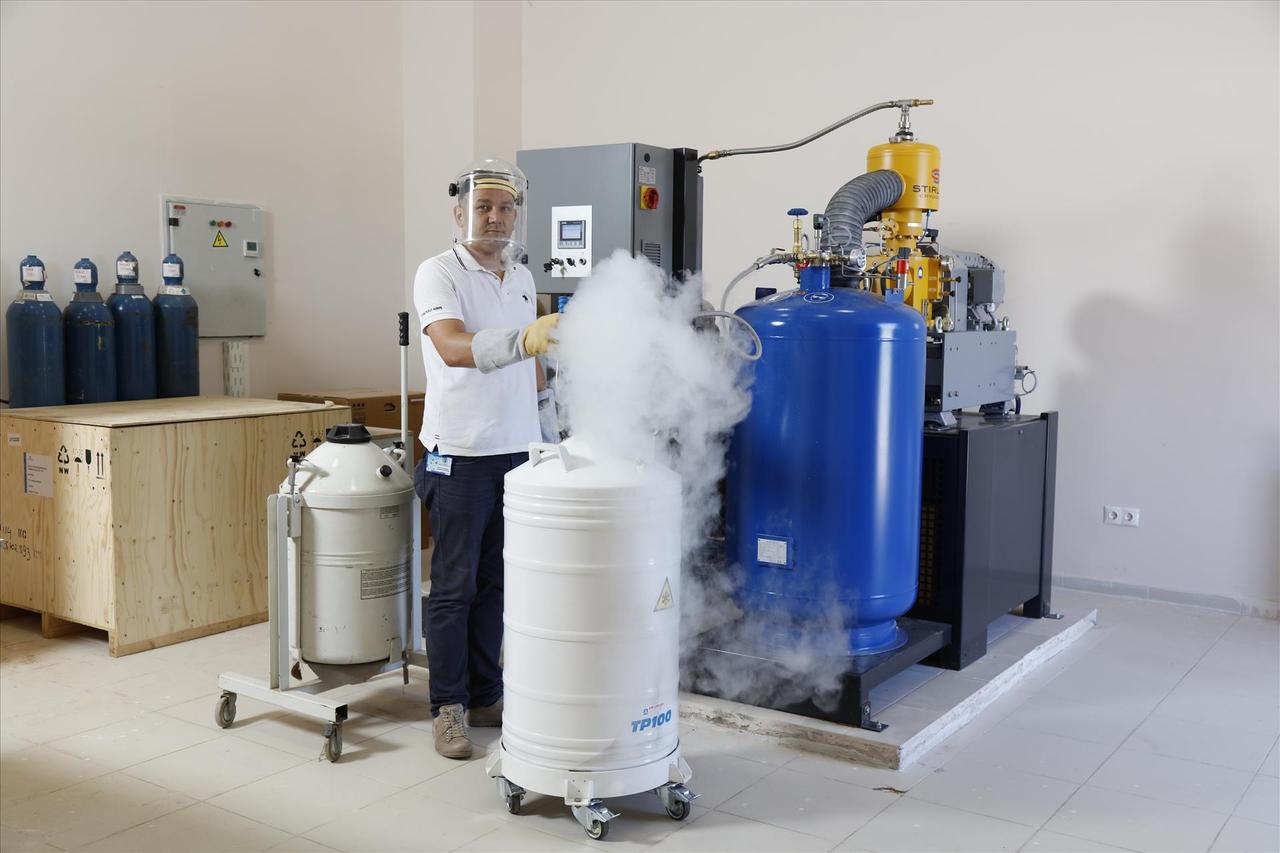
https://arum.ogu.edu.tr/Sayfa/Index/21/sivi-azot-uretim-birimi
LIQUID NITROGEN PRODUCTION
Definition(s) | Liquid nitrogen at -196 °C and inert cryogenic liquid. odorless a colorless | ||||||||
|---|---|---|---|---|---|---|---|---|---|
Applications | Cryogenic cooling, cell and biological sample freezing, food processing, electronic component cooling. | ||||||||
Advantage(s) | Purity of 99.999% wide range of applications. high cooling capacity low evaporation loss (0.5–1% per day) | ||||||||
Liquid nitrogen is a colorless, odorless, and inert liquid obtained by condensing nitrogen gas at -196 °C. Considered a fundamental component of cryogenic technologies, this substance is widely used in biotechnology, medicine, food science, and materials science. Many universities and research centers in Türkiye possess liquid nitrogen production infrastructure. For example, at Harran University’s HUBTAM, liquid nitrogen is used in biological sample storage processes. Globally, the use of liquid nitrogen is increasing at an average annual rate of 5%, while in Türkiye its usage rate in biotechnology laboratories is around 30%.
Liquid nitrogen production is carried out using cryogenic air separation. In this process, atmospheric air is compressed to a pressure of approximately 5–10 bar and then gradually cooled to around -195 °C. The cooled air is liquefied according to the principle of fractional distillation, and nitrogen is separated from other gases, particularly oxygen and argon. The purity of the produced liquid nitrogen is typically at the level of 99.999%. In terms of energy efficiency, approximately 0.5 kWh of energy is consumed to produce one liter of liquid nitrogen.
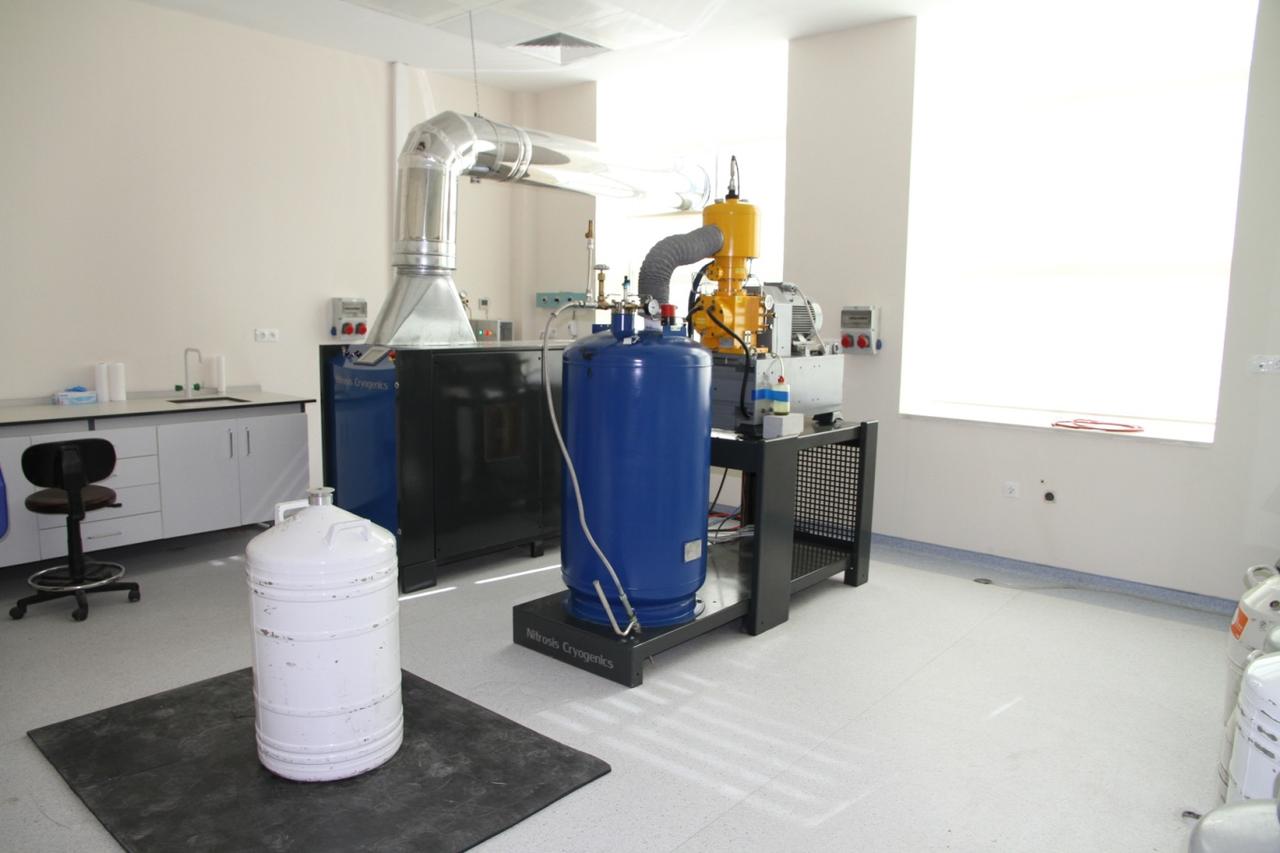
Liquid Nitrogen Production (HARRAN UNIV.)
Liquid nitrogen production systems consist of an air compressor, pre-cooling unit, cryogenic separation column, condenser, and liquid nitrogen tank. The compressor unit raises the pressure of ambient air, while the cooling system reduces the temperature to levels low enough to liquefy the gas. The resulting liquid is monitored and controlled via PLC-based automation systems. Cryogenic tanks in the system typically have an insulation coefficient of 0.1 W/m²K and are vacuum-insulated to maintain the liquid’s temperature constant.
Liquid nitrogen is stored after production in double-walled, vacuum-insulated tanks made of stainless steel. Thanks to these tanks, daily evaporation losses are maintained between 0.5% and 1%. During distribution, pressurized containers and liquid nitrogen transfer lines are designed in accordance with TS EN standards. Both pressure control and environmental safety are critical during transportation operations.
Liquid nitrogen is used in numerous fields, primarily biotechnology. At Harran University’s HUBTAM, it is used for long-term storage of biological samples; at Aksaray University’s ASUBTAM, for cell freezing procedures; and at Osmangazi University’s ARUM, for scientific experiments. In the food industry, rapid freezing at -80 °C has been observed to increase product freshness by up to 20%. Additionally, liquid nitrogen plays a significant role in tissue engineering, cryoablation, cooling of electronic components, and impact testing of metals.
Adıyaman Üniversitesi Merlab. “Sıvı Azot Üretim Odası.” Accessed July 10, 2025. https://merlab.adiyaman.edu.tr/tr/laboratuvarlar/sivi-azot-uretim-odasi.
Aksaray Üniversitesi ASUBTAM. "Sıvı Azot Üretim Cihazı." Accessed July 10, 2025. https://asubtam.aksaray.edu.tr/sivi-azot-uretim-cihazi.
Erciyes Üniversitesi TAUM. "Sıvı Azot Üretim Sistemi." Accessed July 10, 2025. https://taum.erciyes.edu.tr/tr/sivi-azot-uretim-sistemi.
Harran Üniversitesi HUBTAM. "Sıvı Azot Üretim Sistemi." Accessed July 10, 2025. http://hubtam.harran.edu.tr/hubtam/tr/cihazlar/sivi-azot-uretim-sistemi/.
Osmangazi Üniversitesi ARUM. "Sıvı Azot Üretim Birimi." Accessed July 10, 2025. https://arum.ogu.edu.tr/Sayfa/Index/21/sivi-azot-uretim-birimi.

https://arum.ogu.edu.tr/Sayfa/Index/21/sivi-azot-uretim-birimi
LIQUID NITROGEN PRODUCTION
Definition(s) | Liquid nitrogen at -196 °C and inert cryogenic liquid. odorless a colorless | ||||||||
|---|---|---|---|---|---|---|---|---|---|
Applications | Cryogenic cooling, cell and biological sample freezing, food processing, electronic component cooling. | ||||||||
Advantage(s) | Purity of 99.999% wide range of applications. high cooling capacity low evaporation loss (0.5–1% per day) | ||||||||
No Discussion Added Yet
Start discussion for "Liquid Nitrogen (N₂) Production" article
Production Process
Equipment and Systems
Storage and Distribution
Application Areas