


This article was automatically translated from the original Turkish version.
+1 More
Gentrification (English: gentrification), in its general definition, is the process by which residential areas in city centers or their peripheries, historically inhabited by low-income populations and characterized by aging or declining housing stock, are renovated through capital investment in response to demand from middle and upper-income groups, resulting in the displacement of the original residents and the emergence of a new class-based and spatial stratification. The process encompasses multidimensional changes in property relations, modes of production and consumption, lifestyles, and class and gender distinctions. Gentrification is often mentioned alongside urban regeneration, revitalization, or renewal policies and may emerge as a consequence or instrument of such policies.
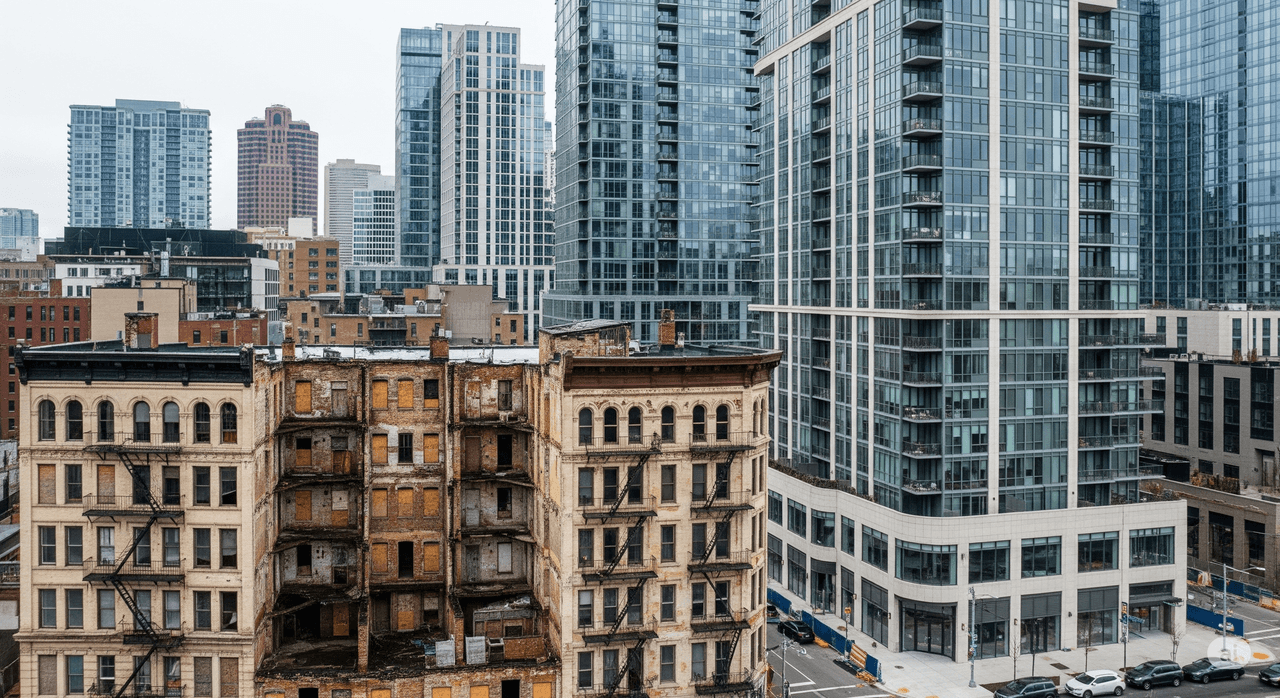
Urban Contrast Created by Old and New Urban Structures (Generated by Artificial Intelligence)
The concept of gentrification was first introduced in 1964 by sociologist Ruth Glass to describe the transformation of social character in London’s working-class neighborhoods, where housing units were purchased and renovated by middle and upper classes, leading original residents to be replaced by newer, more affluent ones. The English root of the term, gentry, refers to landowning nobility below the aristocracy.
Gentrification goes beyond mere physical renewal; it signifies a multifaceted transformation. Its core features can be outlined as follows:
The phenomenon of gentrification was first discussed in the 1960s in Western European cities such as London, spread to major historic cities in North America and Australia during the 1970s, and acquired a global character from the 1980s onward under the influence of globalization and neoliberal policies, becoming evident in developing countries. By the 1990s, gentrification had become a widespread urban strategy.
Concrete examples of gentrification in Türkiye began to emerge from the 1980s onward. The process in Istanbul is generally analyzed in three waves:
Gentrification movements during this period were initiated by individual pioneers and can be described as more “organic.” They were observed in neighborhoods along the Bosphorus such as Kuzguncuk, Arnavutköy, and Ortaköy. Kuzguncuk, in particular, is recognized as Türkiye’s first gentrification example after an architect settled there in the late 1970s and launched a rehabilitation program. These neighborhoods gradually gained popularity by attracting architects, artists, and writers.
This wave occurred in areas around Beyoğlu, including Cihangir, Galata, and Asmalımescit. Cihangir, previously a marginalized neighborhood in the 1980s, began attracting new middle-class professionals in 1993 under the initiative of a painter couple. Its central location, historical fabric, cultural vibrancy, and positive media portrayal led to its emergence as a symbol of bohemian lifestyle in Istanbul.
In this period, gentrification changed in nature as the state and local administrations became direct actors in the process through urban transformation projects. These projects were often justified on grounds of earthquake risk, preservation of historical fabric, or investment-driven rent-seeking motives. Examples from this era include Fener-Balat along the Golden Horn, Sulukule where the Romani population was displaced, and large-scale urban transformation areas such as Fikirtepe and Tarlabaşı. These projects made social issues such as displacement and spatial exclusion more visible.
Academic debates explaining the causes of gentrification primarily focus on two main axes: supply (production)-based and demand (consumption)-based approaches.
These approaches explain gentrification within the framework of capital movements and profit-driven investment decisions. The core of this perspective is the “rent gap” theory developed by geographer Neil Smith. According to this theory, when the difference between the current rental income generated by a piece of land and the potential rental income from its most profitable possible use becomes sufficiently large, investors (construction companies, real estate developers, etc.) enter the area to generate profit. This investment leads to physical renewal and consequently gentrification. This perspective conceptualizes gentrification as “capital’s return to the city.”
These approaches analyze the process through the changing cultural preferences, lifestyles, and consumption habits of the “new middle class” emerging in post-industrial societies. According to theorists like David Ley, this new social class—comprised of highly educated, often young and childless professionals working in service and finance sectors—prefers the cultural, social, and aesthetic offerings of the city center (art galleries, theaters, unique architecture, social diversity) over suburban lifestyles. Gentrification is thus the result of this group’s demand for neighborhoods close to the city center with historical and distinctive character. Sharon Zukin links the process to “cultural consumption,” arguing that urban economic development has shifted from production to consumption.
In recent years, new approaches have emerged that argue supply- and demand-based explanations are insufficient on their own and aim to analyze the process within a more holistic framework. Drawing on theories such as “assemblage theory” and “actor-network theory,” this perspective views gentrification not as a phenomenon reducible to a single cause or dominant actor (state, capital, or consumer), but as a “relational” outcome emerging from the complex and non-hierarchical convergence of diverse actors, practices, events, and spatial conditions. According to this view, gentrification is not a predetermined outcome but an open-ended process shaped by different local dynamics in each context.
Tourism gentrification is a specific form of gentrification in which the primary driving force behind the process is investment in tourism and entertainment sectors. This process, conceptualized by K. F. Gotham, describes how a middle-class neighborhood transforms into a wealthy and exclusive residential and consumption area through the proliferation of institutional entertainment and tourism spaces (hotels, restaurants, bars, tourist shops).
Unlike classical gentrification, the displacing “new class” here is not permanent residents but temporary ones: tourists. The growing demand and purchasing power of tourists increase housing and service prices in the area, raising the cost of living for locals and potentially displacing them. Additionally, the commercial development of residential areas and the commodification of public spaces for tourist consumption can lead to locals feeling alienated from their own environment and experiencing a weakening of belonging. The transformation of the village of Uçhisar, dependent on Nevşehir, where historic housing units were restored and converted into boutique hotels, is an example examined within the context of tourism gentrification, highlighting the impact of tourism on local life.
The gentrification process typically progresses through distinct stages. According to Phillip Clay’s four-stage model, the process begins with the settlement of a risk-tolerant “pioneer” group (artists, students, etc.) in the area. This is followed by a broader middle-class population attracted by the area’s potential. This demand draws the attention of the real estate sector and the media, accelerating the process. In the final stage, property prices and rents rise significantly, larger capital investments enter the area, and the majority of original residents are forced to leave.
The effects of gentrification produce outcomes that can be evaluated as both positive and negative:

Definition and Conceptual Framework
Historical Development
Gentrification in Türkiye
First Wave (1980s)
Second Wave (1990s)
Third Wave (2000s and Beyond)
Theoretical Approaches
Supply (Production)-Based Approaches
Demand (Consumption)-Based Approaches
Holistic and Relational Approaches
Tourism Gentrification
Process, Effects, and Outcomes
Negative Outcomes
Positively Evaluated Outcomes: