


This article was automatically translated from the original Turkish version.
+1 More
The double-headed eagle is a significant iconographic motif with origins in Central Asia and Mesopotamia, appearing since ancient times in various geographical regions and cultures, and carrying symbolic meanings. Throughout history, this figure has been adopted by numerous civilizations and has become a symbol imbued with diverse connotations such as power, authority, sovereignty, and protection.
The general perception of the eagle as the ruler of the sky and a symbol of infinity forms the foundational basis of the double-headed eagle motif. Traces of this symbol have been found in ancient civilizations across a broad geographical range, including Mesopotamia, Egypt, Anatolia, Iran, and even the Americas and the Far East. Its frequent use in Eurasian art indicates spiritual interaction among different communities.
In Turkish culture, the double-headed eagle is deeply connected to the belief in Gök Tanrı (Sky God). Among ancient Turkic communities, the eagle was believed to be the deity itself, its messenger, or its representative. In this context, the eagle figure was interpreted as a cultural value and symbol representing power, strength, authority, sovereignty, nobility, and a protective spirit.
The double-headed eagle is thought to have deepened these meanings further. It was regarded as the guardian of the Sky God, simultaneously representing the underworld and the heavens, night and day, east and west—in other words, opposing forces united. It has also been suggested that the combined power of two eagles symbolized the protector and ancestor of birds. In Central Asia, it was used as an apotropaic charm, a talisman, and a symbol of light and the sun. Ancient Turkic societies believed that the double-headed eagle caused thunderstorms, lightning, and bolts of lightning, which contributed to its sacred status.
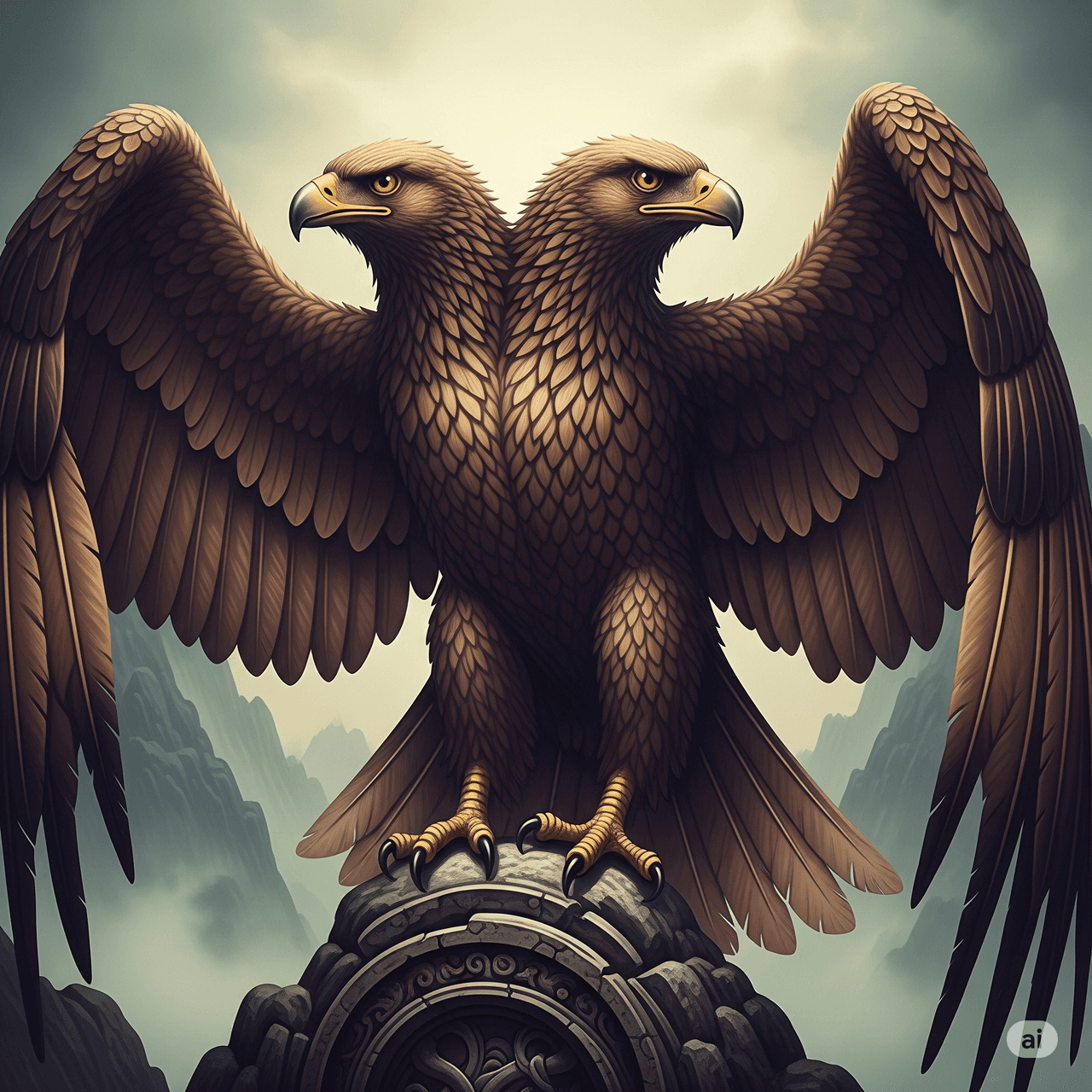
Double-Headed Eagle Image (Generated by Artificial Intelligence)
Even after the Turks embraced Islam and settled in Anatolia, the influence of Shamanistic beliefs persisted. This continuity led to the combined use of animal figures, botanical motifs, rumi patterns, and mythical creatures in architectural stonework as Anatolian Turkish architecture began to develop. These figures were believed to represent the connection between this world and the afterlife.
The double-headed eagle was cherished and employed by various Turkic groups, who attributed symbolic meanings to it. After the adoption of Islam, the meanings associated with the eagle continued during the Karakhanid period, where it was also accepted as a symbol of sovereignty and heroism. It was believed that the eagle could change the seasons: one flap of its wings would melt the ice, and two flaps would bring spring.
In the Dede Korkut stories, the eagle symbolizes goodness, freedom, and bravery. Kaşgarlı Mahmut’s work also references the symbolism of the eagle and other birds of prey. The eagle was sometimes regarded as a symbol of immortality.
The Anatolian Seljuk State was one of the Turkish states that most prominently used the double-headed eagle motif. This figure frequently appears in Seljuk architecture, stone carving, ceramics, carpet weaving, and metalwork. In Seljuk structures such as city walls, mosques, madrasas, and palaces, it was employed as a symbol of protective power, sovereignty, and defense against malevolent forces.
The Muslim Turks of Anatolia did not regard the eagle as a religious symbol. Therefore, they did not hesitate to use it as a decorative element on the exterior facades of mosques. Eagles were depicted in various forms: sometimes with ears, sometimes with a crest-like projection on their heads, and typically with eyes rendered as dots or circles.
There are differing views regarding why the double-headed eagle used during the Anatolian Seljuk period had two heads. Among these, the most prominent interpretations suggest it reflects the Turkic artistic preference for symmetry or represents the union of two spirits or two authorities, thereby doubling their power. It is also noted that the symmetrical application in artistic works was a significant factor.
The double-headed eagle, erected as a sign of victory after battles and as a symbol of sovereignty on the rulers’ tents, found its place in many contexts. In some instances it was used alone; in others, it formed compositions alongside motifs such as the tree of life, lion, dragon, and pomegranate. During the Seljuk era, double-eagle emblems had become merely talismanic signs.
Throughout history, the eagle has been among the animals regarded as emblems of power, authority, and nobility, second only to the lion. Consequently, nearly every society established a connection between the ruler and the eagle. In Omar Khayyam’s work *Nevruzname*, a section is devoted to the eagle, highlighting its grandeur. It is stated that the eagle’s majesty, nobility, and purity resemble those of monarchs and that it possesses a magnificent presence distinct from all other animals.
Göksu, Erkan. "Çift Başlı Kartal Ve Selçuklular / Double-Headed Eagle And Seljuks." *USAD* 5 (Fall 2016): 117–141. Accessed June 7, 2025. https://dergipark.org.tr/tr/download/article-file/285681.
Sönmez, Kezban, and Hale Avcı Yılmaz. "Çift Başlı Kartal Motifinin Türk Sanatındaki Yeri Ve Çağdaş Giysi Tasarımlarına Yansıması / The Double Headed Eagle Motif In Turkish Art And The Reflection Of Contemporary Clothing Designs." *Motif Akademi Halkbilimi Dergisi* 12, no. 28 (2019): 1151-1167. Accessed June 7, 2025. https://dergipark.org.tr/tr/download/article-file/884642.
Tecir, Elif Tuğçe. "Çift Başlı Kartal Motifinin Sembolik Anlamları Ve Tekstillerde Kullanımı / The Symbolic Meanings Of The Chitf-Headed Eagle Motif And Its Use In Textiles." *Motif Akademi Halkbilimi Dergisi* 17, no. 46 (2024): 951-969. Accessed June 7, 2025. https://dergipark.org.tr/tr/download/article-file/3849475.
Uzgidim, Gözde. "Türk Dokuma Sanatında Çift Başlı Kartal Figürü." *STD* (June 2017): 217–231. Accessed June 7, 2025. https://dergipark.org.tr/tr/download/article-file/317204.
Özkul, K. "Anadolu Selçuklu’da Çift Başlı Kartal Figürü." Other Publication, 2021. Accessed June 7, 2025. https://avesis.iuc.edu.tr/yayin/6c18e641-b50b-4e1f-b231-650c7e3225ff/anadolu-selcukluda-cift-basli-kartal-figuru.

No Discussion Added Yet
Start discussion for "Double-Headed Eagle Figure" article
Origins and Early Meanings
Usage Among the Turks
The Double-Headed Eagle in the Anatolian Seljuks
Universal Meanings and Its Place in Literature