


This article was automatically translated from the original Turkish version.
+1 More
Down syndrome is a genetic disorder caused by the presence of an extra chromosome in the 21st pair. It occurs in approximately one out of every 750 births and is the most common chromosomal anomaly. This condition leads to various differences in intellectual and physical development. However, early diagnosis and appropriate education can significantly improve the individual’s quality of life.
Down syndrome can arise from three distinct genetic variations:
Without genetic testing, the types of Down syndrome cannot be reliably distinguished from one another.
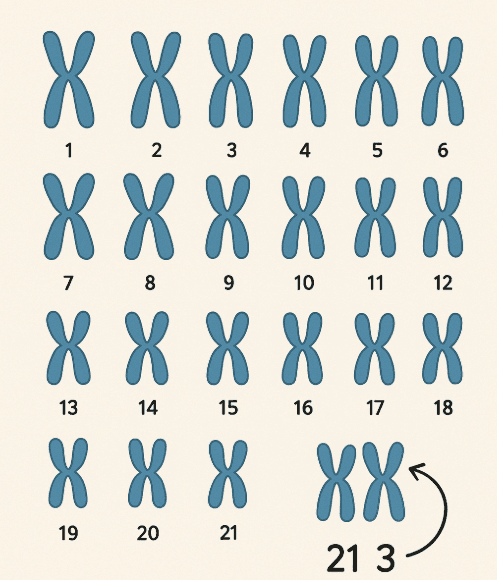
A schematic representation of Down syndrome (Trisomy) (generated by artificial intelligence).
Individuals with Down syndrome commonly exhibit the following physical features:
Developmental delays in mental and social skills may lead to impulsive behavior, poor judgment, shortened attention span, and slow learning.
Language development in children with Down syndrome typically lags behind that of their peers. Speech limitations, delayed speech, and speech disorders are common and can place considerable strain on families. For this reason, it is recommended to begin speech and language support by the age of 10 months. The timing of early intervention and education may vary depending on the child’s development and health status.
Children with Down syndrome learn more slowly and require more repetition than their peers. For this reason, early intervention programs and educational support are crucial for these children. If a baby with Down syndrome has no life-threatening health issues, it is recommended to begin physical therapy at one month of age. Physical therapy aims to enhance the baby’s ability to move independently, promote proper body use, and prevent postural abnormalities caused by hypotonia and joint laxity. While focusing on the baby’s motor muscles, physical therapy also supports cognitive development.
In children with Down syndrome, language development is significantly slower compared to peers. Speech limitations, delayed speech, and speech disorders are frequent and can be highly challenging for families. It is therefore essential to initiate speech and language support early. Although the recommended months for starting early intervention and education are generally established, the specific timing may vary by one or two months depending on the individual child’s development and health condition. The duration of these supports also varies from child to child. It is important to tailor educational programs individually for children with Down syndrome. There is no single educational model that suits all children. The content and duration of education must be adapted to each child’s needs. At this stage, the most important role of parents is to observe their children, identify areas where they excel and where they struggle, and consult with professionals in their environment to request an appropriate educational program.
The role of families in the development of individuals with Down syndrome is vital. It has been observed that children who receive an early diagnosis and whose families actively participate in the educational process achieve developmental milestones more successfully. Raising family awareness, providing social service support, and fostering collaboration between educators and families are key factors in the success of educational interventions.
Bilginer, Hayriye. "Down Sendromlu Çocuklarda Dil Gelişimi." Hacettepe Üniversitesi Edebiyat Fakültesi Dergisi 19, no. 1 (2002): 165–179.
Down Türkiye Derneği. "Down Sendromu Nedir? Belirtileri Nelerdir?" Down Türkiye. Accessed April 20, 2025. https://www.downturkiye.org/icerik/65-down-sendromu-nedir-belirtileri-nelerdir
Medical Park. "Down Sendromu." Accessed April 20, 2025. https://www.medicalpark.com.tr/down-sendromu/hg-1488
Şen, Sevim. Erken Eğitim Alan ve Almayan Down Sendromlu Çocukların Genel Gelişimlerinin ve Görsel Algı Becerilerinin İncelenmesi. Master's thesis, Marmara Üniversitesi, 2008.

No Discussion Added Yet
Start discussion for "Down Syndrome (Trisomy 21)" article
Medical Definition and Types
Physical and Developmental Characteristics
Cognitive and Language Development
Visual Perception and Learning
Early Intervention and Education
Family Involvement and Social Support