


This article was automatically translated from the original Turkish version.
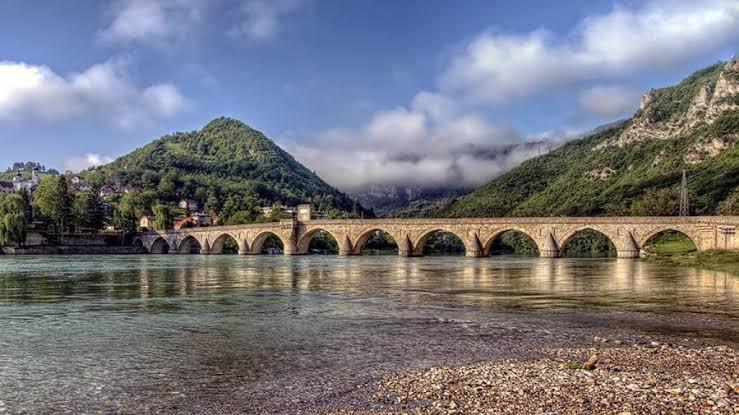
Construction Date(s) | 1571–1577 | ||||||||
|---|---|---|---|---|---|---|---|---|---|
Location | Višegrad Bosnia and Herzegovina | ||||||||
Architect(s) | Mimar Sinan | ||||||||
Patron | Sokollu Mehmet Pasha | ||||||||
Material(s) | Kesme Taş | ||||||||
Number of Arches | 11 Large Arches | ||||||||
Drina Bridge was commissioned in 1571–1577 by Ottoman grand vizier Sokollu Mehmet Paşa, who had it built by Mimar Sinan near his hometown of Sokol village. Located in the city of Višegrad in Bosnia and Herzegovina, the bridge spans the Drina River and is one of the prominent examples of Ottoman architecture in Europe. It was constructed along a major route connecting the Bosnian province with the Ottoman capital, Istanbul, and played a pivotal role in the development of surrounding settlements. It is also known as the Sokollu Mehmet Paşa Bridge.

Višegrad remained within Ottoman borders from the 15th century until the second half of the 19th century and was transformed into a significant center under Sokollu Mehmet Paşa. Alongside the bridge, structures such as a caravanserai, bathhouse, imaret and mosque were constructed in the same area, though most of these works have not survived to the present day.
The bridge spans approximately 179.42 meters in length and 7.20 meters in width along the natural course of the Drina River. It consists of eleven pointed arches, with an additional arch at each ramp. Structurally resembling an “L” shape, the bridge was designed with consideration for defensive needs and geographical conditions.
The bridge is composed of pointed arches of varying spans. The largest arch has a span of 14.74 meters and a height of 8.37 meters. The clear passage between the arches measures approximately 6 meters, and with the parapets included, the total width reaches 7.20 meters.
The bridge remained open to vehicular traffic until the early 20th century, but over time it suffered damage due to increasing traffic loads and natural disasters. During the Austro-Hungarian administration in the early 20th century, various repair projects were undertaken. During the First World War, some of the bridge’s arches were destroyed and temporarily replaced with steel structures.
During the Second World War, in 1943, the bridge was bombed by German forces during their retreat, causing extensive damage. In the postwar period, comprehensive restoration works were carried out between 1949 and 1960, during which lost sections were reconstructed. Great care was taken to use original stone materials during these repairs.
In 1966 and 1989, hydroelectric power plants were constructed near the bridge, leading to damage to its foundations and altering its environmental context, which affected its aesthetic appearance. Reconstruction efforts for the ramp, initiated in 1992, were left incomplete due to the war.
In 2003, the bridge was closed to traffic due to increasing damage and for preservation purposes. In 2007, it was inscribed on the UNESCO World Heritage List.
In 2007, joint efforts were launched between the Republic of Türkiye and Bosnia and Herzegovina under a cooperation protocol aimed at identifying the bridge’s structural elements and preparing and implementing restoration projects. As part of these efforts, the bridge’s load-bearing components, environmental conditions and material composition were thoroughly examined.
The restoration works carried out on the bridge aimed to enhance both its architectural and structural integrity, alongside environmental improvements.
The Drina Bridge was constructed during the most brilliant period of the Ottoman Empire by a prominent statesman who served as grand vizier to three sultans. The bridge holds great importance both architecturally and culturally and historically, serving as a witness to interactions among diverse ethnic and cultural elements in the region. The Drina Bridge also gained widespread literary recognition through the Nobel Prize-winning novel of the same name by Ivo Andrić.
Anadolu Ajansı. “Mimar Sinan'ın Bosna Hersek'teki İmzası: Drina Köprüsü.” Accessed May 22, 2025. https://www.aa.com.tr/tr/kultur-sanat/mimar-sinanin-bosna-hersekteki-imzasi-drina-koprusu/1050319.
TİKA. “Bir Koca Sinan Eseri: Sokollu Mehmet Paşa Köprüsü (Drina Köprüsü) TİKA Tarafından Restore Ediliyor.” Türk İşbirliği ve Koordinasyon Ajansı Başkanlığı. Accessed May 22, 2025. https://tika.gov.tr/detail-bir_koca_sinan_eseri_sokollu_mehmet_pasa_koprusu_drina_koprusu_tika_tarafindan_restore_ediliyor/.
TİKA. “Drina Köprüsü'nün Restorasyonu Tamamlandı.” Türk İşbirliği ve Koordinasyon Ajansı Başkanlığı. Accessed May 22, 2025. https://tika.gov.tr/detail-drina_koprusu_nun_restorasyonu_tamamlandi/.

Construction Date(s) | 1571–1577 | ||||||||
|---|---|---|---|---|---|---|---|---|---|
Location | Višegrad Bosnia and Herzegovina | ||||||||
Architect(s) | Mimar Sinan | ||||||||
Patron | Sokollu Mehmet Pasha | ||||||||
Material(s) | Kesme Taş | ||||||||
Number of Arches | 11 Large Arches | ||||||||
History
Architectural Features
Historical Period and Restorations
Restoration Works
Significance of the Bridge