


This article was automatically translated from the original Turkish version.
Drone logistics is defined as the use of unmanned aerial vehicles (UAVs) in the processes of transporting, storing, and distributing goods and services. This field introduces new dimensions such as speed, flexibility, and accessibility to traditional logistics operations.
Within logistics and supply chain management, drones offer the potential to reduce supply chain disruptions and enhance efficiency, particularly in regions with challenging geographical conditions or limited infrastructure access.
The core components of the system include the drones themselves (with varying payload capacities and ranges), autonomous flight and navigation systems, loading and unloading mechanisms, air traffic control integration, and operational management software. These components enable drones to perform missions safely and efficiently along designated routes.
Drone logistics demonstrates applicability in various areas such as inventory management, emergency medical supply transfer, and last-mile delivery. Particularly in the final stages of the supply chain—when products reach end consumers—drones can play a significant role. These systems can meet the demand for rapid delivery while also having the potential to optimize operational costs.
Drone logistics offers a broad range of applications across multiple sectors, with particular potential to enhance operational efficiency in areas such as supply chain management and last-mile delivery.
In supply chains, drones can be used not only for package transportation but also for tasks such as inventory counting, warehouse inspections, and rapid material transfer between facilities. This accelerates operational workflows by automating manual processes, resulting in time and labor savings.
Last-mile delivery is one of the most discussed and actively developed application areas of drone logistics. It provides fast and direct delivery capabilities independent of road traffic, especially in urban and rural areas.
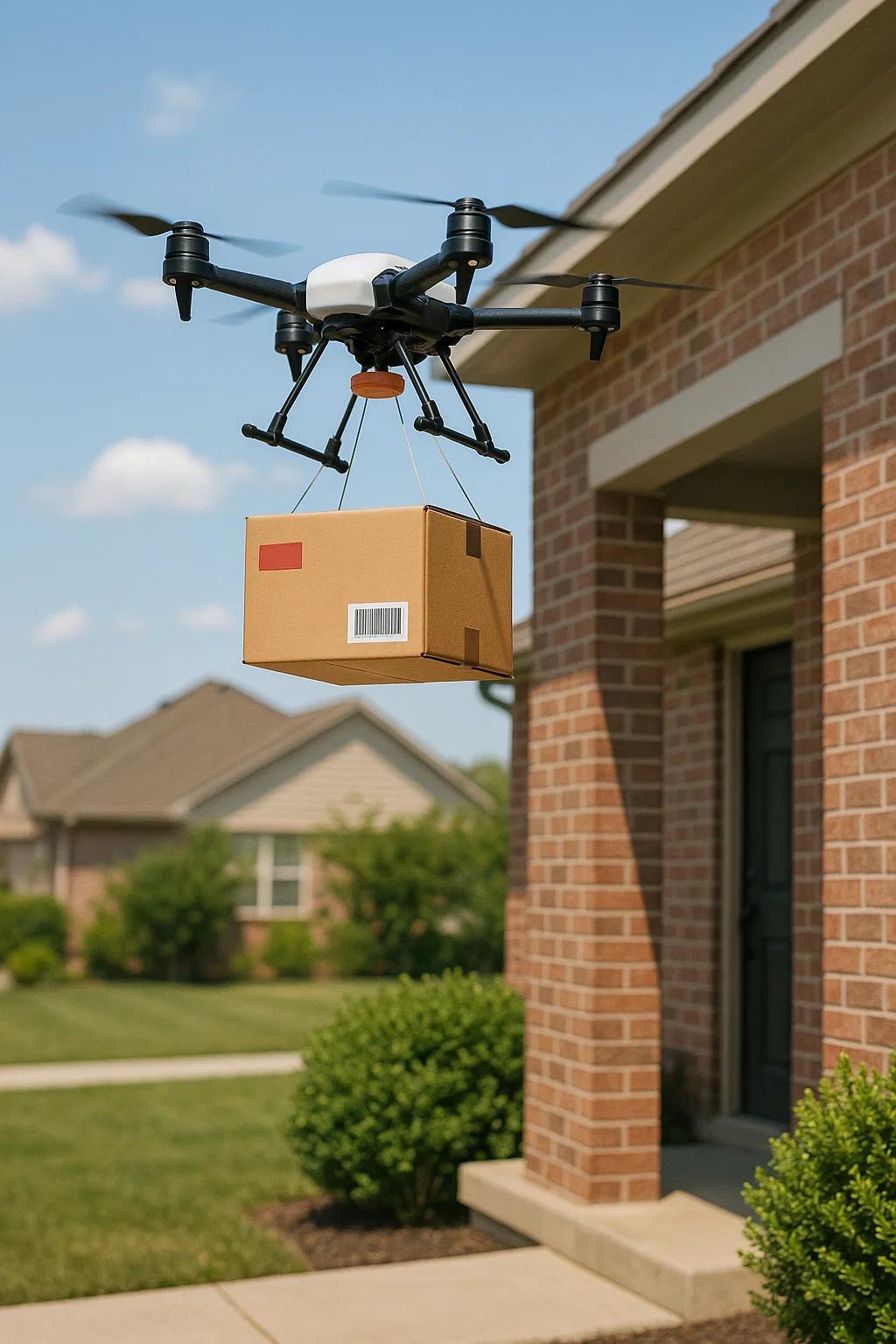
Parcel Delivery via Drone (Generated by Artificial Intelligence)
Drones can deliver lightweight to medium-weight shipments such as medical supplies, emergency aid packages, or e-commerce products faster than traditional transportation methods. This is critically important in emergency logistics or areas with difficult access. However, these operational benefits are accompanied by limitations such as limited battery life, sensitivity to weather conditions, and restricted payload capacity. These constraints are key factors that must be considered in the planning and scaling of drone logistics networks.
The growing adoption of drone logistics operations has necessitated the development of legal and regulatory frameworks worldwide. These frameworks aim to ensure the safe, orderly, and efficient use of drones for commercial purposes.
Different countries implement various regulations that define the scope of drone operations, flight altitudes, ranges, line-of-sight requirements, and types of allowable cargo. Generally, regulations cover airspace integration, operator licensing, drone registration, privacy concerns, and cybersecurity. The integration of drone delivery systems in urban areas introduces additional complexities related to population density, noise pollution, and air traffic management. As a result, many countries’ civil aviation authorities impose special permits, route allocation rules, and specific restrictions for commercial drone operations.
The current regulatory environment requires the development of international standards and mutual recognition agreements to enable drone logistics companies to operate globally. The legal adaptation process is ongoing, and regulations are expected to be continuously updated in parallel with advancements in drone technology.
While drone logistics offers innovative solutions, it also faces several challenges that hinder its widespread adoption. These challenges manifest in both technological and operational dimensions. The primary technological limitations include battery life and range, which pose significant constraints for long-distance deliveries or large operational areas. Additionally, the payload capacity of drones may be insufficient for shipments exceeding certain weight and volume thresholds. Sensitivity to weather conditions—such as strong winds, rain, and snow—is another critical factor affecting operational continuity.
Operational challenges include the complexity of integrating with existing air traffic control systems and establishing safe flight corridors in densely populated urban areas. Public privacy concerns and potential societal resistance to drone noise also impact social acceptance. High initial investment costs and maintenance expenses can further affect the economic feasibility of the system.
Ongoing research and development efforts aim to overcome these challenges. Advances in battery technology, improvements in autonomous navigation systems, weather-resistant drone designs, and more efficient loading and unloading mechanisms may help remove barriers to the future of drone logistics. Additionally, the development of unmanned traffic management (UTM) systems and more flexible regulatory frameworks is critical to achieving operational scalability.
Drone logistics has demonstrated its theoretical potential through various real-world case studies. These examples illustrate how the technology can be applied in different scenarios and highlight its benefits despite encountered challenges.
Especially in medical supply transportation, drones can play a critical role. The rapid and secure delivery of blood, vaccines, or other life-saving medications to remote or emergency-affected areas showcases the life-saving potential of drones. Such applications provide an effective solution in situations where traditional logistics networks are inaccessible or too slow.
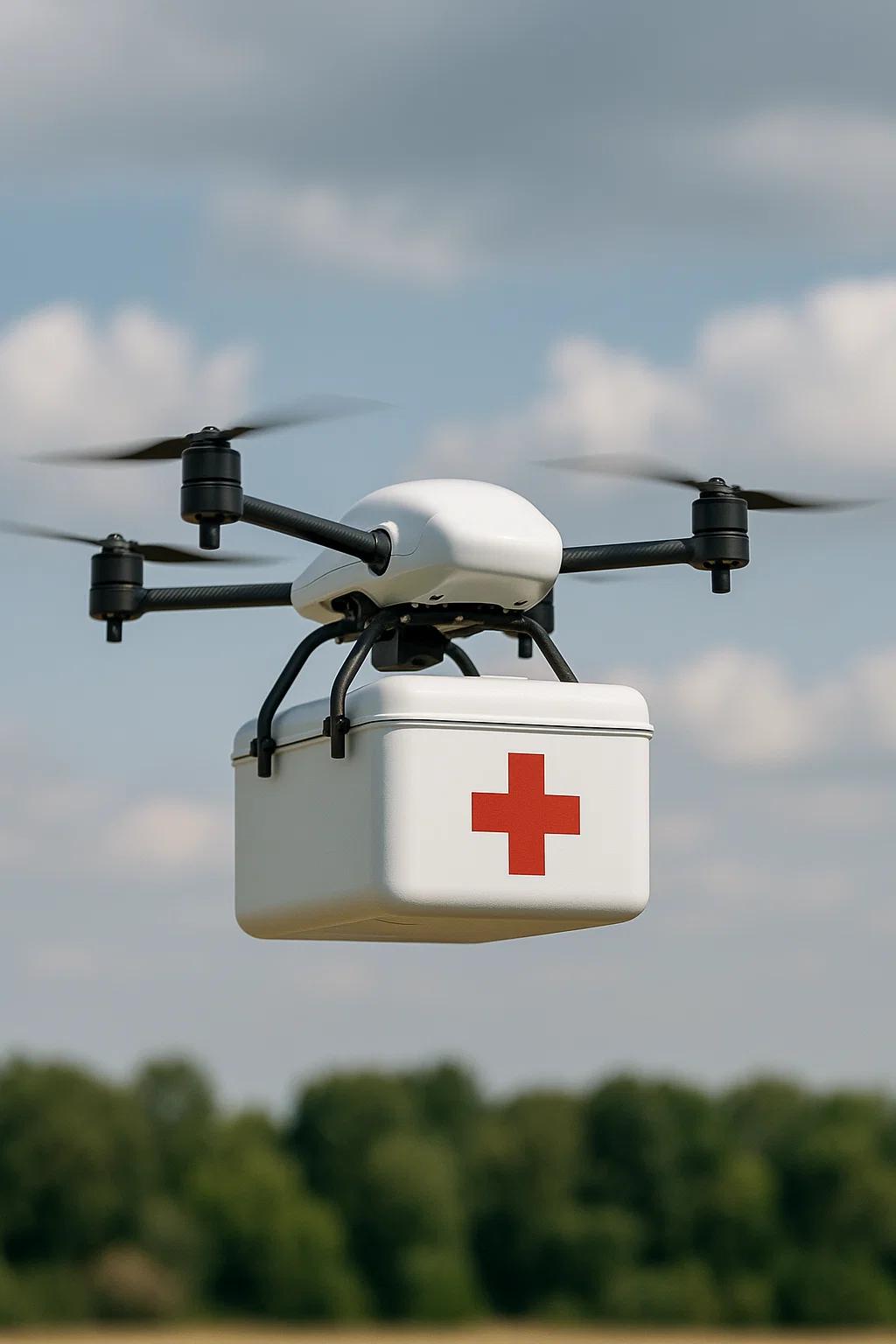
Medical Supply Transportation via Drone (Generated by Artificial Intelligence)
In urban logistics, drones are being evaluated as an alternative model for last-mile delivery, particularly in cities plagued by heavy traffic. With the growth of e-commerce, the goal is to reduce urban delivery times and improve operational efficiency. Several pilot projects have demonstrated that drones can directly deliver small and medium-sized packages to consumers.
Future projections indicate that drone logistics will become more mature and integrated into broader systems.
Autonomous drone networks, combined with advanced AI-supported navigation systems and unmanned traffic management (UTM) systems, will enable larger-scale and more efficient operations.
Investments by major logistics companies and e-commerce giants in this field provide strong signals that drones will become an inseparable part of the logistics ecosystem in the near future. However, achieving this future requires overcoming regulatory barriers, securing public acceptance, and addressing technological limitations.
"Drone Applications in Logistics." *MDPI Drones Special Issue*. Accessed https://www.mdpi.com/journal/drones/special_issues/5663HCFN3X.
"Drone Applications in Logistics: A Literature Review." *POLITesi*. Accessed https://www.politesi.polimi.it/bitstream/10589/151830/3/2019_12_DiPaolo.pdf.
"Drone Kullanımı in Urban Logistics: A Case Study." City Logistics Info. Accessed http://www.citylogistics.info/research/the-use-of-drones-in-city-logistics-a-case-study/.
"Drone Teknolojisi Kullanan Başarılı İş Vaka Çalışmaları." ResearchGate. Accessed https://www.researchgate.net/publication/390154958_Successful_Business_Case_Studies_Using_Drone_Technology.
"Drone Uygulamaları ve Tedarik Zinciri Yönetimi." ResearchGate. Accessed https://www.researchgate.net/publication/377823359_Drone_Applications_in_Logistics_and_Supply_Chain_Management_A_Systematic_Review_Using_Latent_Dirichlet_Allocation.
"Dronların Lojistik ve Tedarik Zinciri Yönetimindeki Rolü." Taylor & Francis Online. Accessed https://www.tandfonline.com/doi/full/10.1080/00207543.2024.2373425.
"Regulatory and Policy Framework for Urban Drone Logistics Systems." SAE International. Accessed https://www.sae.org/publications/technical-papers/content/2025-01-7144/.
"Son Mil Teslimatında Dronlar." Emerald Insight. Accessed https://www.emerald.com/insight/content/doi/10.1108/ijlm-04-2023-0149/full/html.
"Tıbbi Malzeme Drone Taşımacılığı: Vaka Çalışması İçgörüleri." *Hospital Healthcare Europe*. Accessed https://hospitalhealthcare.com/in-depth/health-technology/drone-transportation-of-medical-supplies-case-study-insights/.
Anadolu Ajansı. "Drone pazarının 2030’larda 92 milyar dolara erişmesi bekleniyor." Accessed [Date]. https://www.aa.com.tr/tr/ekonomi/drone-pazarinin-2030larda-92-milyar-dolara-erismesi-bekleniyor/2044228

Application Areas and Operational Dimensions
Legal Frameworks and Regulatory Processes
Challenges and Development Areas
Case Studies and Future Projections